









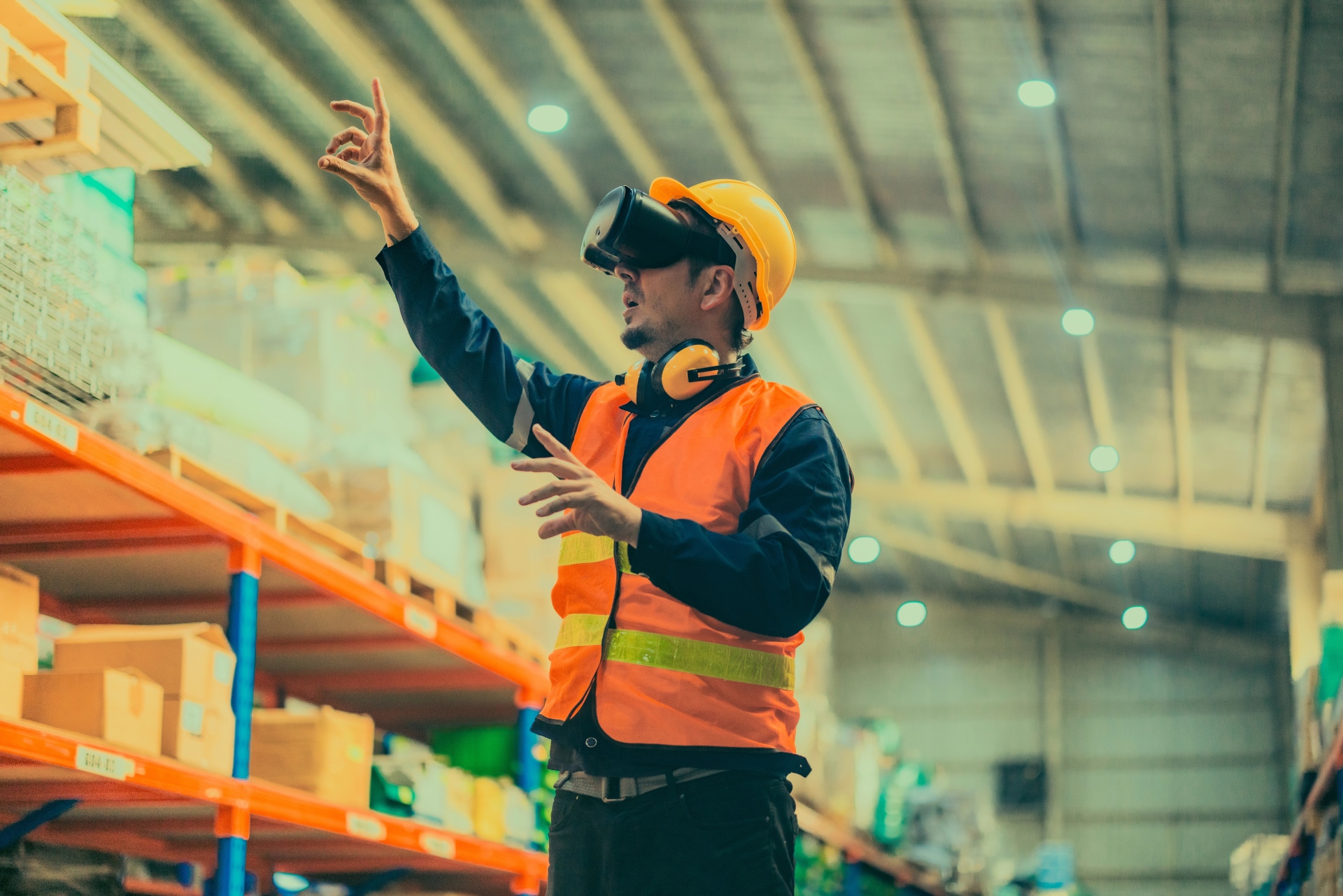
Virtual reality in logistics is becoming a tool for real improvement in the performance of operators and large suppliers. The AR/VR training market is currently worth approximately 20 billion dollars and is growing at a rate of about 20% per year. Companies are investing in simulations not to test novelties, but to shorten employee adaptation time and reduce the costs of operational errors. – Implementations at large operators show that thanks to simulations, new employees reach independence up to twice as fast, without interrupting warehouse operations and without the risk of damage to goods or equipment. This translates into a concrete return on investment and faster process optimization – says Jagna Pomorska, an expert in new technologies and CEO of the technology company Connected Realities.
In logistics, we often start by asking whether to implement VR, instead of considering where in the process it can actually improve our efficiency indicators. The key change is creating conditions for the employee where a mistake is feedback, not an immediate cost or downtime. Virtual reality acts as a protective layer that allows for developing proper habits when handling orders or driving a forklift before a novice interacts with a live warehouse system. On a real floor, the same mistake means cost, delay, and in extreme cases, a threat to the team’s health.
– explains Jagna Pomorska.
When technology grows faster than competence
Global e-commerce already accounts for about one-fifth of retail sales value, and its share continues to grow. For distribution centers, this means the necessity of working at a high pace with increasing operational complexity. Although Polish warehouses are filling up with autonomous robots and AI-controlled systems, the industry is hitting a new barrier, i.e., the employee adaptation gap. Even advanced technology will not deliver the assumed results if the process of integrating humans into the digital ecosystem remains analog. In 2026, the Polish e-commerce market stopped competing solely on labor costs. Rising wage expectations and a chronic shortage of specialists make a novice’s mistake more expensive today than ever before.
The growing complexity of online trade requires high precision from logistics operators. Every delay or shipping error affects customer trust and the financial result. Traditional training under the supervision of an experienced employee is increasingly failing in the face of high staff turnover and pressure for timely deliveries. Virtual training environments allow moving the learning process from a crowded floor to a controlled, digital setting. The employee learns on realistic scenarios, and the facility maintains full operational continuity.
– explains Jagna Pomorska.
From technology to a strategic tool
The use of VR enables systematic tracking of the trained team’s progress. The system records reaction times, the most common types of errors, and how tasks are performed, which allows managers to better match roles and responsibilities to employee competencies. As a result, key parameters such as timeliness and completeness of shipments, which have a direct impact on the operator’s competitiveness, improve. VR simulations also allow for training in dangerous scenarios – e.g., collision situations involving humans and robots – which cannot be safely practiced in a real warehouse.
In a few years, virtual environments will cease to be just an implementation tool for new people. They will become an integral tool for competence management. By linking them with operational data, it will be possible to respond on an ongoing basis to bottlenecks in the supply chain and direct training exactly where the most errors occur. This is a step from general instructions to precise, data-driven knowledge management.
– emphasizes Jagna Pomorska.
Learning that does not stop operations
In a warehouse environment, most key tasks are repetitive and at the same time carry a high risk of errors – from receiving and addressing goods, through putting away and picking, to maneuvering in narrow aisles and zones shared by humans and forklifts. Virtual reality allows these processes to be mapped in the form of a digital warehouse model with a realistic layout, racks, and safety rules, and then used to train operational decisions. Employees go through specific scenarios, such as receiving a delivery, picking an order, maneuvering in an aisle, or reacting to potentially dangerous situations. Errors do not generate downtime or losses; instead, they are recorded and discussed, which allows for quickly increasing team competence without risk to current operations.
From my point of view, it is the ability to separate the learning process from operational work that is crucial. Virtual training environments shorten the time needed for a new employee to reach the required productivity because some typical mistakes are worked through in training scenarios. Additionally, the VR environment itself generates data on participant behavior, reaction time, and areas of uncertainty, which allows treating training as an element of a broader competence management system, rather than a one-time obligation.
– explains Jagna Pomorska.
Data-driven training
The future of training in logistics will be determined by three directions:
- Integrating simulations with operational data so that scenarios reflect real bottlenecks, not just general best practices.
- Combining VR with analytics and AI models that, based on behavior in the simulation, will support the assessment of an employee’s readiness to work in a given position.
- Expanding the scope of training – from basic warehouse activities, through cooperation with robots and automation systems, to practicing reactions to unusual situations.
Companies that are already investing in VR are gaining better-prepared and more flexible teams, resistant to changes in load and seasonality in e-commerce. For logistics operators, this is a step towards a new standard in personnel and knowledge management across the entire supply chain.
Source: Connected Realities