









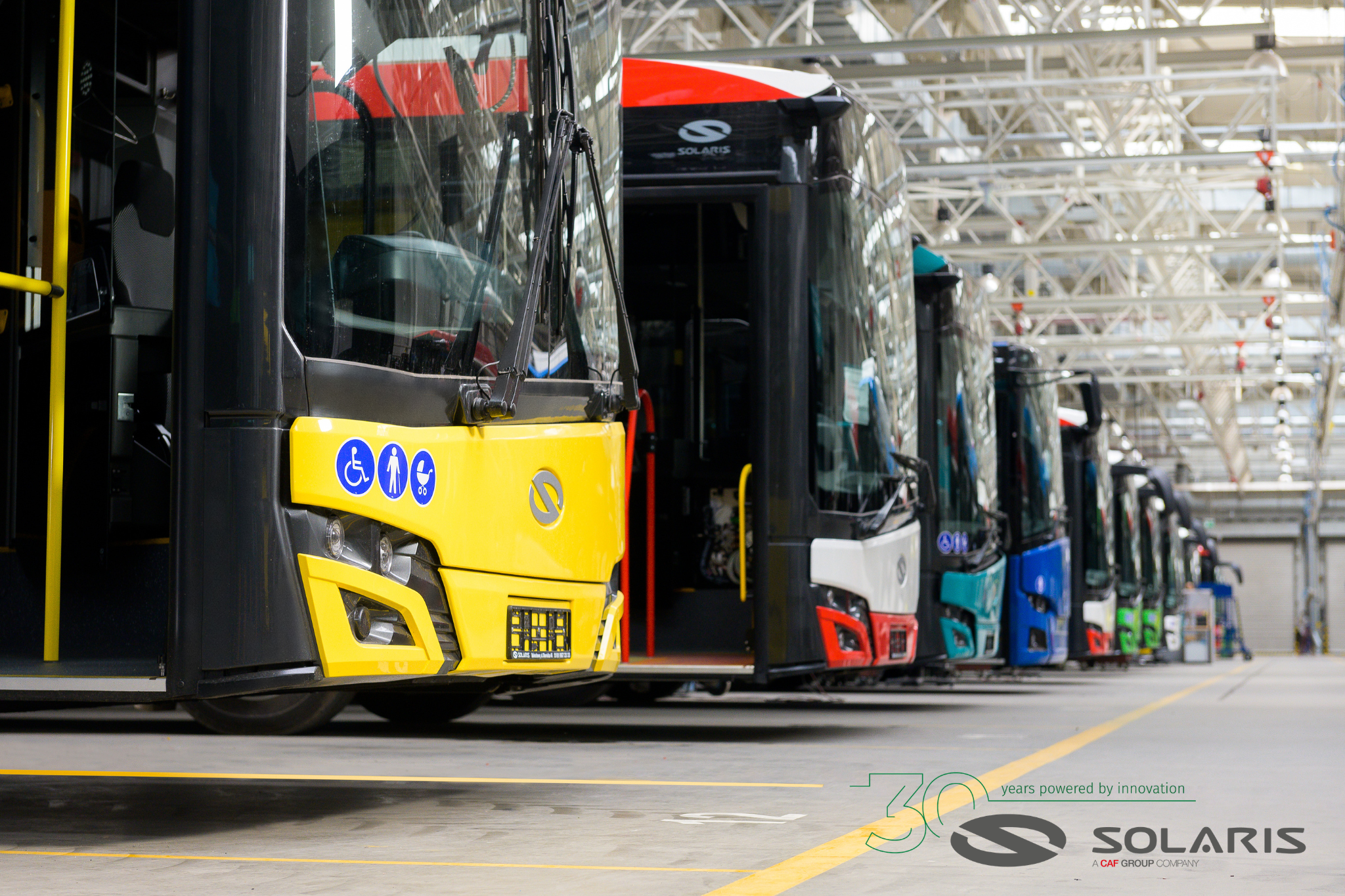
Solaris is celebrating its 30th anniversary this year. Since the first bus rolled off the production line in Bolechowo near Poznań in 1996, the company has grown into one of the most important city bus manufacturers in Europe and a leader in the zero-emission vehicle segment. The brand’s buses and trolleybuses operate in hundreds of cities, and electric and hydrogen technologies represent the manufacturer’s strategic development direction. Solaris celebrates its jubilee by emphasizing that its strength has always been its people – their commitment, competence, and values, which have shaped the character of the company for three decades.
After 30 years of operation, Solaris is among the most important city bus manufacturers in Europe. During this time, the manufacturer has delivered 28,000 buses and trolleybuses to nearly 900 cities in 33 countries across Europe and beyond. Soon, more countries will join this map – Canada and the United States – as the manufacturer is developing a new, North American chapter. A special place in this history is occupied by the development of zero-emission drives – to date, Solaris has introduced nearly 7,000 vehicles that emit no exhaust fumes onto European streets – electric buses, hydrogen buses, and trolleybuses. Quiet and zero-emission Solaris vehicles of various lengths and configurations introduced into European cities translate into a real change in the quality of public transport, thereby improving the lives of city residents.
The road to this position for Solaris began in the mid-90s, during a period of transformation of the Polish economy and the modernization of public transport in many European cities. It was then that Krzysztof Olszewski founded the company that would become one of the market leaders in the following years. Exactly on March 22, 1996, the first low-floor city bus left the factory in Bolechowo – still under the Neoplan brand. At that time, the manufacturer employed only 36 people and produced 56 vehicles in its first year of operation. Today, the company consists of nearly 4,000 employees working at Solaris and its 16 subsidiaries in Europe.
A breakthrough moment in the company’s history was the premiere of the Solaris Urbino model in 1999 – the first city bus designed under the Solaris brand. Soon, in 2001, the offer was expanded to include the Trollino trolleybus, which used electricity from the overhead line and was simultaneously the manufacturer’s first zero-emission vehicle.
The dynamic development of the company meant that as early as the beginning of the 21st century, Solaris began intensive foreign expansion. By 2003, the manufacturer had delivered 1,400 buses to operators in 11 European countries. Solaris also develops new drive technologies – the offer included, among others, CNG-powered buses and the world’s first mass-produced hybrid buses. A new chapter in the company’s history was opened by the development of electromobility. In 2011, Solaris presented the Urbino electric model – the brand’s first fully electric city bus.

The new generation of Urbino brought a new design and award-winning styling. In this version of the offer, the manufacturer introduces models of various lengths and drives. At the same time, zero-emission drives are being developed: a hydrogen fuel cell is added to the offer as a range extender, the Urbino electric wins the “Bus of the Year 2017” title, and in 2019, the portfolio is complemented by a hydrogen bus, in which electricity is generated directly on board the vehicle, and water is produced instead of exhaust fumes. In subsequent years, the offer expands to include further battery and hydrogen models – the intercity Urbino 15 LE electric, the compact midibus Urbino 9 LE electric, as well as a double-articulated model with a length of up to 24 meters. The articulated hydrogen bus was named Bus of the Year in 2025.
In 2018, Solaris joined the CAF Group, which enabled the company to expand dynamically in global markets. Parallel to the development of technology, the company is expanding its production and logistics facilities. The logistics center in Jasin, the innovative Charging Park, a new warehouse hall, and a modernized factory allow the company to meet growing orders in Europe and prepare the manufacturer for global expansion.
Today, Solaris is one of the key players in the European city bus market and one of the most recognizable Polish companies. Since 2012, the company has delivered the most hydrogen and electric buses in Europe – every seventh zero-emission vehicle in Europe is a Solaris brand. As much as 86% of Solaris’s sales today consist of low- and zero-emission vehicles. The company is constantly developing electric and hydrogen technologies, investing in its own battery solutions, and gradually expanding its offer to include further market segments. After three decades of operation, the direction of development remains unchanged – to create modern, zero-emission buses for cities all over the world.
Over the last thirty years, Solaris has become a market leader, shaping modern public transport throughout Europe. We rely on solid foundations that give us prospects for the future. We are ready to continue developing, introducing innovations, and transforming mobility in cities. We are starting our fourth decade with the same determination and even more ambitious plans for the future,” said Agata Stańda, CEO of Solaris Bus & Coach.
Source: Solaris Bus & Coach sp. z o.o.