









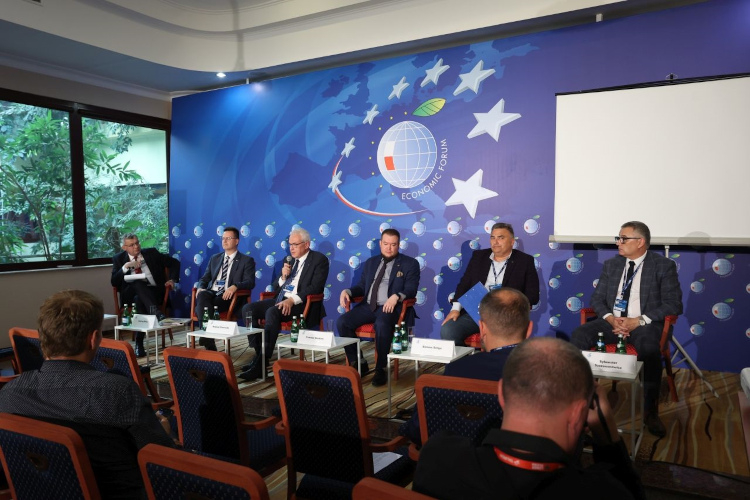
A strong railway in Europe is not a passing fad, but a trend resulting from, among other things, the European Green Deal. The Polish railway, which is a significant player in the EU, still needs to invest to strengthen its position in a highly competitive yet promising market, experts assessed during the Economic Forum in Karpacz.
During a debate on the need for rail transport competitiveness organized by the PKP Group, Andrzej Bittel, Secretary of State at the Ministry of Infrastructure, assessed that a strong railway in Europe is a constant and clear trend that will continue to strengthen. He pointed out that in every European country, the railway has already recovered from the losses of the COVID era and is recording growth results. This will allow it to capture further markets in Europe.
– In Poland, this momentum in the passenger and freight sectors will grow over the coming years, and rail will dominate in competition with road transport, but this requires investment – he emphasized. He explained that this refers especially to investments in infrastructure and rolling stock.
– We have the competence, but we need hard elements, i.e., rolling stock, because the point from which we are starting remains behind compared to Western countries. Allowing Polish rolling stock into the European network has allowed PKP Cargo to operate in Southern Europe and Germany, which is a significant element of competitive advantage – he noted.
He added that the Polish railway could contribute to the reconstruction of Ukraine.
– Cooperation on this issue is already underway, although it will be difficult because our systems are different; nevertheless, Ukraine will be rebuilt with the help of foreign contractors, and we will participate in this – he emphasized.
Andrzej Olszewski, a member of the PKP Group Management Board, spoke about the specifics of investing in railways.
– Railway investments are long-term, hence, among other things, government programs providing subsidies for unprofitable transport services – he explained.
He recalled that the balance sheet total of the entire PKP Group exceeded PLN 29 billion, sales revenues exceeded PLN 10.8 billion, and net profit was almost PLN 400 million. 49 percent of the PKP Group’s revenue comes from freight transport, and 36 percent from passenger transport.
– Rolling stock is largely financed by EU funds, with co-financing reaching up to 85 percent. And this is the best form of financing for us – added Andrzej Olszewski.
As he noted, the Railway Fund managed by the Ministry of Infrastructure is also a good tool, which companies from the PKP Group use in many areas, including financing the station program.
– We also use debt instruments, e.g., bank loans, including those offered by the European Investment Bank, as well as bonds that take into account longer returns on these investments – explained Andrzej Olszewski.
Tomasz Gontarz, Vice President of the Management Board of PKP Intercity, pointed to the competitive potential of rail transport in the area of passenger transport.
– Rail connections are already a competitor to car travel, which began last year with the rise in fuel prices. Our record results are proof of this – he indicated.
– 45 million passengers carried by PKP Intercity trains in the first 8 months of this year is 8 million more year-on-year. In July and August, we had over 7 million passengers per month, which is an absolute record. This year we will significantly exceed 60 million passengers carried – he said.
He added that not only fuel prices but also ecology affects the competitiveness of railways, because train travel is the least emission-intensive.
According to Dariusz Seliga, CEO of PKP Cargo, the railway is on one hand at a difficult moment, and on the other in a good one, because the European Green Deal assumes that 75 percent of freight transport should be carried out by trains.
– In Poland, nuclear power and the CPK (Central Communication Port) will drive the development of rail freight transport – he indicated. He added that his company is consistently making up for delays by investing in rolling stock, because it still has wagons that cannot enter Germany. “Today there is a lot of talk about Ukraine and we must be there, we are looking for a place for our terminal there,” emphasized the head of PKP Cargo.
The panel dedicated to the future of rail transport took place in Karpacz during the 32nd Economic Forum.
Source: PAP MediaRoom