









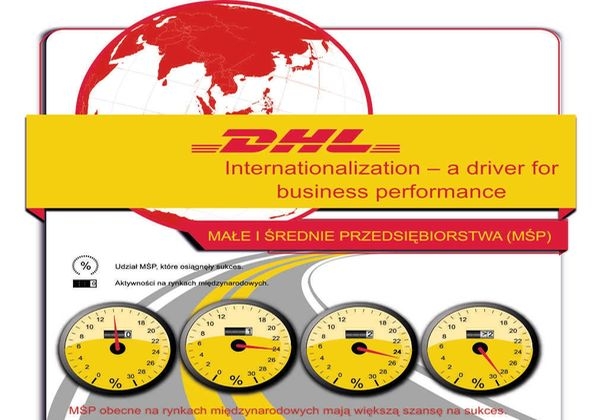
International trade and cooperation are the most important factors determining the international success of small businesses. This is the key conclusion from research conducted by DHL Express and IHS.
A macroeconomic analysis and a survey of 410 executives from small and medium-sized enterprises (SMEs) in G7 and BRICM* countries show that SMEs present on international markets are twice as likely to succeed as those operating only on the domestic market**. Among the respondents surveyed, 26% of companies active in international markets achieved high revenue growth, while in the case of companies operating on the domestic market, 13% of companies can boast such a result. SMEs also indicated that the most important benefits associated with the international reach of their business stem from access to new markets, know-how and technology, and the diversification of products or services.
The study also shows the growing pace of globalization and an increasing emphasis on conducting international business among smaller firms. Those founded within the last five years are more open to conducting international business operations than older ones, even though they have had less time to develop their business. Importantly, the majority of SMEs that have expanded their operations outside their home country over the last three years indicated that they plan to increase the percentage share of exports in their turnover over the next three years, despite the uncertain economic situation.
The report also shows that inadequate economic infrastructure, which reduces business efficiency, limits competitiveness. SMEs must work much harder to overcome infrastructure inefficiencies, especially compared to large companies with greater resources. The biggest concerns regarding international trade are related to the lack of available information on foreign markets, customs duties, and potential difficulties in establishing contacts with business partners and customers in other countries. Most of the better-performing companies in this sector participating in the study employ over 50 people, which highlights the importance of human resources in overcoming barriers to international development.
Research shows that when it comes to internationalization, SMEs operating in emerging markets are significantly ahead of those from developed markets. In developed markets, per capita consumption is still higher than in emerging markets. This encourages SMEs from BRICM countries to conduct business on the international stage, while for SMEs from G7 countries, it may mean that development on the international stage will be a greater challenge for them. Moreover, SMEs from BRICM countries place greater emphasis on using logistics as a positive driver supporting the development of international operations than their counterparts from G7 countries, relying more often on efficient transport and customs processes that allow them to overcome infrastructure obstacles. They also perceive logistics services as a competitive differentiator supporting their business.
– The strong link between improved business performance and international trade points to clear benefits for small and medium-sized enterprises operating on a global scale – said Ken Allen, CEO of DHL Express. – As a global leader in international express shipments, we agree with the assertion that international trade provides great value for companies in this sector. It not only opens up new markets for their products and services but also provides access to best practices and innovation. Perhaps most importantly, international competition provides an important impetus that forces the development of their internal operations and processes, which in turn translates into benefits both in domestic and foreign operations. There are, of course, obstacles that small companies with global aspirations must face, but we are pleased that more and more companies in this sector are recognizing the fantastic opportunities that international trade opens up for them. Our role, as a global logistics company, is to make this process even more efficient. We will continue to adapt our services and solutions to support SMEs in their growth and ability to compete within the “global village”.
Despite the significant contribution of SMEs to employment and value added to the economy, there is a lack of complete and up-to-date information on their activities in individual countries.
– This lack of information is a result of the restraint shown by the small and medium-sized enterprises themselves. This stems from a limited ability to self-organize and present interests collectively based on reliable data and information, on the principle of “SMEs have a voice”. This represents an opportunity for policymakers, as well as large companies, who can support this sector by creating new jobs and added value, and increasing export revenues through the creation of personalized solutions that support its development – said Dick Buttigieg, Managing Director of IHS.
* G7 – Canada, France, Germany, Italy, Japan, UK, USA; BRICM – Brazil, Russia, India, China, and Mexico.
* Based on three-year average annual growth rates, IHS and DHL Express research, September – November 2012.