








The logistics industry is at the beginning of a long and winding road leading to the electrification of deliveries, especially urban ones, which make the most sense today. This transformation will be driven by three fundamental factors: regulatory requirements, urbanization, and the dynamics of e-commerce. However, the entire sector will be held back by an infrastructure gap and the massive, underestimated cost of the transformation. Furthermore, there are hundreds of other variables, and even a scenario where China pulls the plug on the new mobility in Europe.
Modest beginnings of EU logistics electrification
Data from the European Alternative Fuels Observatory (EAFO) shows that at the end of 2023, there were 307,943 battery-powered vans (BEV – Battery Electric Vehicle) in the European Union. Thus, for the first time in history, N1 class vehicles, i.e., commercial vehicles with a GVW of up to 3.5 t, surpassed those powered by LPG, which numbered 293,667. The database, updated in mid-April this year, also shows that the total number of vans using alternative fuels was 770,548, representing a 14% increase from 675,828 in 2022. It is worth emphasizing that the share of electric vans in the entire fleet of this class of vehicles has increased, but at the end of 2023, it still amounted to only 1.2%, as there were well over 30 million of them driving on EU roads. An increase in share by mere fractions of a percentage point shows that the electrification of the light commercial fleet, currently used mainly in urban logistics, has reached at best early infancy, and it is difficult to talk about an adolescence period, let alone a mature phenomenon or a booming market.
Electrification in other areas related to the EU TSL market looks similar. BEV trucks, i.e., N2 and N3 class vehicles powered by electricity, are currently even less popular. The EU fleet of such vehicles in 2023 amounted to only 8,781 units, which is more than twice as low as those powered by CNG (25,736 units). Most heavy electric trucks were registered last year (5,209 units), but this still accounted for only 1.5% of entries in the register. Ultimately, the share of electric trucks in the EU vehicle fleet still oscillates around 0.1%, as there are almost 6.5 million of them on the roads, of which nearly 1.3 million were registered in Poland.
In Poland, progress in delivery electrification is even smaller
In 2023, the Polish fleet of electric vans amounted to 4,356 units, and its share in the total vehicle fleet still did not break 1%. Most light commercial vehicles were registered in 2023 (2,599 units), but this accounted for only 4.07% of last year’s registrations. The fleet of heavier vehicles (N2 and N3) recorded an impressive growth of 691.67%, but in reality, this means only 85 registrations (a share of 0.24%) and a total number of 95 large electric vehicles. This pool also includes manufacturers’ demonstration vehicles. For comparison, in 2023, there were 8,453 LPG models and 491 CNG models.
In this context, it is difficult to talk about a heavy vehicle charging network, as the first publicly available charging zone for them in Poland was launched only this year. So, today we have one public charging zone where two vehicles can be charged simultaneously. The infrastructure for vans looks much better because they can use the network intended for other light vehicles, so there are 6,649 chargers listed in the EFAO report as of mid-April this year.
The infrastructure gap is the Achilles’ heel of European electromobility
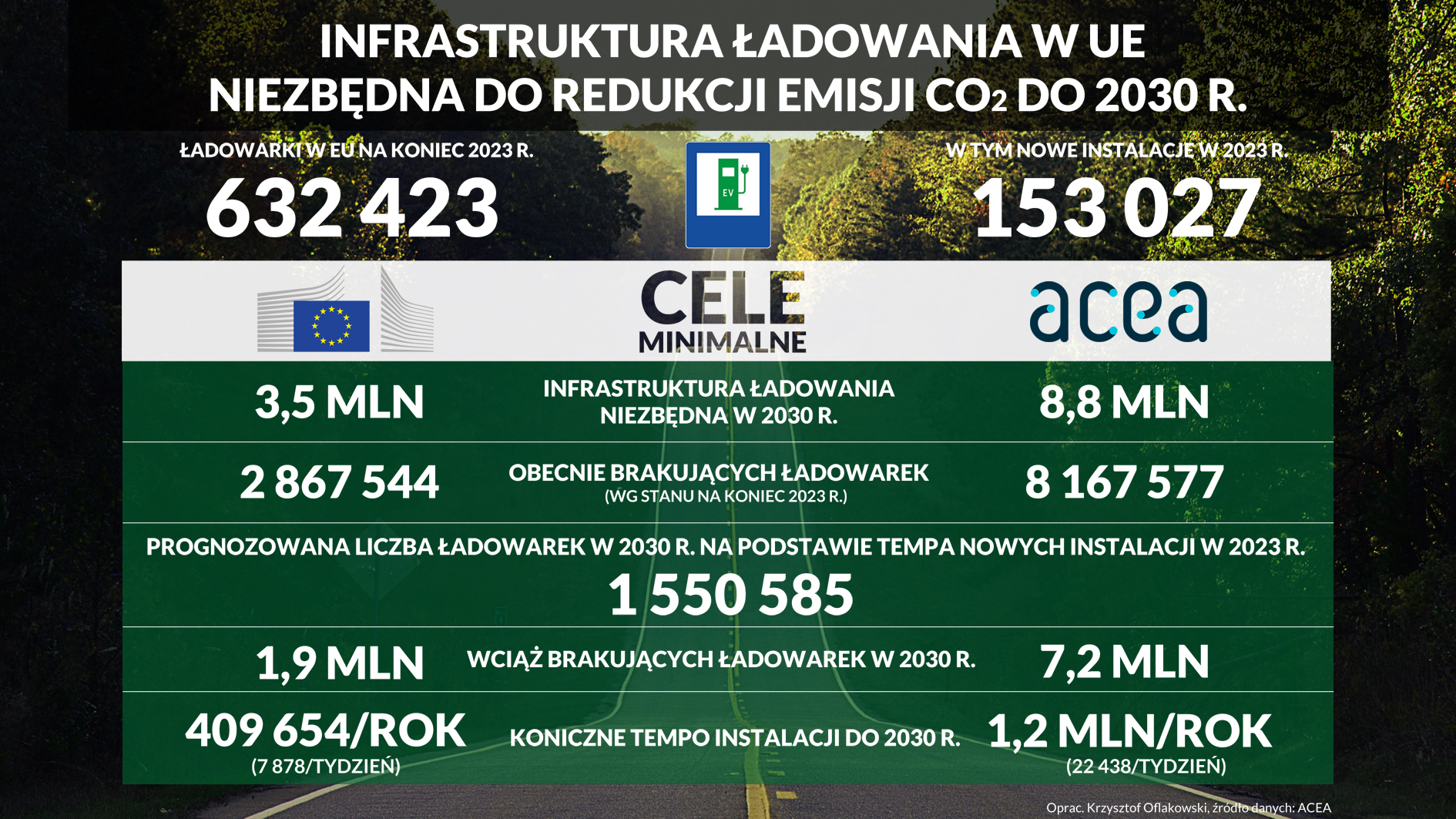
May data from the European Automobile Manufacturers’ Association (ACEA) shows that at the end of 2023, just three EU countries (the Netherlands, France, and Germany) had 61% of public electric car charging points on their territory. This is a total of 384,333 chargers out of 632,423 available throughout the Union, of which the small Netherlands had 52 times more than, for example, Romania, which had 2,754 plugs. In Poland, there were 6,102 chargers, which is only 1% of the European network.
This is a huge problem, as ACEA points out that there is a clear correlation between the availability of charging points and the sales and popularity of battery-powered vehicles. This results in a danger that will eventually begin to negatively affect sales and the development of electromobility as a whole, not only in the passenger segment but also in the logistics sector. The organization’s calculations show, among other things, that between 2017 and 2023, sales of electric cars in the Union grew three times faster than the installation of new chargers.
ACEA specialists warn that 8 times more annual installations are needed to meet the decarbonization goals set only for 2030. At the same time, the adoption of electric vehicles across the entire Community should become mass-market, which will not happen without infrastructure.
Analysts from ACEA have thus questioned the calculations included in the already applicable regulation on the development of alternative fuels infrastructure (AFIR), which suggests that for a 55% emission reduction to be realistic by 2030, 3.5 million charging points should be installed throughout the Union. In practice, this means launching approx. 410,000 points per year, i.e., approx. 7,900 every week. Meanwhile, in 2023, a total of 153,027 were installed, most of them in 3 countries. Therefore, taking into account current dynamics, there will be less than 1.6 million points in 2030, which is 1.9 million too few. Even if the originally planned level were achieved, according to ACEA, it would still be significantly below real needs.
The organization’s estimates show that not 3.5 million points will be needed, but 8.8 million, which means it is necessary to install not 410,000, but 1.2 million points per year, i.e., 22,438 per week – eight times more than currently. By 2035, 18.8 million will be needed! Such a large discrepancy in forecasts results from estimates regarding the fleet of vehicles on EU roads that will require electric charging. According to the EU, there will be 30 million in 2030, and according to ACEA data, even 65 million. The difference in assumptions also stems from the fact that ACEA also takes into account electric vans, as light vehicles, they are to use the same infrastructure as passenger cars and plug-in hybrids. Divergent calculations regarding energy consumption are also at play.
– It is a fact that without adequate fast-charging infrastructure, the dynamic development of zero-emission transport will not be possible. This certainly applies to long-distance heavy transport, and to a lesser extent, the last mile. This is due to the fact that, in practice, operators carrying out urban operations use their own charging stations located in logistics centers. Internal infrastructure is currently the basic condition for the success of such operations. A public network is obviously needed, but individual energy replenishment capabilities created by the operator will play a key role in logistics. Especially since there is no turning back from zero-emission urban deliveries. This is determined not only by the recently adopted EU regulations concerning, among other things, limiting the emissions of vehicles up to 3.5 tons, but also by global trends of metropolises creating clean transport zones or cities’ participation in programs leading to climate neutrality, such as Net Zero Cities. Warsaw, Krakow, Wroclaw, Lodz, and Rzeszow have already announced their participation in the latter. A zero-emission fleet will ensure unrestricted access to the centers of these cities, and at the same time, give the opportunity to use bus lanes and free parking in paid zones, which is undoubtedly a very large asset – says Adam Olejnik, Electromobility Project Manager at ID Logistics Poland, providing comprehensive logistics and transport solutions, e-commerce handling, and supply chain management in 18 countries.
– The sense of urban delivery electrification should also be sought in two other parameters, less obvious but global in nature. These are the growing urban population and the increasing momentum of the e-commerce market. According to UN analyses, 55% of the global population already lives in cities, by 2030 it will be 60%, and by 2050 as much as 68%. In the face of such rapid urbanization, ecological deliveries will gain even greater importance, all the more so because growth in e-commerce shipments continues. Forecasts from the Pitney Bowes Parcel Shipping Index point to a global parcel volume of 225 billion in 2028, which means an average annual growth rate of 6% in the years 2023 – 2028. Even in a more conservative scenario, this will be 200 billion and an average 4% growth annually – adds Adam Olejnik.
A number of challenges await operators, including financial ones, because they will mainly finance the transformation with their own resources
The Transport and Logistics Poland (TLP) employers’ association calculates, for example, that in order to meet the demand to reduce CO2 emissions from trucks (a 90% reduction by 2040), Polish companies’ investments in N2 and N3 class electric vehicles would have to reach levels of 81 billion euros by 2030, another 36 billion euros five years later, and an additional 45 billion euros by 2040, which gives a total budget of 162 billion euros. At the same time, the support proposed by the National Fund for Environmental Protection and Water Management (NFOŚiGW) in the amount of PLN 1 billion to cover up to 60% of the price difference between a combustion-engine truck and an electric one would be enough to satisfy 0.28% of the actually needed investments, which have been estimated at PLN 350 billion. Moreover, for the assumptions to be realized across the entire Community, by 2040, EU carriers will have to spend 1 trillion 674 billion euros on fleet replacement!
Not only TLP is calculating the costs necessary to carry out the transformation of freight transport. The British Green Finance Institute calculates that the UK sector would need between 50 and 100 billion pounds to decarbonize a fleet of 450,000 vehicles. Of this amount, 40-75 billion would go towards purchasing battery-powered trucks, which are 2 or even 3 times more expensive than diesels, and in the case of hydrogen versions, even 5 times more expensive. Another 11 to 25 billion would cost adapting infrastructure at bases, and 1-2 billion would be investments in public chargers, intended, for example, for vehicles arriving from continental Europe.
The NFOŚiGW, however, is planning subsidies for chargers that can be used by heavy vehicles. The subsidy program for the expansion of charging stations, whose budget until the end of 2029 has been set at PLN 2 billion, will finance infrastructure along the TEN-T network in 80%, and only 20% of this amount has been directed to points launched in logistics centers or intermodal terminals, i.e., an average of 80 million annually for 5 consecutive years.
How does this relate to the cost of building infrastructure?
Such calculations for the US market were presented at the end of 2023 by analysts from McKinsey. According to their calculations, a DC charging unit with a power of 150 to 350 kW, and thus classified as fast, can cost from 45,000 to over 100,000 dollars. Installation costs can range from 40,000 to over 150,000 dollars. Meanwhile, the cost of modernizing and integrating the energy grid can cost millions. This depends largely on the number of fast chargers in the area.
Alongside the gigantic investments on the part of the operators, there remains the question of whether the sector even wants to decarbonize?
The Green Freight Report 2024, published by Transporeon, in which 527 carriers and 181 clients using road transport services in Europe participated, shows that as many as 24.7% of transport companies see no business opportunities resulting from efforts towards sustainable climate action. Another 23.55% believe that such efforts provide a business opportunity only to a small extent, and 28.2% say it is to a medium extent. Only 19.48% see high business potential in it, and just 4.07% very high. The situation is completely the opposite for cargo shippers. Only 6.25% do not see any opportunity in it, and 12.5% rate it as small. On the other hand, 22.5% perceive sustainable climate actions as a very large business opportunity, 28.75% as large, and 30% as medium.
– These and similar data are perfect proof that the success of the energy transition in road transport, both light and heavy, will depend on the consensus developed between all stakeholders in the process. A dialogue between the client and the operator is necessary, as well as simultaneous communication with the regulator, mutual understanding of needs and capabilities, including operational and financial ones. It should be expected that the coming years will be a huge technological and investment effort for the industry, which is why instruments allowing for a smoother transition through the entire process while maintaining the competitiveness of the domestic sector are necessary. Certain steps have already been taken, but they can be considered a good start today for thinking about future needs and challenges, of which there will certainly be no shortage – summarizes Adam Olejnik from ID Logistics.
New challenges have just appeared
In mid-May this year, as part of protecting its own industry, the USA announced the imposition of a package of tariffs on imports of Chinese goods worth 18 billion dollars. Tariffs on electric vehicles were raised from 25% to 100%, the rate on lithium-ion batteries for electric vehicles jumped from 7.5% to 25%, and on photovoltaic cells from 25% to 50%. At the same time, taxes on semiconductors, some critical minerals, as well as steel, aluminum, and port cranes were raised.
What does this mean? Well, China has already announced retaliatory measures, which in short means that the energy transition in the USA will be more expensive, because the Middle Kingdom in many areas almost entirely controls the technological cycles necessary for energy transition and electromobility, e.g., battery production. The EU, as part of an ongoing anti-subsidy investigation, is also considering raising tariffs on Far Eastern electric vehicles from 10 to as much as 25%. Quite recently, the directors of the largest automotive concerns in Europe warned against this, explaining that it could thwart EU decarbonization plans, and the CEO of BMW said outright that there would be no Green Deal in Europe without resources from China, and without components from there, not a single car would be produced in the Union. The investigation is still ongoing and no decision has been made yet. Certainly, Chinese retaliatory tariffs will not lower the costs and challenges of the transformation in European logistics. On the contrary, it will be more painful, especially since the TSL sector is only at the beginning of a long and winding road leading to electromobility.