








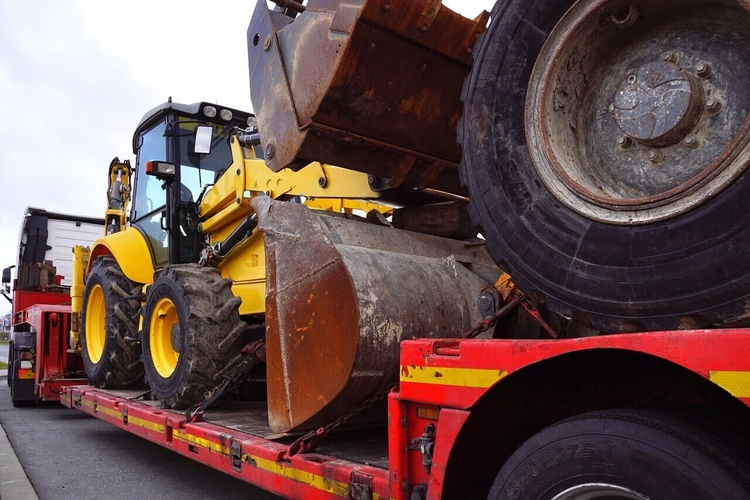
Transport using low-loader trailers does not constitute the largest niche in the TSL (Transport, Shipping, Logistics) sector. However, it is of great importance to the transport industry and is constantly developing. Every year, the number of shipments using low-loader trailers increases. This does not mean, however, that this area is free of problems and challenges. What obstacles do transport companies providing low-loader semi-trailer transport services have to face? What do they have to watch out for and what are their biggest worries?
Low-loader transport services – industry profile
Before we answer the above questions, it is worth introducing this industry and its specifics. Low-loader transport is a specialized type of transport service. It is characterized by the use of vehicles with a lowered loading platform height. It is specifically adapted to transport goods with excessive dimensions, weight, or unusual shapes.
Transporting goods and objects that require a low-loader vehicle fleet requires experience, a qualified team of employees, appropriate know-how, as well as precise planning and the ability to establish partnership relationships with clients and other market participants. That is precisely why it is handled by specialized transport companies like Jupiter: https://jupiter-gabaryty.pl/transport-niskopodwoziowy/.
Importantly, shipments carried out using low-loader vehicles are used in many different industries, such as construction, energy, industry, or the petrochemical sector. As they support areas strategic from the point of view of economic development, they constitute an extremely important link in logistics chains.
It is worth noting that specialized low-loader transport unfortunately features high operating costs. At the same time, it is considered the cheapest way to transport various types of out-of-gauge cargo and other loads requiring the use of low-platform semi-trailers. It is also more flexible than other methods of transporting goods and more common than one might think.
International and domestic low-loader transport
Shipments using low-loader semi-trailers are carried out in Poland both on international routes and within the country. Oversize transport has a particularly significant share in this regard. These are the most complex logistics operations, sometimes requiring months of planning.
Important points on the country’s map when it comes to international transport are seaports and airports. Thanks to them, oversize transport cargo reaches as far as Saudi Arabia or India. Non-standard cargo is also transported through Poland in transit to Germany, the Czech Republic, Slovakia, Ukraine, Belarus, or the Baltic countries. From there, it can also be transported further to other countries, e.g., to France. Sometimes, Poland is the destination country when it comes to international low-loader transport.
In the case of transporting oversize cargo, international orders can be exceptionally spectacular. When the load exceeds several hundred tons or is dozens of meters long and its transport is a significant logistical challenge, such an operation attracts media attention. However, there are far more orders on a smaller scale. A significant number of shipments of cargo requiring special low-loader trailers take place over short and medium distances.
It is also worth emphasizing here that urban centers such as Warsaw, Wrocław, Katowice, Kraków, Łódź, and Poznań play a major role in the low-loader transport industry. These are important communication hubs through which routes for oversize cargo often pass.
Machine transport and other low-loader transport services
It must also be noted here that transport using semi-trailers of the semi, tiefbett type, or low-bed trailers is often equated with the implementation of non-standard transport. Meanwhile, low-loader transport concerns not only oversize loads. In addition to non-standard shipments, the industry also carries out orders concerning objects that do not exceed standard dimensions, but for various reasons are more convenient to transport using trailers with a platform placed at a lower height. An example of this can be the low-loader transport of cars.
What loads can be transported by low-loader transport? What is most often transported? When it comes to non-standard low-loader transport, one must primarily indicate loads for the energy, petrochemical, industry, and construction sectors.
This involves the transport of wind turbine towers and blades, generators and transformers, transport of heavy machinery, transport of construction machinery (e.g., TBM machines for drilling a tunnel on the S19 road), transport of industrial equipment and installations (an example of which is the Wash Tower for the PKN Orlen complex under construction in Płock), transport of machine elements, transport of steel structures and concrete elements, transport of silos and tanks, or transport of boats and yachts. These shipments are an important part of low-loader transport. Mention should also be made here of military equipment (e.g., tanks) and mobile homes.
In addition to such specialized transport using low-chassis semi-trailers, orders are also carried out for the aforementioned transport of cars, transport of agricultural machinery, and transport of construction machinery. Such services are handled, for example, by the company Jupiter: https://jupiter-gabaryty.pl/transport-maszyn-budowlanych/. Thanks to such shipments, machines with low mobility, unadapted for normal driving in road traffic, can appear on construction sites and fields.
Regardless, however, of whether it concerns the transport of construction machinery or agricultural machinery, or special transport of high-weight and high-size cargo, low-loader transport enables increased production and expansion of the country’s economic potential. Thanks to it, both ambitious infrastructure projects and smaller investments and undertakings are carried out. Therefore, it is of great importance for the Polish economy.
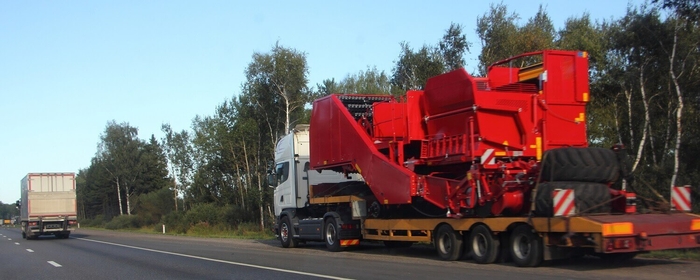
Equipment for low-loader transport – types of low-loader semi-trailers
Thanks to the variety of types of low-loader semi-trailers, carriers are able to adapt to different types of cargo and transport conditions, which enables effective and safe execution of orders.
For the largest, most demanding operations, self-propelled modular transporters are used, sometimes even vehicles specially designed for the needs of a given project. Transport using platform-type semi-trailers is necessary for the carriage of heavy and oversize cargo, such as construction machinery, steel structures, or energy equipment.
Usually, however, more standard types of semi-trailers are used – semi, tiefbett, telescopic platforms – with different parameters, such as a different number of axles or different lengths (e.g., adapted for long loads). Some of such non-standard vehicles have a recessed deck, while in others it has the character of an open platform.
When organizing the low-loader transport of machines and all kinds of non-standard cargo, the carrier must know how to choose the type of means of transport to guarantee a safe journey and timely execution of the order, e.g., for the transport of silos or tanks (you can read about organizing such shipments here: https://jupiter-gabaryty.pl/transport-zbiornikow-silosow/). For experienced personnel, however, this is not a major challenge.
Oversize low-loader transport – regulations, procedures, and bureaucracy on the road
Where, then, are the biggest problems when it comes to non-standard and low-loader shipments? For many carriers, these are administrative issues and legal imperfections. Bureaucracy also plays a major role in the non-standard transport industry, but transport company owners would willingly simplify and speed up some procedures.
As an example, one can cite issues related to organizing the transport of large equipment, machinery, infrastructure elements, and other objects in urgent mode. It happens that some orders should be performed express (for example, in the event of a failure). However, there is a lack of procedures that would allow obtaining a permit for the passage of non-standard vehicles in an accelerated mode, even if oversize cargo transport were to concern orders for State Treasury companies in critical sectors, e.g., for the energy industry.
There are also other problems related to permits, e.g., an overly long waiting time for a decision or rigidly set deadlines for the implementation of the transport. The arbitrariness of official decisions is also a trouble. The necessity of carrying out some expert opinions is also questioned by the environment.
Current procedures and regulations are often not adequate to the needs of the market. Even official statistics in official documents do not always match the realities. As a problem, it can also be pointed out that the regulations regarding the non-standard transport industry (road and otherwise) have not been collected in a separate legal act and must be sought in different places.
Transport using low-loader semi-trailers and road infrastructure
For more efficient performance of low-loader transport, it would also be useful to develop maps with information about the technical parameters of road infrastructure elements and transport corridors designated for non-standard passages. And this not only in Poland but also in other countries of Europe. They would facilitate the international transport of equipment, machines, and other cargo requiring the use of low-loaders. Deeper harmonization of EU regulations, which differ between countries of the community, would be positively received.
The possibilities of low-loader transport are also inhibited by restrictions resulting from insufficiently developed road infrastructure. For carriers, good road parameters and adapting them for oversize transport is of great importance. Meanwhile, both old and newly built routes leave much to be desired in this regard.
Emerging roads and motorways are sometimes inaccessible in the initial period of operation for heavy and unusual low-loader transport due to warranty requirements or the approach of officials. In oversize road transport, objects such as roundabouts, narrow and low viaducts, or bridges often turn out to be a problem. The way bends are profiled, their width, and their poor technical condition cause trouble. One must also reckon with elements present in the road strip, such as telecommunication lines, trees, or signage. This forces modifications on the route during transport (e.g., dismantling lighting or signage).
All this means that service costs increase and the execution time of orders extends, especially when additional, periodic obstacles in road traffic appear, such as repairs. This affects both heavy, complex low-loader transports and shipments of a more standard character, such as the transport of excavators (more on the organization of such orders in this place: https://jupiter-gabaryty.pl/jak-organizowac-transport-koparki/).
Challenges in running a transport company – how to organize low-loader transport?
Just as well-prepared logistics is a key element of low-loader transport, so must an efficiently operating company be properly managed. However, carriers encounter a number of problems in this area.
Qualified personnel are needed for low-loader transport. Experience also matters, but transporting non-standard cargo primarily requires a professional approach, caring for safety, and compliance with procedures. Meanwhile, staffing issues are one of the biggest problems of the entire TSL industry. This especially applies to drivers and pilot cars. As market research shows, acquiring and retaining competent employees in the industry is one of the most frequently indicated problems in the industry.
It is also worth noting the change in customer approach and expectations. They are increasingly willing to use the amenities provided by new, digital technologies. This is one of the effects of the pandemic, thanks to which the development of e-commerce and internet services has accelerated. Carriers must take this into account, ensuring more comfortable service for clients, offering them convenient communication channels, and functional online platforms.
They should also implement technologies and concepts related to logistics 4.0 and industry 4.0. Where possible, companies should automate operations and introduce innovative solutions. Some of them allow for streamlining customer service, but there are also those that optimize certain logistics processes, the management of non-standard vehicle fleets, and company operation (e.g., regarding document circulation, accounting, legal services, or administrative activities).
Their implementation can be a certain challenge for companies. However, this is a good moment for it, because many enterprises in the Polish industry are family businesses that were founded in the 1990s. In many of them, the moment of generational change is approaching, which favors the reorganization of these businesses.
Low-loader transport services in the context of global events
It is worth mentioning here the good prospects for the oversize and low-loader transport industry. The announced investments in energy and infrastructure facilities (e.g., CPK, nuclear power plants) will certainly generate demand for the transport of equipment, machines, and other cargo for which a passage by a non-standard vehicle is needed. The upward trend in the number of commissioned shipments is also promising for the special and low-loader transport industry.
However, there are some events of global reach that may weaken these positive future prospects, adversely affecting the condition and operations of non-standard and low-loader transport carriers.
One of the first events that in recent years disturbed logistics operations in the transport industry was Brexit. The exit of the UK from the European Union is, however, a controlled and expected process.
A much bigger problem for the non-standard and low-loader transport industry was certainly the SARS CoV-2 coronavirus pandemic. The restrictions introduced at that time disrupted logistics chains and also affected the ways of performing low-loader transport.
Another challenge proved to be the war in Ukraine, which limited the traffic of low-loader and oversize road transport to the east. The conflict is also one of the factors that contributed to the increase in inflation and imposed on other, previously existing economic problems.
These types of events and phenomena do not always have a direct impact on the activities of Polish operators. However, they are felt by the non-standard transport industry, if only in the form of increased costs and uncertainty regarding business planning and development. Therefore, entrepreneurs must take these factors into account, especially if they handle international oversize transport.