A long list of doubts and threats accompanying the idea of replacing up to 30 million light delivery vehicles in the EU is keeping logistics companies awake at night, even though most of them support the electromobility transformation. Bottlenecks are evident in both the pace and scale of planned changes, high vehicle costs, the tragically low rate of charging infrastructure development, the lack of transitional solutions, and the social and climatic consequences of the regulations. The situation is further complicated by shortages of microprocessors, which electric vehicles need twice as many of as their combustion counterparts, as well as the issue of batteries, which realistically makes the transformation in the Union dependent on supplies from China, which controls up to 80% of the global lithium-ion battery market.
At the beginning of June this year, the EU logistics industry held its breath at the news that the European Parliament supported the European Commission’s proposal, which in practice ends the sale of light commercial vehicles with combustion engines in 2035. Specifically, this concerns new vehicles with a reference mass not exceeding 2,610 kg, and in some cases 2,840 kg. The ban follows directly from the earlier position of the EC stating that the emissions of popular vans introduced to the EU market in less than 13 years should be zero gCO2/km. The same vote also set target and intermediate CO2 emission thresholds for passenger cars, but the end result is meant to be the same – zero emissions for new vehicles by 2035, which is in practice a ban on the sale of passenger cars with combustion engines. At the same time, the possibility of using alternative fuels was rejected, which clearly indicates that the future of light transport as seen by EU officials is to be based on electric vehicles.
Contrary to popular belief, the matter is not definitively decided yet, as the June agreements are only the official position of the EP, serving as a starting point for negotiations with individual members of the Union. However, it is already clear that at the national level, enthusiasm for the proposed regulations is much weaker than at the EU level. A perfect example in this context is the position of Germany – the leader of the automotive industry in Europe. Just two weeks after the vote in the EP, German Finance Minister Christian Lindner announced that his government would not agree to regulations banning the sale of cars with combustion engines. He argued that it was a bad decision, while pointing out that Germany would remain a leader in the electric vehicle market, but there would still be a place for combustion engines. This is not the only such voice in the Union. Previously, Italy, Portugal, Slovakia, Bulgaria, and Romania lobbied for a slower pace of transformation and wanted the emission threshold to be softened to 90% in 2035 and the total ban on the sale of light combustion engine cars to be postponed to 2040. Their demands, however, were not taken into account.
A long list of doubts, the Union’s motivation, and its severe consequences
The doubts of individual countries, but also of the logistics industry and the automotive sector regarding the shape and pace of the proposed changes are justified, rooted in, for example, the projected availability of components necessary for the construction and replacement of the fleet, production capacity, the dependence of the transformation on raw material supplies from outside the European continent – especially from China, adverse social and climatic changes in Europe, the cost and scale of popularizing a new type of vehicle, or even the tragically low pace of charging infrastructure development in most EU countries.
To understand the scale of the challenges, it is worth first looking at the motivation behind the ban on the sale of both vans and passenger cars with combustion engines. The proposal is intended to help implement the “Fit for 55” legislative package, which is to reduce net greenhouse gas emissions by at least 55% by 2030 (compared to 1990), and subsequently contribute to achieving climate neutrality by 2050. If this goal is to be achieved, it is necessary to reduce emissions in the transport sector by approx. 90%, especially since currently, an increase in emissions is recorded only in this sector, which, by the way, accounts for approx. 25% of all EU CO2 emissions.
According to the European Commission, passenger cars and vans generate approx. 12% and 2.5% of total CO2 emissions in the Union, respectively, so the changes seem fully justified. Additionally, already in a 2019 publication, the Joint Research Centre (JRC), which is the scientific body of the EC, indicated that a high saturation of electric light commercial vehicles could lower emissions from all transport by more than 3% by 2030. Switching to electric vehicles could therefore significantly lower direct emissions, if not for one frequently overlooked fact, which is pointed out by another European institution, namely the European Parliament.
It points out that when assessing the amount of CO2 produced by a given vehicle, one must take into account not only the amount of CO2 emitted during use, but also emissions caused by its production and permanent storage. According to the EP, the production and permanent storage of electric cars are less ecological than those of cars with combustion engines, and the level of emissions from electric cars varies depending on how electricity is generated. With the development of renewable energy in Europe, climate benefits will tip in favor of electric vehicles, but currently, this is one of many arguments that legislators must face.
Another one is the loss of 275,000 jobs
Data from the European Association of Automotive Suppliers (CLEPA) published at the end of 2021 shows that a hard transition to electric cars could lead to the loss of employment in the Union at the level of 501,000 people by 2040. Employment will indeed be compensated by demand from the electric vehicle side, but it will amount to only 226,000 positions. The final account means the loss of work for 275,000 people. Most of them will lose their jobs in Germany (121,000), Italy (74,000), Spain (72,000), and Romania (56,000). From the mentioned pool of over 0.5 million people, approx. 70% will lose their employment in the five-year period between 2030 and 2035. CLEPA argues that if a policy allowing renewable fuels were maintained, the potential to reduce CO2 emissions by 50% by 2030 could still be maintained while preserving existing employment.
These are not the only social threats resulting from the accelerated transformation
In the regulation adopted in June, officials admit that due to the low rate of renewal of the current vehicle fleet, these will long affect worse results in the field of environmental protection. What is more, the regulations clearly indicate that the market for high-emission used cars in Central and Eastern Europe creates a risk of transferring pollution to poorer and less economically developed regions of the Union. At the same time, there are no ready-made solutions fostering the modernization of the existing fleet and promoting the use of already available technologies reducing emissions, including in the field of fuels. Such regulations are yet to be created, just like a financial plan ensuring a just transition in the automotive sector, especially in regions and communities where it will be most felt.
Companies and organizations faced with a fait accompli
By opting for a hard fleet replacement, the EP simultaneously rejected the recommendations of dozens of industry, research, and non-governmental organizations, pointing to real and available solutions today that could contribute to achieving the assumed goals. For example, the International Transport Forum (ITF) operating within the OECD, in its report last year, clearly indicated that until carbon-neutral heavy trucks responsible for the lion’s share of emissions become a widely available solution, one should bet on further intensive development of technology, supply chains, as well as distribution and implement solutions already within reach, including betting on vehicles generating less air resistance, tires with reduced rolling resistance, reducing vehicle weight, increasing engine efficiency, and setting more ambitious emission standards. Solutions indicated in urban deliveries, on the other hand, are alternative fuels in logistics operations, zero-emission zones, expansion of charging infrastructure, and policies aimed at the adoption of alternative fuels by large fleets.
Within the next few years, hundreds of thousands of logistics companies in Europe will face a decision regarding a new technological concept for the fleet within their own organization and may be forced to interrupt or undertake completely new investment processes forced by the recent decision of the European Parliament. Enterprises throughout the Union have invested gigantic sums in projects favoring the environment, the implementation of which was scheduled over many years, including voluntary emission reduction, process and route optimization, general computerization, and automation. Some organizations bet on biofuels, we started to consciously work on reducing exhaust emissions by implementing solutions in the distribution network that reduce the number of involved means of transport, such as night deliveries, milk runs, or “direct to store” – eliminating the number of shuttle lines. In June, however, it turned out that a top-down decision at the Community level will eliminate some of these activities in a completely artificial way, which in practice will favor large and wealthy organizations for which the cost factor is not the most important when making decisions about fleet electrification. This is confirmed by recent studies prepared for the European Federation for Transport and Environment. They show that companies that currently invest in light electric vehicles are primarily guided by environmental issues, then image issues, and only in third place by the economic factor. In turn, those organizations that did not decide on such a step explain their decision by the limited range of vehicles, purchase costs, which are 40-55% higher than in the case of combustion versions, and the lack of publicly available charging infrastructure. This seems to be a more common-sense approach, rooted in the realities of most European countries – says Dariusz Szczerbinski, Sales Director of Transport Services at Spedimex, a Polish operator serving retail chains, shopping malls, e-commerce, and less-than-truckload (LTL) and full truckload (FTL) transport in Poland and Europe.
The pace of charging infrastructure development may be one of the main brakes
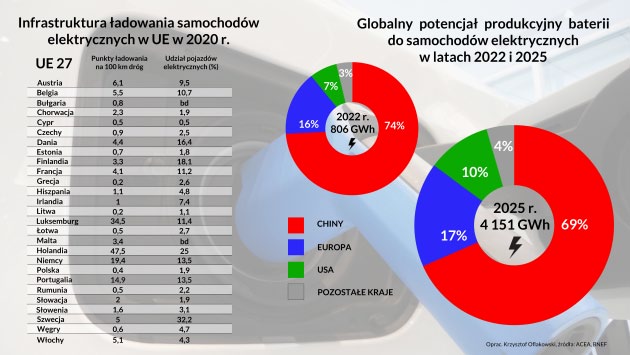
According to last year’s report of the European Court of Auditors, there are over 330,000 public charging stations in the Union, however, as many as 69% of chargers from this pool are in Germany, France, and the Netherlands. The Court – based on data from the European Automobile Manufacturers’ Association (ACEA) – calculates that within the Community, there are as many as 10 countries where there is not even one charger per statistical 100 km of road. Among them are, among others, Lithuania and Greece with a result of 0.2 chargers/100 km, then Poland, where there are 0.4 chargers per every 100 km of roads. Further down the list – with a result of 0.5 – were Latvia and Romania. Currently, there is little indication that the situation will improve quickly, so as to realize the current goal of the European Commission speaking of 1 million charging points by 2025. Since the publication of the report in May 2021, approx. 150,000 new locations would have to be built each year, at a rate of approx. 3,000 points per week. It is worth noting here that this is still a significantly lowered threshold, because in the 2017 action plan, the Commission planned 440,000 public charging points in 2020 and approx. 2 million in 2025. In the Green Deal adopted in 2019, however, the value was reduced to the 1 million currently in force in less than 3 years, but a year later, in the strategy for sustainable and intelligent mobility, it was recognized that 3 million publicly accessible points would be needed by 2030.
The production scale of the challenge may be an even bigger brake
Therefore, the fundamental question is: How many new electric vehicles will satisfy the EU market for light commercial vehicles? Data (ACEA) published in April 2022 shows that in 2020 there were 246.3 million passenger cars (1.2% more than in 2019) and almost 29 million vans on EU roads. In 2021, van sales in the EU grew by 8.5%, reaching almost 1.6 million units, of which 90.2% of new vehicles were powered by diesel, 3.8% by gasoline. Only 3% of new vans had a fully battery-powered drive, which gives 48,000 new electric vans. Hybrid versions accounted for only 1.6% of production, the remaining 1.4% were powered by alternative fuels.
Summing up the ACEA data on the van fleet from 2020 and last year’s production, it is easy to calculate that the number of light delivery vehicles moving on EU roads currently significantly exceeds 30 million units, assuming even that a large part of them has already ended their life. The average lifespan of a light commercial vehicle in the Union is just under 12 years, so it can be assumed that the majority of them will not last until 2035, and those that will still be technically operational will work in companies for at most a few more seasons. Regardless of whether the current fleet is replaced by combustion or electric vans, by 2035 at least several million new vehicles of this size will be needed. Taking into account the projected increase in demand for transport, the expected growth of e-commerce services, or the rising value of the logistics services market for last-mile and in cities, this number may approach even 30 million.
As you can see, the popularity of electric light commercial vehicles is not yet as great as it might seem from the declarations of many companies. It is only 3% of last year’s registrations in the entire Union, translating into less than 50,000 units. I believe that when automotive concerns in Europe have problems with delivering even relatively small orders – and that for vehicles with a conventional drive, for which one has to wait for several months, then a volume of orders at the level of, for example, 1 million electric vehicles would be a complete shock and would cause gigantic problems for suppliers. This results, of course, from many interrelated factors, from the lack of semiconductors, through prices and availability of raw materials. Even the main players in the European automotive industry do not hide their concerns about the challenge awaiting them, paying special attention to the adopted pace of change and the risk of dependence on a small number of suppliers – adds Karolina Pawlak, Director of Full Truckload Transport at Spedimex.
The transport revolution in Europe will also depend on China – they rule the market for raw materials and batteries
According to the International Energy Agency (IEA), China dominates the global electromobility market, and in 2021 alone, the sale of electric cars in the Middle Kingdom increased almost threefold to 3.5 million vehicles. This is more than the entire global sale of electric vehicles in 2020.
Based on current trends, analysts from Frost & Sullivan predict that even in 2025, China and Europe will account for 68.8% of the global e-LCV (electric Light Commercial Vehicle) market. After this period, the USA will take the initiative from Europe and will single-handedly account for every third vehicle sold globally. In 2030, together with China, they will be responsible for 70% of global production. At the end of the decade, despite a good start, the Old Continent will have to settle for a slightly smaller share in global production of electric delivery vans at the level of 23.8%. In the meantime, it will look for ways to secure supplies of batteries and raw materials for the green transformation. For now, Europe is doing quite well, although, as IHS Markit analysts estimate, China is the undisputed leader in the production of refined cobalt and processed lithium, with a global share in the production of lithium-ion batteries at the level of 80%. Despite the overwhelming dominance of the Asian giant, by 2027 production capacity in Europe will increase from the current 13% to 22% of global production. Slightly different calculations are presented by BloombergNEF (BNEF) analysts, researching the market for clean energy, transport, and digital industry. According to their analyses, China currently accounts for approx. 74% of global production capacity and this share will fall to approx. 69% in 2025. In turn, Europe’s current potential is estimated at approx. 16% of global production and it will grow by just 1% in 2025. Despite different estimates by data providers, there is no doubt that it is China that dominates the battery market and this situation will not change much over the next few years.
Access to cheap batteries and raw materials will be of fundamental importance for stable production and the development of the automotive sector in Europe. These two areas will be the true center of interest for the industry, because global demand will be huge.
Although over the last decade the development of battery production technology and economies of scale have reduced the total production costs of lithium-ion batteries by 90%, currently, the proportions of costs have changed – and it is not technology and scale, but minerals that account for 50-70% of battery costs. 5 years ago it was approx. 40-50%. A further increase in mineral prices would therefore have a huge impact not only on the price of the batteries themselves but also of the entire vehicles, as batteries account for up to 40% of their price. For example, according to IEA calculations, doubling the prices of lithium and nickel would lead to an increase in the cost of battery production by 6%. If prices rose at the same time, this would negate all expected unit cost benefits, including those related to the doubling of production scale effect.
The situation with batteries is all the more complicated because compared to oil and gas, the occurrence of minerals necessary for the green transformation is much more regionally concentrated, just as is their processing. When it comes to, for example, lithium, cobalt, and rare earth metals (REE), just three countries control over 75% of total global production. In some cases, even a single country accounts for half of the world’s supplies. For example, the Democratic Republic of Congo and China accounted in 2019 for 70% of cobalt production and 60% of rare earth elements. The processing of these minerals is even more concentrated. China refines approx. 35% of globally processed nickel, 50% of lithium, 70% of cobalt, and almost 90% of rare earth elements.
High concentration means that any disturbances in producer countries, sanctions, armed conflicts, trade wars, or other unpredictable scenarios will affect the global supply chains of the mentioned raw materials. Of course, intensive negotiations are underway with other suppliers, and even searches for new deposits. The problem is that according to IEA estimates, between the discovery of a deposit and the first production, an average of 16.5 years passes, which is a perspective much more distant than 2035. The agency has been warning for a long time that without a significant acceleration of investment, the world may face a shortage of lithium and cobalt as early as 2025. Some potential that could mitigate the expected turmoil is placed, among others, in the recycling of necessary minerals and it is estimated that by 2040, the recovery of copper, lithium, nickel, and cobalt from batteries could reduce primary demand by 10%. This, however, does not reassure either car manufacturers or companies monitoring the prices of new vehicles, because it is enough to look at IHS Markit data, which show that the prices of nickel, cobalt, and lithium rose between January 2021 and January 2022 by 36, 125, and 750%, respectively.
A completely separate issue is also the question of microprocessors, which electric cars need twice as many of as conventional vehicles.
The direction of emission-free transport requires a stable and long-term supply of both chips and metals of the green revolution, especially lithium, nickel, cobalt, copper, aluminum, and rare earth metals (REE). It is not without reason that cobalt, lithium, and REE have been recognized in the Union as critical raw materials. These metals are not only electromobility but also wind turbines, energy storage, power grids, and many other branches of the modern economy. There is little indication that the prices of key elements will fall sharply, especially since the July forecast published by BNEF shows that the demand for minerals necessary for battery production will grow this year by 50% to 4.8 million tons, and the total demand at the end of the decade will reach 17.5 million tons. The demand for lithium alone between 2021 and 2030 will increase sevenfold. All these factors will be reflected in the prices of new electric vehicles
More in the journal LOGISTYKA 4/2022.
The e-edition of the journal is available in our offer!

Stay up to date, order a subscription to the LOGISTYKA journal!