









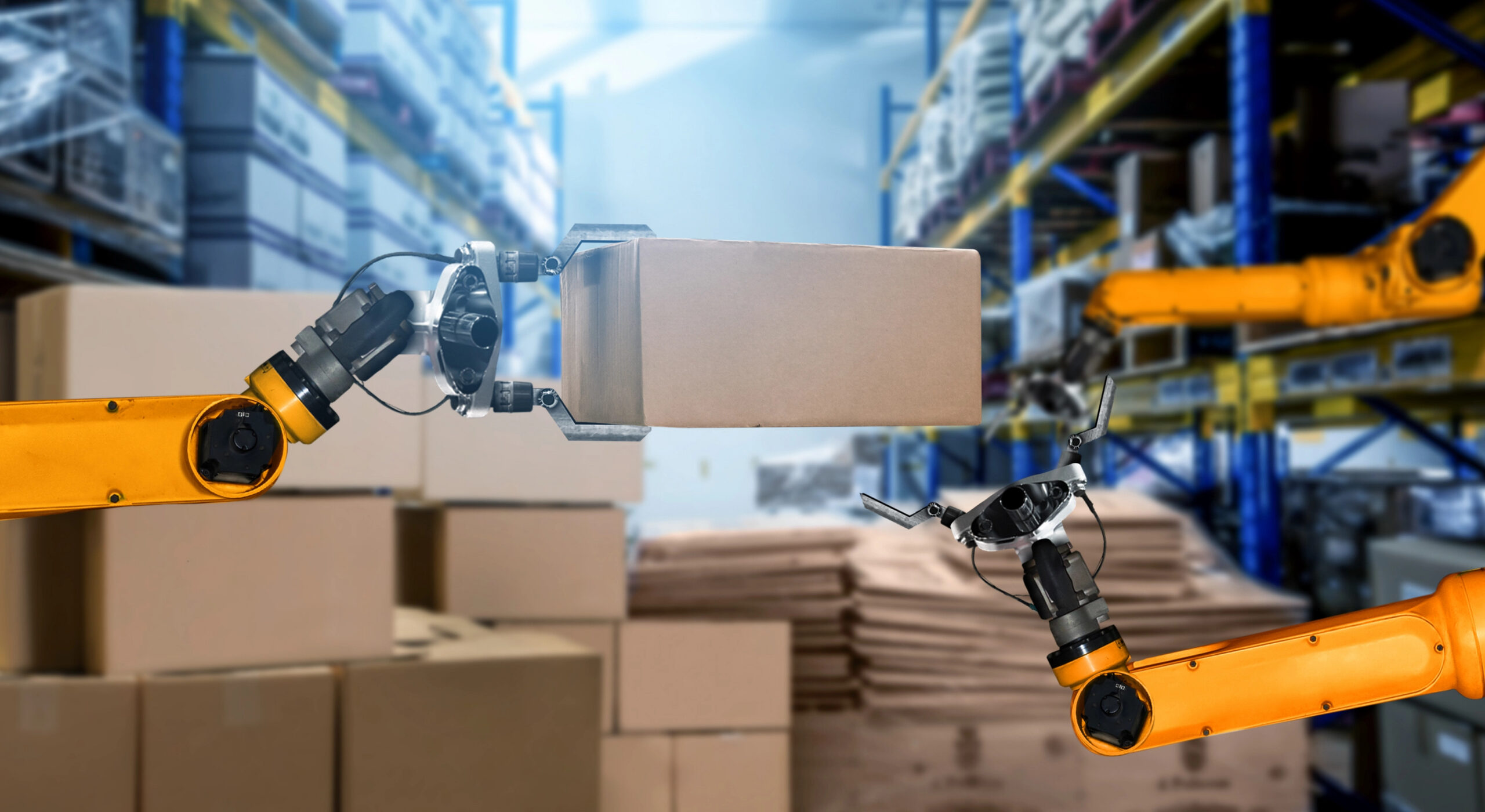
Autonomous navigation, route planning, and traffic management are now well-established functions in many warehouse environments. Modern mobile automation can often be integrated into existing facilities and can operate alongside forklifts and people without major structural changes. However, when it comes to autonomous piece picking and mobile manipulation, what is an instinctive action for a warehouse worker—securely grasping an item that looks slightly different every time—proves to be much more difficult. As staffing warehouse positions becomes increasingly challenging, this hurdle will gain significance.
Poland’s labor cost advantage is shrinking, even though average hourly labor costs remain well below the EU average. According to Eurostat, the average hourly labor cost in Poland rose in 2025 to 19.1 euros from 17.3 euros a year earlier, with the EU average at 34.9 euros. While the growth rate is high, it is still barely over half of the EU average.[1]
For warehouse operators, this creates a decision-making trap: the business case for automation in Poland can differ significantly from markets with higher labor costs, such as Germany, while simultaneously, pressure related to recruiting and retaining employees is growing. In the ManpowerGroup report “Where are you heading, logistics?” 2026 edition, as many as 68% of the logistics organizations surveyed had difficulty finding new employees. The hardest roles to fill are forklift and machine operators (88%), and the main recruitment barrier is the rising cost of employment (60%). In these conditions, the number of tasks that can be automated becomes increasingly important.[2]
Polish operational perspective
The issue of robotic grasping should be approached by outlining local conditions. The first is structural: many Polish warehouses, which will serve for years to come, were not designed with robots in mind. However, contrary to appearances, a greater challenge than the age of the hall itself is the preparation and optimization of processes and data digitization, which should be the prelude to automation.
The second condition is the volatility of the environment. The e-commerce explosion during the pandemic, the slowdown in demand after the outbreak of the war in Ukraine, and the crisis in component availability—unpredictability often causes decision-making paralysis for companies fearing investments that require certainty of volumes for years. Stationary automation can work excellently where flows, volumes, and requirements are relatively stable. In a more volatile environment, however, operators are increasingly gaining from automation that can be introduced in stages, expanded over time, and adjusted without major changes to the facility structure. This also applies to the introduction of picking robots.
How do they grasp it?
In the long term, automation in Poland will lead to a stage of intralogistics development where autonomous systems not only transport goods but actively work with them. This approach is known as mobile manipulation: the combination of movement, AI-based perception, and physical interaction with an object in a single solution.
One of the greatest challenges for engineers is the latter feature. The crux lies in designing an appropriate gripper. It must be able to adapt to an item, regardless of its shape, texture, perforations, etc.
The second layer of this challenge is reproducing actions that a human can perform instinctively—such as adjusting force and movement when the assortment packaging changes, a product is on promotion with an additional attached element, plastic bags are stuck together, or a cardboard box is damaged. For a robot to do this, excellent coordination of perception, mechanics, and artificial intelligence is required.
A frequently used approach is vacuum gripping, which can work very effectively for many uniform surfaces and shapes. However, more porous, irregular, or flexible items can create additional challenges.
A flexible membrane structure is capable of meeting a greater variety of object features, adapting to differences in shape, surface, material, and weight. Such a construction allows handling breathable textiles, loosely packed goods, perforated plastic bags, and delicate products. Of course, the construction of the gripper alone is not enough: the robot must have the support of physical AI to adapt the action to the specifics of the given object.
Grasping as an element of adaptive order fulfillment
Grasping is not a standalone solution here, but another layer in the automation system. An example is the patented membrane gripper NeuraGrasp, developed by Nexera Robotics. Following the acquisition of this company, it is being incorporated into the Locus Array solution, which brings autonomous picking into order fulfillment processes. The effectiveness of this solution still depends on integration and orchestration within a single platform, rather than the gripper itself.
Coordination is ensured in this case by LocusONE. This platform distributes tasks between humans and robots based on real-time operational data, balances workload, and reacts to changing priorities. In this view, mobile manipulation is an element of the operational layer, not a separate robotic function.
This is one way to deal with the Polish operational dilemma. Adding separate machines, each working according to its own logic, is too limited an answer to rising labor costs, difficulties in staffing, and variable volumes. Operators need an order fulfillment infrastructure that can adapt to changing requirements. Perfecting autonomous grasping and integrating solutions into a cohesive platform allows progress toward this goal. Additionally, the Robots-as-a-Service model helps with this, where the scope of automation can be changed over time without sizing it permanently for peak demand.
99% is not enough
A key challenge after introducing autonomous picking robots is scale. Across an entire warehouse, even a 99% first-pick success rate can still translate into a significant number of exceptions during a shift when thousands of picks are performed every hour. Each of these can require manual intervention, disrupt the flow, or increase cost.
Therefore, the way robotic picking systems are evaluated is changing. For years, they were measured by picks per hour and assortment coverage (number of supported SKUs). Today, the primary question is not how well a single pick is performed, but how reliably the system operates at a large scale: how it handles exceptions, how often it can automatically resume work, what is the frequency of manual interventions, and how stable throughput remains during a shift.
It is reliability at scale that pushes the boundary of what can realistically be automated in a warehouse. The single-pick success rate is less important than what happens when a pick fails. The fewer exceptions requiring manual intervention and the more of them that can be resolved automatically, the more stable the material flows, throughput, and the cost per pick become.
For Polish operators, this is more than just a new robotic feature. With decreasing employee availability and increasing assortment complexity, mobile manipulation can expand the scope of work that can be automated within an adaptive order fulfillment infrastructure. The strategic value lies not only in automating another task but also in expanding its scope over time without making the operation dependent on one rigid assumption regarding future volumes, processes, or SKU profiles.
[1] Eurostat, “EU hourly labour costs ranged from €12 to €57 in 2025”, press release, March 31, 2026, ec.europa.eu/eurostat/web/products-eurostat-news/w/ddn-20260331-2 (dataset: lc_lci_lev).
[2] ManpowerGroup, “Where are you heading, logistics? 2026 Edition” (report, in cooperation with AmCham Poland), May 27, 2026, manpowergroup.pl/raporty/dokad-zmierzasz-logistyko-edycja-2026; “Nearly 7 out of 10 logistics companies have difficulty recruiting new employees” (publication based on the report), June 11, 2026 https://biuroprasowe.manpowergroup.pl/459655-blisko-7-na-10-firm-w-logistyce-ma-trudnosci-ze-zrekrutowaniem-nowych-pracownikow.
Source: Locus Robotics