









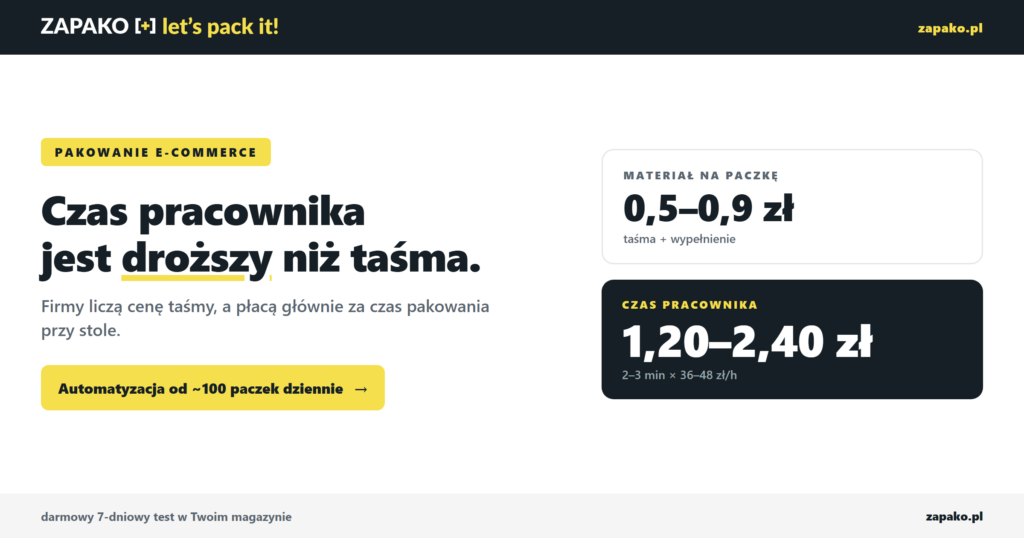
Packing a single parcel costs between PLN 0.5-0.9 in materials (paper version) or PLN 0.3-0.6 (plastic film version), plus the employee’s time, which at Polish rates is usually more expensive than the material itself. It is the opposite of what intuition suggests: when looking for savings, one looks at the price of tape, but the real money lies in work speed. Below I break down the cost of a parcel into parts and show where it can actually be reduced.
If you want to see paper tapes and roll prices based on specific numbers, I compare them further with labor costs.
How much does the material for one parcel cost?
Let’s calculate this based on two components that every parcel actually uses: tape and filler.
| Component | Consumption per parcel | Unit price | Cost per parcel |
| Paper tape (200 m) | 2 strips, approx. 0.8-1.2 m | PLN 0.086/m | PLN 0.07-0.10 |
| Filler – bubble paper | 0.3-0.5 m² | PLN 1.42/m² | PLN 0.43-0.71 |
| Filler – bubble wrap | 0.3-0.5 m² | approx. PLN 0.80/m² | PLN 0.24-0.40 |
Total: approx. PLN 0.5-0.9 per parcel for the paper version, and approx. PLN 0.3-0.6 for the plastic film version. Where do these numbers come from? A water-activated paper tape 200 m long costs PLN 17.15 net, which is PLN 0.086 per meter, and two strips are enough to close the carton – one for the top and one for the bottom flaps. Bubble paper costs PLN 1.42 per m², bubble wrap hovers around PLN 0.80 per m².
These are indicative numbers because they depend on the size of the carton and the amount of filler, but the order of magnitude is stable: the material for a parcel is less than one zloty.
How much does the employee’s time cost?
This is where it gets interesting. Employing a warehouse worker usually costs an employer in Poland PLN 6,000-8,000 gross per month (salary plus ZUS contributions and funds), which is about PLN 36-48 per hour. This means that every minute of work at the packing table costs PLN 0.60-0.80.
If packing one parcel takes an employee two to three minutes, the labor alone is PLN 1.20-2.40 – which is usually more than the material itself. And this is the heart of the problem: companies count the cost of tape, but pay mainly for the time an employee spends walking around the warehouse, looking for tape, measuring it by hand, and wrapping the carton with stretch film.
Why material is a poor area for savings
Since material is less than a zloty per parcel, fighting for a few pennies on tape will not change the result. The real leverage is in time. Implementing a dispenser increases packing table speed by about 20 percent (as shown by independent tests cited by ZAPAKO) – and every saved second multiplies by the number of parcels and the hourly rate.
It is worth stating this clearly, because many entrepreneurs assume the opposite: that savings will come from cheaper tape. They will not. They will come from the same person packing more parcels in the same amount of time.
How to calculate your packing costs (method)
Instead of taking external numbers, measure three things in your own warehouse:
- Time per parcel – stopwatch on 20 parcels, divide by 20.
- Material consumption per parcel – how many meters of tape and how many m² of filler are used on average per one carton.
- Hourly rate – gross employee cost divided by working hours.
Parcel cost = (time × rate) + (consumption × material price) + fixed station costs. Only these three numbers will show where the largest position is. In practice, the first one dominates.
Where money actually escapes
The biggest problem we see with clients is the lack of station ergonomics. Basic tools are moved away, fillers are at the other end of the warehouse, and the tape is hidden. The result: the packer walks instead of working.
The second type are systems that save money but not the employee’s time. This happens with manual gluing and stretch wrapping – it comes out “cheap” on paper, but expensive in hours. A device should shorten the path to the tape and eliminate unnecessary movements, not add another piece of furniture.
When does the investment pay off?
According to our implementations, sensible automation starts at about 100 parcels per day. Below this limit, a good manual dispenser is usually enough; above it – an automatic one.
To illustrate, on a clear assumption: with 100 parcels and 2-3 minutes of work per parcel, the station operates for approx. 4-5 hours a day, so a 20 percent speed increase recovers roughly one hour per day; at a rate of PLN 36-48, this gives approx. PLN 750-1000 less per month on labor. This is a calculated value, not a specific client measurement – but the order of magnitude shows where the money is.
Conclusion
Three takeaways worth remembering:
- Material per parcel is less than a zloty – there are no large savings there.
- Employee time is the largest position – a minute of work is valued at PLN 0.60-0.80.
- Change should reduce work, not just the price of tape.
Before you compare tape prices, measure the time per parcel. It is usually what determines whether an investment in a packing station will pay off in months, or at all.
About the author
Piotr Kusy and Paweł Jackiewicz, ZAPAKO. They advise e-commerce, logistics, manufacturing, and industrial companies in the scope of organization and automation of the packing zone – from material selection to equipment service.
Data on material prices comes from the zapako.pl offer (net prices, as of 2026-10). Work speed increase (~20 percent) is provided based on independent tests cited by ZAPAKO. Employee cost is an estimated employer cost (as of 2026). Values marked as an assumption are illustrative calculations.