









Companies in the TSL sector entered 2023 with the prospect of a global economic slowdown; nevertheless, as of December 2022, 72.3% of them declared they would maintain or increase their level of investment. Most enterprises do not intend to reduce employment, and the war in Ukraine no longer has a significant impact on their operations. They also managed to avoid the driver market crisis, and January surprised with a record number of new vehicle registrations. The sector’s strengthened resilience and flexibility will come in handy in the future, as there will certainly be no shortage of challenges.
Variable expectations for economic growth and trade
According to the latest forecast by the UN Department of Economic and Social Affairs (UN DESA), global GDP growth will weaken to 1.9% this year and 2.7% next year. For 2023, these assumptions are 1.2% worse than those from mid-2022. As for this year’s European Union economy, it is expected to grow by only 0.2%, which is 2.2% worse than the forecasts from six months ago. In 2024, the Union is expected to see a rebound to 1.6%, both in and outside the eurozone. For comparison, the opening Chinese economy will grow by 4.85% in 2023 and 4.5% in 2024. The forecasts for Poland are better than the EU average, but real GDP in our country is expected to grow by only 1% this year and 2.6% next year.
The significant slowdown in global economic activity also persisted in the IMF forecast update published in January. Although the organization raised this year’s global GDP growth to 2.9% and 3.1% in 2024—which in the case of the current year is an estimate 0.2% better than in October, but still lower than the historical average of 3.8% from 2000–2019—the IMF notes that the positive indicators are, among other things, due to the surprising resilience of many economies, and ultimately, no recession is forecast for global GDP. A weak result of 0.7% is expected in the eurozone this year, and it will be little better in the following year (+1.6%). To the benefit of our economy and despite earlier announcements, a recession will bypass Germany, and our neighbor’s economic growth is expected to reach 0.1% in 2023 and 1.4% in 2024.
Both institutions also updated their trade forecasts, which, according to UN DESA, will reach a negative value of -0.4% in 2023 and a growth of 2.5% in 2024. For this year, this is an estimate as much as 5.2% worse than that from mid-last year. The IMF also assumes a further reduction in trade for this and next year. Growth will stop at 2.4% and 3.4%, which are assumptions 0.1% and 0.3% lower than those from October.
A bit more optimism is brought by the European Commission’s winter forecast, which assumes a better condition of the EU economy than the estimate presented in autumn 2022. According to the EC, economic growth in 2023 will reach 0.8%, and 1.6% in 2024. Earlier predictions assumed a growth of 0.3% this year. Unfortunately, the latest forecast assesses the Polish economy more weakly. According to the EC, Poland’s GDP will fall from the previously announced 0.7% to 0.4% this year and from 2.6% to 2.5% in 2024.
The TSL sector is still holding strong
Despite the slowdown announced at least since the middle of last year in the global, European, and Polish economy, but also in trade, industry, and freight transport, the analysis of data for the last year and forecasts for the current quarter indicate that the Polish TSL sector has achieved significant resilience to crises and acquired the ability to react appropriately to adverse events, including the war in the East.
This can be seen, for example, in employment and the conclusions from the ManpowerGroup survey published in January this year. They show that 47% of transport and logistics companies in Poland intend to maintain current employment levels in the first quarter of 2023. What is more, 29% of employers want to increase their employee base in the potentially worst quarter of a weak year, and only 24% of companies plan staff reductions. According to the authors of the study, transport and logistics is one of the few branches of the Polish economy that declares maintaining a positive recruitment indicator at a net +3% level. Compared to the previous quarter, this is a 3% better result, although the year-on-year perspective shows a decrease of 7%. The broader forecast for the EMEA region (Europe, Middle East, and Africa) is better than the Polish labor market. Net employment for this region for Q1 is +19%, and 38% of companies are planning new recruitment. The same percentage of companies wants to maintain employment, while 20% of organizations announce layoffs.
In 2022, there was no expected outflow of foreign drivers
The Polish TSL sector, especially road transport, managed to avoid one more serious and widely predicted crisis: the outflow of drivers, especially those from Ukraine. It turned out that not only did there not occur a drastic deterioration in this area, but on the contrary, the number of drivers increased, which is confirmed by data from the Chief Inspectorate of Road Transport (GITD). The latest GITD data shows that in 2022, both the number of driver attestations valid in legal circulation at the end of 2022 and the number of new documents issued during the year to citizens of non-EU countries increased. Compared to 2021, both categories gained 21.14% and 18.6%, respectively, and the number of attestations issued to Ukrainian citizens decreased by only 3.03%. Rights granted to drivers from Russia shrank by as much as 23.08% at the same time. Interestingly, the number of attestations issued to citizens from countries other than Belarus, Kazakhstan, Moldova, Russia, and Ukraine increased by over 166%, which is a sign that the sector has acquired the ability to attract drivers from new directions. Contrary to many fears, there was no significant collapse in the driver market caused by the outflow of workers from the East, that is, those employed legally. The number of Ukrainian drivers with a valid driver attestation at the end of 2022 was 127,389, which is 22.77% more than a year earlier (103,766). The overall balance of employed foreigners remained positive in 2022 and amounted to 28,039 in the case of permits valid at the end of the year and 16,721 in the case of permits issued during its duration.
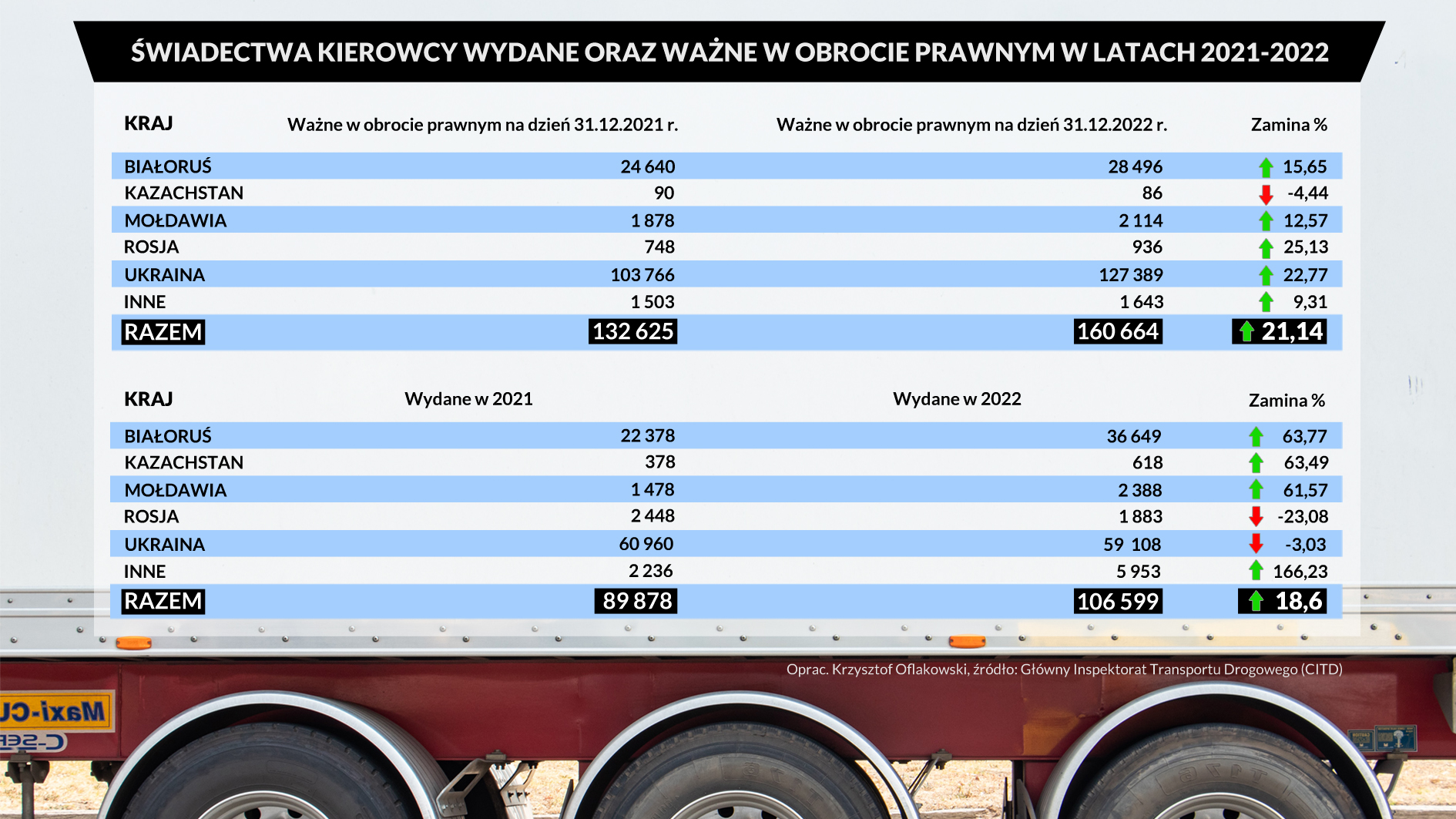
Positive data on drivers is of significant importance because Europe, and Poland in particular, which has the largest fleet of trucks in the Union, has been suffering from a shortage for years. Alarming IRU data on the inevitable employment crisis in road transport say it will become extremely dangerous after 2026, when the labor market loses its ability for generational replacement. The organization’s calculations show that as early as 2021, 34% of European drivers were over 55, and only 7% were under 25. Estimates for 2021 say that in Poland, as many as 80,000 positions were unfilled, which accounted for 11% of all vacancies. Only Great Britain was in a worse situation, where there was a shortage of as many as 100,000 drivers, i.e., 9.7% of vacancies. The percentage of unfilled positions in Europe also amounted to 9.7%, which translates into a shortage of as many as 425,000 drivers. According to expectations for 2022, the share of unfilled positions was to reach 14%.
– Considering all the adverse macroeconomic and geopolitical factors, it can be said with certainty that the Polish TSL sector has met the challenges posed to it throughout the year. Despite a huge blow to the economy, which was entering a path of dynamic growth after the pandemic, it was possible to achieve overall growth in freight transport in Poland at the level of 0.8%, despite a weak last quarter. Road transport ultimately closed the year with a result 0.7% higher than in 2021 and transported over 284.2 million tons of goods, which, in the context of a strong weakening, can be considered a success. It is even more justified given that during the year, companies lost access to markets across the eastern border and had to adapt to new EU regulations, including changes in driver working hours. More importantly, however, companies once again learned very quickly how to operate in a new and uncertain economic environment. This is the second time in just a few years that we have had to face crises that have not occurred for decades. First, there was the pandemic; now, it is the war in our immediate neighborhood. We believe that such flexibility and the ability to adapt quickly will be an extremely valuable feature in the future. After all, we are on the threshold of a technological revolution in the transport market, and perhaps in the near future, we will have to face the deglobalization of the industrial and supply chain. This will open up new opportunities for a strong TSL sector, but will require a new approach and bold decisions. The experience of recent years shows that such competencies exist in Poland, as companies have significantly immunized themselves against crises and are no longer looking for survival scenarios, but for development and investment strategies – says Karolina Pawlak, FTL Director at Spedimex, a Polish logistics operator serving retail chains, shopping malls, e-commerce, and LTL and FTL transport in Poland and Europe.
The beginning of the year confirmed the smaller impact of the war on the TSL industry
Statistics Poland (GUS) data for January regarding the impact of the war on the economic situation indicate that the transport and storage sector has become even more resistant to its influence. As many as 21% of enterprises point to the lack of negative effects of the conflict. This is the highest rate since March 2022 and a significant increase compared to December, when only 9.3% of respondents said so. Furthermore, 49.8% of companies believe that the war creates only minor effects, and 19% and 10.2% of enterprises, respectively, declare serious effects that threaten the company’s stability. Among those companies that declare the negative consequences of the war, the greatest difficulties are: an increase in operating costs (75.3%), supply chain disruptions (22.9%), and a decrease in revenue (20.5%).
As in the case of drivers, the war has ceased to have a significant impact on the employment of workers from Ukraine. As many as 67.3% of surveyed organizations in the entire transport and storage sector claim that this issue does not concern them. 25.2% indicate a slight outflow of workers, and 26.7% feel a slight influx of workers from Ukraine. Only 4.5% and 1.6% of the surveyed entities feel significant outflows or inflows.
The beginning of the year also brought investment data, which shows that 44.9% of companies in the sector declare maintaining expenditures, and 27.4% announce an increase. In turn, 27.7% assume a decrease in investment, which was decided primarily by: high inflation (69.5%), high implementation costs (63.7%), and an uncertain macroeconomic situation (38.7%).
In the crisis, transport companies registered more heavy vehicles, and January brought records
Despite unfavorable market conditions, Polish companies recorded relatively good results in new vehicle registrations in the segment above 3.5 t. According to data contained in the latest report by the Polish Automotive Industry Association (PZPM) and KPMG, the registration of new delivery vans with a GVW of up to 3.5 t fell by 16.8% in 2022 compared to the previous year; however, an increase of 6.8% was recorded in the heavy vehicle segment (above 3.5 t), with 34,905 units registered. Trucks and motorcycles are basically the only market segments that recorded growth. According to PZPM and KPMG, a similar trend was noted at the EU level, where registrations of light commercial vehicles fell by 18.1% to 1.279 million units, while an increase of 3.5% was achieved by heavy vehicles, of which 299,900 units were added. Production data also speak in favor of freight transport, because out of the basic types of vehicles, only delivery vans, both light and heavy, finished the year in the plus. 223,700 units rolled off the production lines, which is 29% more than in 2021.
As for the beginning of this year in Poland, according to PZPM data, 14.9% more delivery vans up to 3.5 t were registered in January than a year ago (+672 units), and this is the second highest result (after January 2019) for this month in the history of records. As for new trucks above 3.5 t, 10.3% more were added than a year earlier, and this is the highest result for the same month in the entire history of records. There were 4.4% more registrations of the heaviest vehicles (above 16 t) in January than a year earlier.
ACEA also presented its calculations regarding commercial vehicles in the Union, calculating that registrations of all vehicles of this type fell by 14.6% in 2022 to 1.6 million units. This was due to problems within supply chains, which translated into shortages of new vehicles throughout the year. However, the blame for such a large drop lies with light vehicles up to 3.5 t, whose registrations were 18% lower than a year earlier. A jump of 6.5% was recorded in the heavy vehicle sector, above 16 t. Entrepreneurs from Spain (+13.6%), Poland (+6.6%), and Italy (+2.3%) could boast the largest increases at the end of the year. In the area of medium vehicles (above 3.5 t), ACEA noted an increase in registrations at the level of 3.5%. Clear growth in the medium vehicle categories was visible especially in the period from August to November, where the number of registrations grew by +18.1%, +18.3%, +16%, and +19.4%, respectively, and only in December was there a slight decrease of 3.2%. The situation for heavy vehicles above 16 t looked similar. The rally of new registrations started in August (+24%), followed by +21%, +18%, and +21.1% in November. Only in December was there a decrease of 1.9% compared to the corresponding months of 2021.
Stabilization is visible on the horizon
After a weak last quarter of 2022, the start of the current year brought the first signs of normalization, as evidenced by current index readings and better sentiment in selected economies. The global supply chain volatility index from GEP and S&P Global of February 14, which is a leading indicator tracking demand conditions, shortages, transport costs, inventories, and backlogs in companies in 40 countries around the world, fell in January to 0.97 from 1.61 in December, showing that global supply chains are improving and are the least strained since September 2020. For this indicator, the higher the values above 0, the more strained the supply chains are. January data also show that product shortages are at their lowest in more than two years. Additionally, companies are making progress in clearing out inventories and safety buffers that were accumulated over the last few years. Global inventory reports, in turn, ease concerns about future supply and prices. The same applies to transport costs, which are normalizing along with the easing of pressure in all modes of transport. This is clearly visible, among other things, in maritime transport rates, where prices for a 40-foot container fell by 80% at the beginning of March this year compared to the same month in 2022.
Indicators in selected regions of the world are also improving, which indicates progressive stabilization in the surveyed economies. For example, the Eurozone Manufacturing Output Index, which answers the question about the improvement in manufacturing company results in the eurozone, published at the beginning of March, rose in February to 50.1 from 48.9 in January—this is the best result in 9 months. Production data for the entire global economy also rose, from 48.9 in January to 50.8 in February, where any value above 50 indicates expansion in the economy, below 50 signals declines, and the 50 mark indicates a neutral level. Exceeding the desired level of 50 points is, of course, good news for the TSL sector, because higher production means greater demand for transport services.
Another composite index for the entire industrial sector of the Eurozone (Eurozone Manufacturing PMI), consisting of production, new orders, employment, delivery speed, and inventories, unfortunately remains in the decline zone (48.5), but improvements in February were noted by Italy (52.0), Greece (51.7), Ireland (51.3), and Spain (50.7), among others. However, weak results are still being recorded by France (47.4), Germany (46.3), the Netherlands (48.7), and Austria (47.1). In Poland, the manufacturing sector PMI also remained below the neutral level, but took an upward trajectory, climbing from 47.5 in January to 48.5 in February. A similar situation currently prevails in the UK (increase from 47 to 49.3) and the USA (increase from 46.9 to 47.8). Global data, on the other hand, jumped to a neutral level (50.0) (from 49.1 in January), and solid improvement was recorded in China, where the PMI rose from 49.2 in January to 51.6 in February. The situation in India (55.3) and ASEAN countries (51.5) also looks good. Data flowing from the world indicate a slight improvement, but this is still a weak first quarter, which was announced as early as 2022. At the same time, it is expected that the global economy will improve, especially in the second half of 2023.