








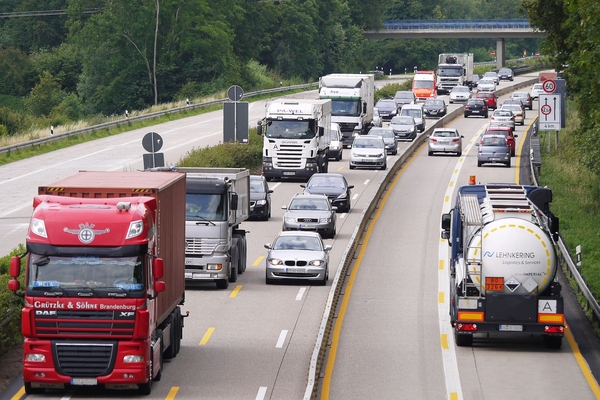
Europe is struggling with the coronavirus pandemic – the introduced restrictions have significantly slowed down the economy, and entrepreneurs are slowly counting their losses. For the transport industry, the epidemic is not the only cause for concern. The Mobility Package in Europe is now all but decided. How will carriers cope in this new, more difficult reality?
The prospect of reforming transport law and implementing the Mobility Package has long been a source of sleepless nights for carriers. All changes have their supporters and opponents. This is no exception. The main beneficiaries of the new EU regulations will be: Germany, France, Italy, Austria, and the Benelux countries. The regulations will protect the transport markets of these nations. Carriers from Poland, Romania, Lithuania, Slovakia, Bulgaria, and Latvia will suffer the most.
Despite a pan-European strike in June 2019, the European Commission did not abandon work on the reform. In March 2020, transport ministers from Poland, Hungary, Lithuania, Latvia, Bulgaria, Romania, Malta, and Cyprus appealed to the European Parliament and the European Commission to suspend work on the social and market aspects of the Mobility Package, at least until the end of the coronavirus pandemic, which is already causing many problems for the industry. Unfortunately, although nothing is functioning normally right now, MEPs have managed to take another step toward approving the transport law reform. The Mobility Package was voted on in its first reading by the General Affairs Council of the EU. The legal acts must now be adopted by the European Parliament in a second reading, which will most likely take place in July 2020. After appearing in the Official Journal, the first changes will take effect 20 days after publication.
 – Work on the Mobility Package has been ongoing for nearly three years and is slowly coming to an end. It seems we already know a great deal about the legislative changes proposed, drafted, and pushed primarily by Germany, France, and Austria in the interest of protecting their internal markets. It is important for Polish transport companies providing international road haulage services to understand the changes in the law and to prepare as well as possible, among other things, for the new rules concerning weekly rest periods for drivers, the mandatory return of drivers every three or four weeks to their base or place of residence, and the ban on taking weekly rest in the cabin. These enter into force the fastest, as they do 20 days after the approval of Regulation 561/2006 – explains Kamil Wolański, expert at INELO.
What will change in conducting transport business in Poland?
Within 20 days of the publication of the adopted Mobility Package, among other things, the following will come into effect:
• Clarification of the ban on taking regular weekly rest in the cabin. Any rest period of more than 45 hours must be spent outside the cabin in a place with adequate sanitary facilities.
• Stricter rules for taking reduced weekly rest periods, meaning an international driver will be able to take two reduced weekly rest periods in a row (2x24h) provided that they have at least two regular weekly rest periods and two reduced ones every four weeks. After taking two reduced weekly rest periods in a row, the next one will be a regular weekly rest preceded by compensation. Such a long rest period must be taken at the base in the country of establishment or the driver’s place of residence. Note: documentation of the return is required in this case.
• Mandatory return of the driver to the company’s operational center in the country of establishment (base) or the driver’s place of residence at least every four weeks. The driver should return at least for a 45-hour rest period.
18 months after the adoption of the Mobility Package, revised regulations regarding driver posting, i.e., minimum wage settlement, and market access, i.e., rules for conducting transport business in the EU, including significant obstacles to performing cabotage operations, will be implemented.
Regulations that will apply 18 months after the directive’s publication include:
• The return of every vehicle to the company’s operational center in the country of establishment at least once every eight weeks.
• Restriction of market access regarding cabotage. Previous rules for international transport allowed three operations within seven days. In the Mobility Package, the EU has added a four-day break period between cabotage operations by the same vehicle in the same country.
• New driver obligation – logging the country upon crossing the border at the first possible safe place.
• Possibility of losing good repute for violations related to cabotage and the posting of workers.
• Addition of a so-called company rating, defining, for example, the frequency of violations in the ERRU and KREPTD registers.
• Exclusion from posting for transit operations, bilateral transport (from/to PL), and a maximum of two loading or unloading operations accompanying bilateral transport (the latter subject to certain conditions, e.g., smart tachograph gen 2, on the way from Poland max. 1 additional operation allowed).
• Inclusion of cross-trade transport and all cabotage operations under posting rules.
• Use of full collective agreements when settling minimum wages and the inability to include per diems and lump sums.
Additional important findings are:
• 56 days back, a new road check period that will apply from the end of 2024.
• Installation of new smart tachographs of the second generation in new vehicles two years after the entry into force of technical regulations.
• Mandatory replacement of tachographs in international transport to the next generation:
– analog and digital within three years from the entry into force of technical regulations
– smart first generation within four years from the entry into force of technical regulations.
• Requirement for owners of transport companies with a so-called light fleet to comply with driving and rest time standards like those currently in force for truck drivers (Regulation 561), and the obligation to install and use a tachograph will apply from July 2026.
• Within 21 months from the date of publication of the Mobility Package, carriers with vans will be obliged to meet all requirements related to practicing the profession of road haulier, including having a license and financial security for each vehicle.
Will Polish transport be able to adapt to the new guidelines?
Polish carriers do not hide their bitterness over this turn of events.
– I fear that the issue of adopting the Mobility Package is already a foregone conclusion. In July, we should expect the project to be adopted and published. With the planned 18-month adjustment period, the Mobility Package will likely enter into force at the beginning of 2022. In recent weeks, the public debate in this regard has intensified significantly.
 Supporters point to the need to protect the social rights of employees, especially those threatened during periods of negative economic change. Opponents emphasize the irrationality of the proposals, which are completely ill-suited to the specific nature of international transport, and their protectionist character. I lean toward the latter opinion. Particularly at the moment of introducing restrictions related to COVID-19, we clearly observed numerous disruptions in the transport system. For this reason, drivers in international traffic were exempted from the quarantine requirement, and some regulations regarding driving time and rest periods were temporarily relaxed. Well-functioning transport proved to be a necessary condition to ensure the availability of products for society and to mitigate the economic effects of the crisis. This positive reflection did not last long, however, and gave way to determination in protecting local markets. It is a pity, because we will all feel the consequences of irresponsible decisions. These are higher costs for transport companies and consequently higher service costs. It also means lower planning efficiency under new legal restrictions, and consequently, greater road congestion and higher CO2 emissions. I feel absolutely no logic here, only short-sighted and narrow interests. At a time when we are simplifying business models and implementing digital tools to optimize economic activity all over the world, Europe is going the other way. This directly limits our competitiveness. Instead of effectively using available resources, based on political populism, we are closing ourselves in local silos. I think it has been a long time since we needed a united Europe, defending its basic values, as much as we do now. I hope it is not too late for reflection – said Paweł Trębicki, General Manager of Raben Transport, Raben Group.
 – There are many indications that transport companies with financial backing will cope with the effects of the economic slowdown caused by the coronavirus. Unfortunately, Brussels has additionally ensured that entrepreneurs, especially from Central and Eastern Europe, will soon have to face further challenges, the most difficult of which seems to be rising labor costs, the creation of administrative barriers, and restricted access to the European market. The coming weeks will show more clearly how the future of transport in Poland is shaping up. The Mobility Package may finally be approved later this year, as early as July. At the moment, the earliest date for the package to enter into force is July 8, 2020. This is the date of the planned first plenary session in July – claims Mateusz Włoch, INELO Group.
– Due to the coronavirus epidemic, the transport industry must react quickly to new challenges to ensure the continuity of supply chains. It is necessary to adapt to restrictions introduced in many sectors or regulations concerning the free movement of goods and workers between countries. As a result of freezing economies in most EU countries, the implementation of the Mobility Package will require additional time for preparation and new discussions at the European level. The financial situation of Polish entrepreneurs has significantly deteriorated. Some companies have lost the ability to optimize processes, but above all, they currently have difficulty financing investments and maintaining financial liquidity, which directly and indirectly affects the implementation of the package – says Marek Skowroński, Vice President Land Transport Cluster North East Europe at DB Schenker.
New reality – new solutions
An old proverb says that “there is no point crying over spilt milk” and one should consider how to approach the inevitable changes in the transport industry.
– It seems that despite the extraordinary situation related to COVID-19, the implementation of the package is becoming inevitable, and all entities will have to adapt to the new regulations. Every change forces entrepreneurs to take appropriate actions: modifying the current company business model, managing its resources reasonably – with particular emphasis on human resources, to ensure an adequate level of remuneration and social facilities. An important element is the consolidation
 of transport entities with large logistics operators that operate globally and use a network of mutual connections for more optimal management of goods flow, building a synergy effect. This also motivates effective management of driver working time, increased productivity, and better use of loading space. An example of projects enabling increased loading capacity is the implementation by DB Schenker, in cooperation with carriers, of swap bodies (BDF/swap body), which are used in domestic and international traffic.
One of the solutions that will allow for survival in the industry is process optimization, including the effective use of driver working time. The introduction of autonomous vehicles should influence the change in the definition of a driver’s work and enable the extension of their actual activity. Applications that will inform drivers and forwarders in real-time about the details of loading and deliveries will be helpful, helping to properly plan the route, taking into account traffic situations and choosing a free parking space. Such amenities will improve working conditions. In the case of DB Schenker, drivers are hired by collaborating carriers who expect candidates to take care of property, have teamwork skills, have the right attitude toward the customer, and practice a safe driving style. After being hired, new drivers are invited to introductory training, during which they learn about the company, important procedures, and safety rules. They receive support from a driver-mentor, and also participate in customer service training to, among other things, learn how to solve difficult situations, and benefit from collected experiences and tips. We pay for accident insurance for about 3,000 drivers working for the company and equip them with company clothing. We also organize periodic satisfaction surveys regarding cooperation with DB Schenker. This is a broad, detailed project, and the opinions obtained are very valuable to us. We care about building partnership relations, which is why we invite drivers to participate in events organized by DB Schenker – sports competitions or volunteer actions. Thanks to this, the driver knows from whom they can get support, but also integrates with employees and identifies with the company. After a good introduction to the organization, new drivers handle unpredictable situations more easily and stay with the employer for longer – says Marek Skowroński, Vice President Land Transport Cluster North East Europe at DB Schenker. – Polish carriers have always been able to adapt to new regulations quite flexibly, which is why I believe that this time it will also be possible to work out appropriate solutions that allow meeting the requirements of the Mobility Package. A particular challenge will be the regulations regarding weekly rest of more than 45 hours – this involves the need to spend time outside the cabin, in a place with adequate sanitary facilities. Some carriers are already recommending more frequent driver changes, even for those driving sets, or are renting residential premises for drivers operating regular routes.