








Why can the cheapest trade rule turn out to be the most expensive? A conversation with an international freight forwarding expert
In the world of logistics, the term INCOTERMS is certainly not unknown: it is a set of trade rules that define the scope of responsibility in trade. Depending on which rule we use to execute our transport, we are responsible for the process to varying degrees. Each rule is characterized by a different scope of transport, financial, and insurance responsibilities. Based on our forwarding experience, we can say that among all the rules, the most popular is EXW – in which the buyer is responsible for the vast majority of the import. They (or their representative) must focus on organizing everything from the moment the goods leave the factory, which means costs. Conversely, CIF allows one to worry about the cargo only from the port where it is picked up, meaning fewer costs and fewer actions. The prospect of saving energy and funds tempts many importers, but not everyone realizes what taking the easy way out can entail.
What is the CIF rule, and why does it tempt importers?
The CIF rule is a formula under which the seller bears responsibility for the goods until they are unloaded at the destination port. They pay for transport, loading and unloading, and insurance. The buyer becomes fully responsible for the goods only at the moment the designated carrier takes over the goods. The carrier, after taking the goods at the port of discharge, can complete the delivery to the buyer’s door.
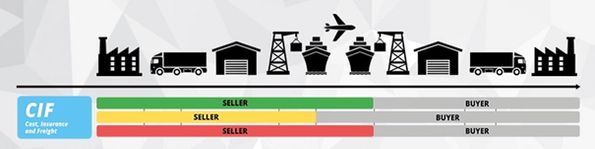
The magic of CIF is that sellers often work in agreement with trusted entities. Such cooperation allows for lower rates and the presentation of a very attractive price to the buyer. The agreements allow for significant savings, which, when transporting entire containers, can sometimes be an incredible benefit.
What do buyers on the CIF rule not know?
The catch is that what is beneficial in FCL transport is not necessarily so in LCL transport. Buyers, usually using this rule for the first time, are often unaware that the tempting “cheaper option” may contain hidden costs. This happens mainly because the seller—often working in cooperation with loaders and carriers—makes up for the lower rate with a percentage of the profit and additional costs as part of the collaboration. Additionally, this solution often means a lack of information about the course of transport, not to mention control over the cargo. At the same time, the control of the process is often looser than in the case of the EXW rule, which results in the buyer having no awareness of what they are importing until the very end. This is partly due to the low awareness of sellers regarding the attestations, certificates, documents, permits, and commodity classifications required in Europe.
INCOTERMS CIF applies to both break-bulk and full containers in sea transport. While one can actually benefit from it in FCL transport, it becomes truly problematic in break-bulk transport.
What does importing on CIF look like in practice? A conversation with Jan Piwowarski
 |
Jan Piwowarski – sales representative at BBA Transport System. He specializes in imports from China and Southeast Asian countries, and also seeks new opportunities to organize exports from Poland to China. |
Why does CIF tempt importers bringing goods from China to Europe?
Primarily due to low initial costs. The price of the service provided under CIF is low, and the responsibility is not overwhelming. After all, the sender takes it upon themselves almost entirely—the importer only needs to designate a carrier to pick up the goods from the port. And possibly pay some additional fees, but it rarely looks like they will be high.
In that case, what is the problem?
It is that the client is often not informed about what the fees will look like at the destination port. Since the seller only has to deliver the goods to the port, they do not worry about the costs the buyer will incur on-site. And these can be very high: storage, customs clearance, licenses… It is enough to say that we have encountered situations where the final fee was as much as 16 times higher than the initial one. An additional issue is that the buyer is often not fully aware of what has been sent to them. Frequently, appropriate licenses are missing, and inspections are either not thorough enough or skipped altogether. Such a situation can even lead to the cargo being denied entry to the European market.
“The problem with CIF is that effective communication is very difficult in the process. In practice, you wait several days for every response.”
My “favorite” problem with CIF, however, is that effective communication is very difficult in the process. Since we are not the ones organizing the transport, every question must go through the seller, who redirects it to another entity. And so, to ask the carrier where the shipment is, we have to go through at least three intermediaries. In practice, this means waiting several days for an answer.
Can you give an example of such hampered communication?
Let’s imagine we need some information about the status of a shipment. We ask the manufacturer (usually also the loader), who in turn asks the forwarder in China, who asks the shipowner. The shipowner sends the answer to the forwarder, the forwarder to the manufacturer, and the manufacturer to us. An agent can help in obtaining information—this often shortens the communication path. This does not change the fact that we have to wait many days for every bit of information. And what if we asked the question incorrectly? Or the responsible entity does not know the answer? In addition to high costs, you have to add a lot of stress resulting from a lack of information. This often translates into delays, and delays are costs, so the loop closes.
Do you often work on CIF? What does the execution of an order look like then?
Fortunately, it does not happen that often, but when it does, you remember it for the rest of your life. A few months ago, I helped a client who fell into the trap of this rule. It happened shortly before Chinese New Year—one of the most important holidays in the international transport calendar. As is usual before CNY, prices were systematically rising, transport time was increasing, and instead of our EXW, the client chose the CIF formula offered by the manufacturer. The solution was faster, and time played an important role here. After the shipment set off, contact with the manufacturer was lost. At that moment, I stepped in as an independent consultant, advising the client on what needed to be done. We received information about problems with the bill of lading (maritime transport document), but we could not contact the manufacturer for over four weeks. After that time, we found out that the cargo that was supposed to arrive in Gdynia had arrived in Slovenia instead.
At that moment, the fun began: Slovenia is quite far from Poland, and the route from the Adriatic to the Baltic is long—regardless of whether by ship or truck. The cargo had to be deconsolidated and transported to the port in Gdynia or Gdańsk. We still did not know the dates. Finally, after another month, the transported pallets reached their destination and we could work. I remind you, the client was on a tight schedule.
Those complications along the way could be stressful, but did they actually translate into high costs?
Oh yes. The transport, which was originally supposed to cost 600 USD, cost 3500 USD at this stage, and there was also a margin. But the adventure was not over yet. After unloading in Gdynia, it turned out that the goods did not have certificates and the content of the shipment differed from the declaration. At that moment, the representative of the Chinese side lost any remaining enthusiasm for contacting us and responded reluctantly, once in a while. Since it was not known whether the goods could be introduced into the market at all, the specter of retrospective customs clearance loomed over us. This involves additional costs and significantly extends the procedure.
Fortunately, it was not necessary, but just obtaining the certificates took two weeks. Our agent could not contact the manufacturer, the cargo waited at the port, and the procedures generated additional expenses and delays. Ultimately, after exceeding the initial costs several times over, we managed to complete the matter successfully, but it was not a success. From the moment the decision was made until the receipt of the shipment, 4 months had passed.
How did this story end for the client?
Well, this import was exceptionally painful. Although everything ended relatively well, the losses caused by the ignorance of the rules and risks far outweighed the benefit that would have resulted from the timely execution of the order, even under other, seemingly more expensive rules. The whole situation taught both me and the client a lot. Today, I am a staunch opponent of carrying out break-bulk transport on CIF and I strongly advise against it for every order, and the client now uses only the EXW rule.
Do you want to learn more about the possibilities of importing from China? Contact a specialist!
If the above conversation did not provide you with all the answers to your questions about the CIF rule, contact BBA Transport System specialists. We are happy to explain all issues related to import and export and find solutions that will allow every transport to be carried out satisfactorily. Visit us on our website: https://bbats.pl