








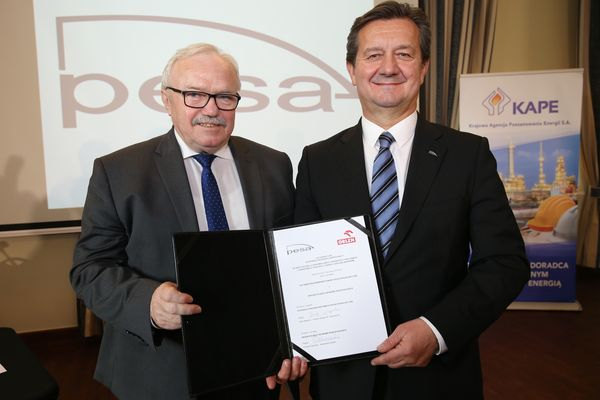
PKN ORLEN and Pesa Bydgoszcz will cooperate to develop zero-emission freight transport. The project aims to develop a rail vehicle powered by hydrogen. During a conference organized by the National Energy Conservation Agency in Warsaw, the companies signed a letter of intent in this regard.
The cooperation assumes actions for the development of zero-emission transport technology. It will include the exchange of information and research that will lead to the development by Pesa Bydgoszcz of a rail vehicle equipped with a drive based on hydrogen fuel cells. Consequently, both companies will conduct tests of hydrogen-powered rail vehicles and ultimately implement them into commercial solutions. This technology will be used both in freight locomotives and in rail vehicles designed for passenger transport.
– We are aware of the changes taking place. Like other fuel companies, we are preparing for the energy transition. That is why we are focusing our activities and investment plans on, among other things, the development of the petrochemical sector, investments in renewable energy sources, and the development of alternative fuel infrastructure. We have already made the decision to build a hydrogen purification installation, which will be built at the plant in Trzebinia, belonging to the company ORLEN Południe. The start of production of clean hydrogen fuel, which will be used to power electric vehicles, including locomotives, is planned for 2021. The letter of intent signed with Pesa Bydgoszcz, the second one this year after the Upper Silesian-Zagłębie Metropolitan Area, is another stage serving the development of transport based on ecological technology – said Daniel Obajtek, CEO of PKN ORLEN.
Hydrogen is one of the key sources of clean energy supported by the European Union in order to build a zero-emission economy. This solution is being successively implemented in all passenger and freight transport.
– Hydrogen fuel cells are a very promising technology in rail transport, and cooperation with the largest fuel producer in the region in this area gives us a unique opportunity to implement highly scalable solutions. To start with, these will be freight locomotives with hydrogen propulsion. Ultimately, we will be able to produce a completely emission-free trainset designed for passenger traffic – says Krzysztof Zdziarski, Member of the Management Board for Operations at Pesa Bydgoszcz.
– I am convinced that hydrogen-powered vehicles are the future of automotive industry. Hydrogen is a fuel that gives a chance for future generations to live in a cleaner environment. Its advantage is also a relatively long range and short refueling time, which is why using this fuel for heavy rail vehicles will be ideal. PKN ORLEN, as part of its capital group, already produces nearly 45 tons of high-quality hydrogen per hour in its production process. We sell this raw material for passenger cars at two stations in Germany. Soon, passenger car drivers in the Czech Republic will also be able to refuel with hydrogen, because UNIPETROL from the ORLEN Group will begin construction of three hydrogen stations next year. We are now expanding our potential sales market to include rail transport, which in the future will have a much greater demand for hydrogen than road transport – said Józef Węgrecki, Member of the Management Board for Operations.
Hydrogen technology is becoming increasingly popular in the rail transport sector. Recently, German carriers ordered vehicles of this type, and the German government is to cover as much as 40% of the cost of hydrogen fuel. Hydrogen fuel cell technology is most widespread in Japan and California in the United States. Poland, thanks in part to PKN ORLEN, is one of the largest hydrogen producers in the world.
Source: Pesa Bydgoszcz SA