








Intermodal transport is a branch of transport with which great hopes are associated. What is the condition of intermodal transport in Poland?
<\/strong><\/p>
 Bartosz Guszczak, <\/strong><\/em><\/strong><\/em><\/strong><\/em><\/strong><\/em>expert from the Logistics Knowledge Center at the Institute of Logistics and Warehousing<\/strong><\/em><\/strong><\/em><\/strong><\/em><\/strong><\/em><\/strong><\/em><\/strong><\/em><\/strong>: <\/em><\/em><\/em><\/em>Intermodal transport belongs to complex transport processes in which cargo is moved by transport means of different transport branches*. It should be added here that the transport of goods takes place in one and the same Intermodal Transport Unit (ITU), e.g., a container, swap body, or road semi-trailer, throughout the entire route – from the sender to the recipient, using transport means of different branches of transport.
In Poland, all branches of transport can be used to carry out intermodal shipments. However, intermodal transport is practically not carried out by inland waterway transport. The most common solution is the combination of sea, rail, and road transport.
Over the last few years, intermodal transport has been systematically increasing. However, despite the fact that better and better results are achieved year after year, the level of development of intermodal transport cannot be considered satisfactory. The share of intermodal transport in the rail market should be significantly larger. An inseparable element of this is a well-developed infrastructure: linear – railway lines, and point – container terminals. These should be railway lines meeting the highest technical parameters and a network of container terminals enabling the transshipment of the intermodal transport unit between the means of transport used. Over the last few years, an increase in the number of container terminals located in our country can be observed. The figure below presents the location of 39 existing points – container terminals, enabling the transshipment of intermodal transport units. 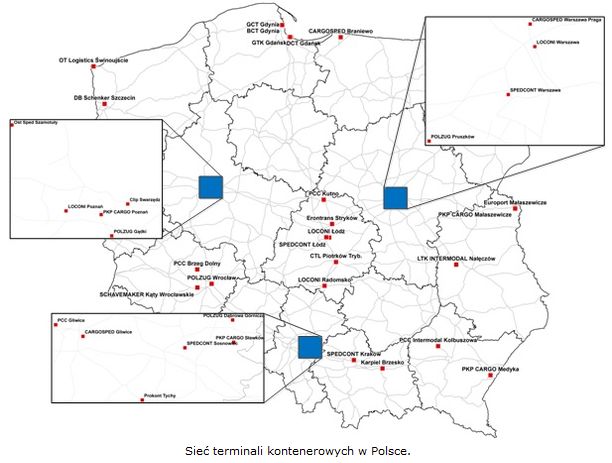 <\/p>
The year 2016 in relation to the development of container terminals should be considered stable. There were no radical closures or spectacular openings of new container terminals. Nevertheless, in the coming years, one should expect the expansion of existing terminals as well as the construction of new ones. This is connected with the new European Union financial perspective 2014-2020. Under the Infrastructure and Environment program 2014-2020, it is planned to allocate 1 billion PLN for the development of intermodal transport. The money is to be used primarily to increase the number of container terminals, as well as to increase their area and transshipment capacities. A very important element is also investments related to the improvement of road and rail access infrastructure to the terminal. All these activities make one look optimistically at the intermodal transport market.<\/p>
* Mindur L., The concept of combined transport, in: Modern transport technologies, ed. L. Mindur, Radom University of Technology, Radom 2002.<\/em><\/p>