









Your name was included on the list of 200 people who currently have the greatest influence on the Polish economy and shape its reality*. How do you assess the current situation of maritime transport in the context of the national economy?
<\/strong><\/p>
 <\/em>
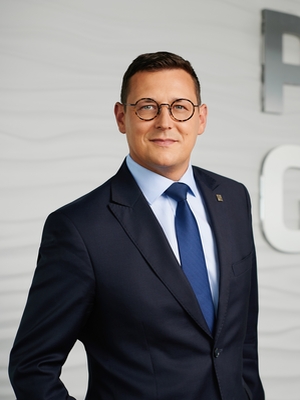
Łukasz Greinke, President of the Board of the Port of Gdańsk Authority SA:<\/em><\/strong><\/p>
Looking at the scale of maritime trade, it can be stated that virtually most industries benefit from the port’s operation. Primarily the petrochemical, energy, agri-food, and construction industries – the list goes on. Thanks to the transshipments carried out at the Port of Gdańsk, 20 billion PLN flows into the budget annually in the form of taxes, duties, and excise taxes. We are talking about revenues generated by the port infrastructure itself located at our port. The Port of Gdańsk is today a window to the world for many Polish companies that have decided to develop their business internationally. Today, 98 percent of cargo from Asia to Europe travels by sea. The unit cost of transporting goods by ship (per ton or container) is almost three times lower than the cost of rail transport, not to mention even more expensive air transport. Additionally, maritime freight costs from China to Polish ports are the same as to German or Dutch ports, from which the land transport route for goods to destinations in Central and Eastern Europe is much longer. Currently, nearly 90 percent of goods in global trade are transported by sea. These facts show how important ports are for national economies.
The degree of openness of economies to using maritime trade has been measured for over a dozen years by experts from the United Nations Conference on Trade and Development (UNCTAD), which is part of the UN. Experts agree that maritime trade contributes to establishing particularly strong links between countries and thus accelerating economic development. Half of the top ten most sea-open countries in the world are Asian nations. At the same time, Poland has been pointed out as a country that has made enormous progress in utilizing its access to the sea. I hope this trend continues. According to UNCTAD experts, the lack of direct transport options reduces bilateral trade turnover between individual countries by even more than 40 percent. Between 2016 and 2019, transshipments at the Port of Gdańsk increased by 40 percent. In 2019, we reached a record 52 million tons of transshipments. This is a historic result that shows the direction we chose a few years ago is bringing tangible results. Universal infrastructure, its quality, as well as the parameters of the vessels that can be serviced thanks to this infrastructure, determine the volumes of handled goods. At the Port of Gdańsk, we are currently carrying out investments related to both the modernization of quays and deepening of the fairway, as well as road and rail investments directly related to improving access to the port and individual terminals. All this is to create development opportunities for our contractors and thus increase transshipment capabilities.<\/p>
* Ranking of the 200 people with the greatest influence on the Polish economy in 2020 conducted by three economic editorial offices: RMF FM, the money.pl portal, and the 300Gospodarka portal.<\/em><\/p>