








Article distinguished in the 4th edition of the “Pen of the Logistician” competition.
Tool
The previously presented genetic algorithm was implemented in an application written in LCS, which made using the algorithm easier.
The previously presented genetic algorithm was implemented in an application written in LCS, which made using the algorithm easier.
Data about locations (recipient addresses, quantity of goods) are entered into the application. Of course, the algorithm also needs data about the resources it can use when determining routes. Therefore, data about available vehicles along with their load capacities are also provided.
The first stage carried out by the algorithm is creating a dataset that is easier for the algorithm to analyze, i.e., assigning each location a distance from the starting point (warehouse location) and the time required to reach it. Combinations of locations (“from” location and “to” location) are also created, for which distances and travel times are also provided. Having such a dataset, it is possible for the genetic algorithm to begin its work.
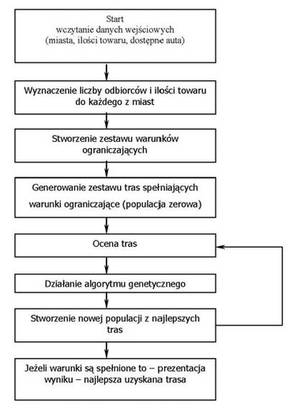
The application’s workflow diagram is shown in the figure below.
Source: Own elaboration
The result of the work is a sheet filled with a representation of locations (recipient addresses). This means that postal codes or city names for a given route are provided in a sequence, for example:
Car 1; Paweł; 5:29; 342 km
WAREHOUSE => PIEKARY ŚLĄSKIE => BYTOM => GLIWICE => RYBNIK => WODZISŁAW ŚL. => JASIENICA => WAREHOUSE
Car 2; Staszek; 7:39; 326 km
WAREHOUSE => KRAKÓW => KIELCE => TARNÓW => WAREHOUSE
During its operation, the algorithm generates a set of initial solutions called the zero population. Based on them, genetic operators such as selection, crossover, mutation, and reproduction operate. The operation of the operators depends on the fitness function. This function determines the fit of solutions to the problem with respect to the variable that is to be optimized. Based on it, using a random number generator, the best solutions are selected, on which the genetic algorithm operates. The selection of solutions for further operations is called selection.