









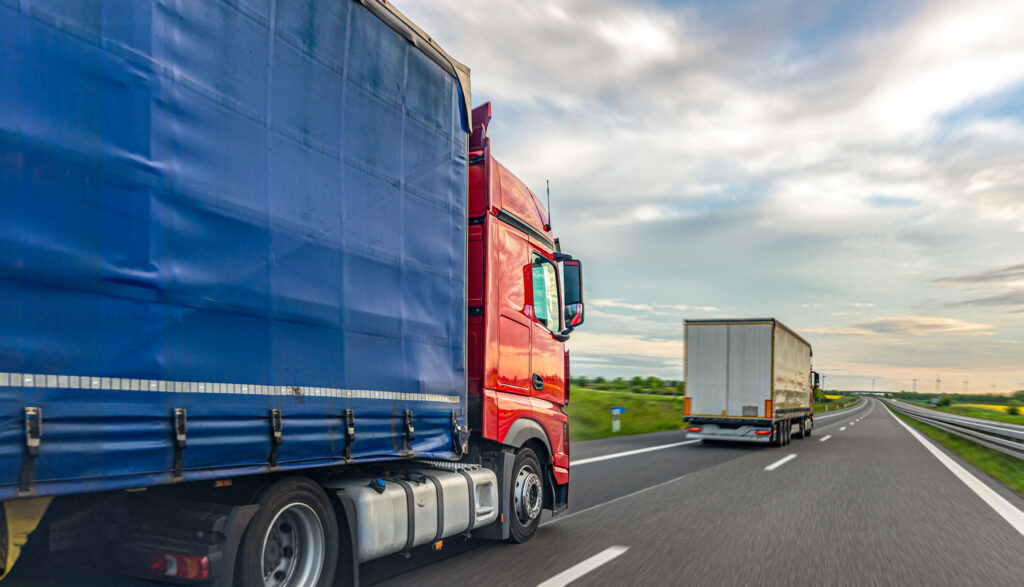
On the Poland–UK route, the fluidity of travel is usually decided not by customs formalities themselves, but by the completeness of the data provided for them. In this chain, the carrier is not just the executor of transport: in road traffic, it is their duty to file the Entry Summary Declaration (ENS), and the driver must present a reference at the port that links all declarations. Below, we organize what information to collect before the documents are sent to the customs agency.
EORI numbers: who and which one
An EORI number identifies an entrepreneur in dealings with EU customs administrations, including exports, imports, and transit [7]. A non-EU entity needs an EU EORI when, among other things, filing customs declarations or ENS declarations, or acting as a carrier — it is assigned by the country where the first customs operation is performed [7].
On the UK side, a number starting with “GB” is needed — without it, you cannot register in the GVMS system [2]. A company without a registered office in the United Kingdom also needs a GB number to submit ENS declarations to the UK [4]. In practice, a Polish carrier serving this route should have two numbers: Polish (PL) and British (GB). You need to collect the EORI numbers of both the sender and the recipient.
Export from Poland: export declaration and proof of export
The export of goods outside the EU begins with an export declaration submitted electronically in the AES system, as a rule at the office competent for the exporter’s registered office or the place of loading [8]. The goods are then presented to the office of exit, which supervises their physical departure from the EU customs territory and notifies the office of export [8].
For the carrier, the MRN of the export declaration is crucial — according to HMRC guidelines, the driver must have it for every shipment on the EU→GB route [3]. The exporter, in turn, needs the electronic message CC599C from the AES system; if it contains confirmation (and not refusal) of exit, it is the most commonly used proof of export for the 0% VAT rate [16].
Entering the United Kingdom: import declaration, ENS and GMR
When entering the UK, the duty to file an ENS declaration rests with the carrier; they may authorize a third party, e.g., a customs agency, to submit it, but only with their knowledge and based on a contract [4]. The declaration is submitted via the S&S GB service, exclusively from compatible software [4]. HMRC confirms that the transitional exemption from safety and security declarations for goods from the EU no longer applies [4].
The deadline depends on the route. For ro-ro ferry transport (with or without a driver), it is at least 2 hours before arrival, and for the Eurotunnel — 1 hour before arrival at the terminal in Coquelles. In transport with a driver, the declaration is submitted by the transport company; in transport with trailers without a tractor unit, by the ferry operator [5].
In ports supported by GVMS, the driver presents a Goods Movement Reference (GMR). It must be created for all goods in the vehicle, trailer, or container, as well as for an empty trailer [1].
The following is entered into the GMR on the EU→GB route:
- vehicle registration number (accompanied transport) or trailer/container number (unaccompanied);
- MRN of the UK import declaration from the CDS system or EORI number if the importer declares goods in their own records;
- MRN of the ENS declaration — optional in this direction;
- for transit — transit MRN from NCTS (without import declaration numbers) [1].
The driver should also check if the vehicle needs to report for an inspection — the “Check if you need to report for an inspection” service is used for this [3].
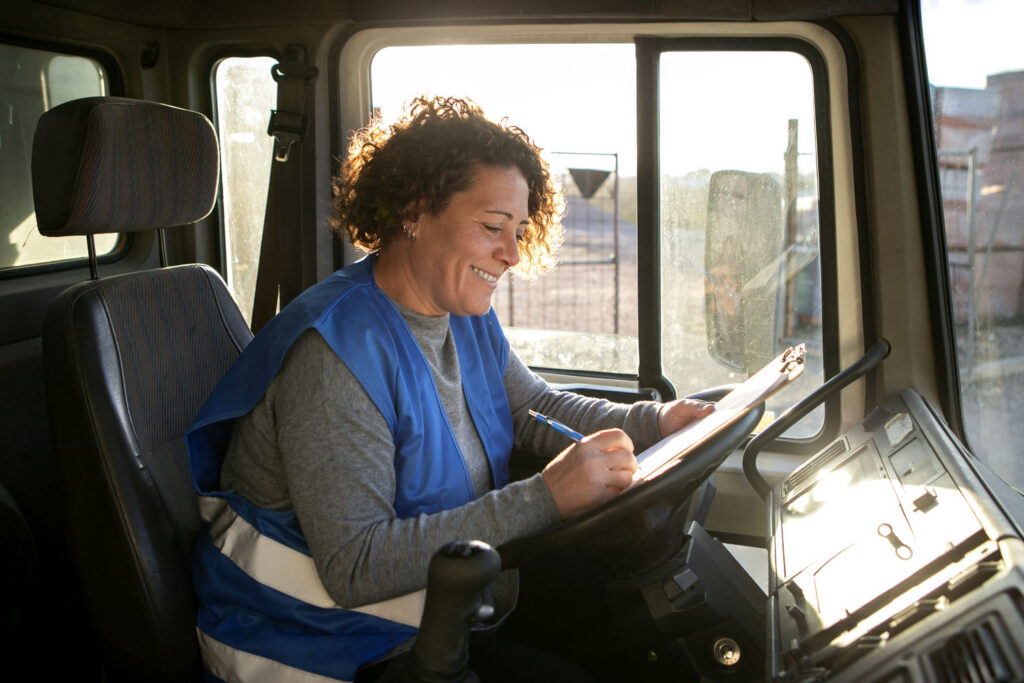
Transit T1 / NCTS: when and why a guarantee
The common transit procedure (T1) covers the transport of goods from the office of departure to the office of destination [9]. The United Kingdom is a party to the Convention on a common transit procedure [17].
A transit declaration is submitted in NCTS. Once accepted, the system assigns an MRN, and the goods are accompanied by a Transit Accompanying Document (TAD). The operation is secured by a guarantee, which is released only after the transit is closed [9]. The driver must deliver the goods to the office of destination or to an authorized consignee indicated in the TAD. If they do not report there, the release of the guarantee may be delayed [13].
Return: import from the UK to Poland
In the GB→UE direction, British export declarations (DUCR numbers) and — if required — the MRN of the entry summary declaration (EXS) are entered into the GMR. The driver cannot set off to the point of departure until all DUCRs have obtained the “Permission to Proceed” status [3].
Upon entry into the EU, the carrier files an ENS in the ICS2 system [11]. As of September 1, 2025, the system operates in all member states for all modes of transport, including road. Some countries used temporary derogations, and the Commission points out that as of June 1, 2026, every shipment entering the EU should have a valid ENS [10]. In road transport, the deadline is at least 1 hour before arrival at the office of first entry. When the truck is on a ferry, the deadline specific to the vessel applies [12].
If the ENS data is not included in the transit declaration, the MRN of the ENS declaration must be entered as a previous document in the transit declaration — the Commission warns that its absence may disrupt the transport [9].

Commercial documents
The data that the agency transfers to the declarations comes mainly from the invoice and the packing list. Therefore, it is worth collecting from the sender:
- invoice with value, currency, and delivery terms;
- precise description of goods and commodity code (HS/CN) — customs duty and VAT rates upon import, as well as whether a license is needed, depend on these [14];
- gross and net weight and number of packages, in accordance with the waybill;
- country of origin. To benefit from preferences resulting from the EU–UK Trade and Cooperation Agreement (TCA), an exporter’s statement on origin on an invoice or other document, or “importer’s knowledge,” is required [15].
What most often delays clearance
Official guidelines indicate several recurring causes of delays: missing MRN or DUCR in GMR (the driver will not be allowed on the ferry) [3], missing MRN of the ENS declaration in the transit declaration [9], and failing to report at the office of destination [13]. In practice, problems are also caused by discrepancies in weights and numbers of packages between the invoice, packing list, and waybill, as well as vague descriptions of goods that make it impossible to determine the tariff code.
Checklist for the dispatcher and driver
Before loading (dispatcher):
☐ EORI of the sender and recipient; carrier’s own EORI (PL and GB)
☐ invoice and packing list: value, currency, delivery terms, description, HS/CN codes, gross/net weight, number of packages, origin
☐ weights and number of packages consistent with the waybill
☐ decision: customs clearance at the border or T1 transit (who provides the guarantee, where is the office of destination)
☐ who and when submits ENS (GB: S&S GB; EU: ICS2) — before the deadline appropriate for the route
Before entering the port (dispatcher/driver):
☐ MRN of the export declaration (PL→GB) or DUCR numbers with “Permission to Proceed” status (GB→PL)
☐ MRN of the import or transit declaration; MRN of the ENS declaration
☐ GMR with the correct vehicle/trailer registration number — also for an empty trailer
☐ paper TAD for transit, as well as ATA/TIR carnets, if applicable
Upon arrival (driver):
☐ check if the vehicle is cleared or requires inspection
☐ in case of transit, report to the office of destination indicated in the TAD
Sources (accessed: 2026-11-14)
1. http://GOV.UK — Get a goods movement reference: https://www.gov.uk/guidance/get-a-goods-movement-reference
2. http://GOV.UK — Register for the Goods Vehicle Movement Service: https://www.gov.uk/guidance/register-for-the-goods-vehicle-movement-service
3. http://GOV.UK — Transporting goods between Great Britain and the EU by RoRo freight: guidance for hauliers: https://www.gov.uk/guidance/transporting-goods-between-great-britain-and-the-eu-by-roro-freight-guidance-for-hauliers
4. http://GOV.UK — Making an entry summary declaration: https://www.gov.uk/guidance/making-an-entry-summary-declaration
5. http://GOV.UK — Safety and security import requirements: entry summary declarations: https://www.gov.uk/guidance/safety-and-security-declarations/safety-and-security-import-requirements-entry-summary-declarations
6. http://GOV.UK— Get an EORI number: https://www.gov.uk/eori
7. European Commission (DG TAXUD) — EORI: https://taxation-customs.ec.europa.eu/customs-4/customs-procedures-import-and-export/customs-procedures/economic-operators-registration-and-identification-number-eori_en
8. European Commission (DG TAXUD) — Exportation: https://taxation-customs.ec.europa.eu/customs-4/customs-procedures-import-and-export/what-exportation_en
9. European Commission (DG TAXUD) — New Computerised Transit System (NCTS): https://taxation-customs.ec.europa.eu/online-services/online-services-and-databases-customs/new-computerised-transit-system-ncts_en
10. European Commission — Import Control System 2 (Release 3): https://taxation-customs.ec.europa.eu/customs-4/customs-security/import-control-system-2-ics2-0/import-control-system-2-release-3_en and communication from 29.08.2025: https://taxation-customs.ec.europa.eu/news/transition-ics2-release-3-complete-limited-temporary-derogations-some-member-states-2025-08-29_en
11. Regulation (EU) No 952/2013 (Union Customs Code), Art. 127(4): https://publications.europa.eu/resource/celex/32013R0952
12. Commission Delegated Regulation (EU) 2015/2446, Art. 108 and 110: https://publications.europa.eu/resource/celex/32015R2446
13. http://GOV.UK — Transporting goods into the UK under transit: step by step: https://www.gov.uk/guidance/transporting-goods-into-the-uk-under-transit-step-by-step
14. http://GOV.UK — Finding commodity codes for imports or exports: https://www.gov.uk/guidance/finding-commodity-codes-for-imports-or-exports
15. http://GOV.UK — Proving originating status and claiming a reduced rate of Customs Duty for trade between the UK and EU: https://www.gov.uk/guidance/proving-originating-status-and-claiming-a-reduced-rate-of-customs-duty-for-trade-between-the-uk-and-eu
16. http://trade.gov.pl — Export outside the European Union: easier to document export for VAT purposes (06.11.2026): https://www.trade.gov.pl/wiedza/eksport-poza-unie-europejska-latwiej-udokumentowac-wywoz-dla-celow-vat/ ; Sejm print no. 2838 (10th term): https://api.sejm.gov.pl/sejm/term10/prints/2838/2838.pdf
17. http://GOV.UK — Common transit convention countries: https://www.gov.uk/guidance/common-transit-convention-countries