









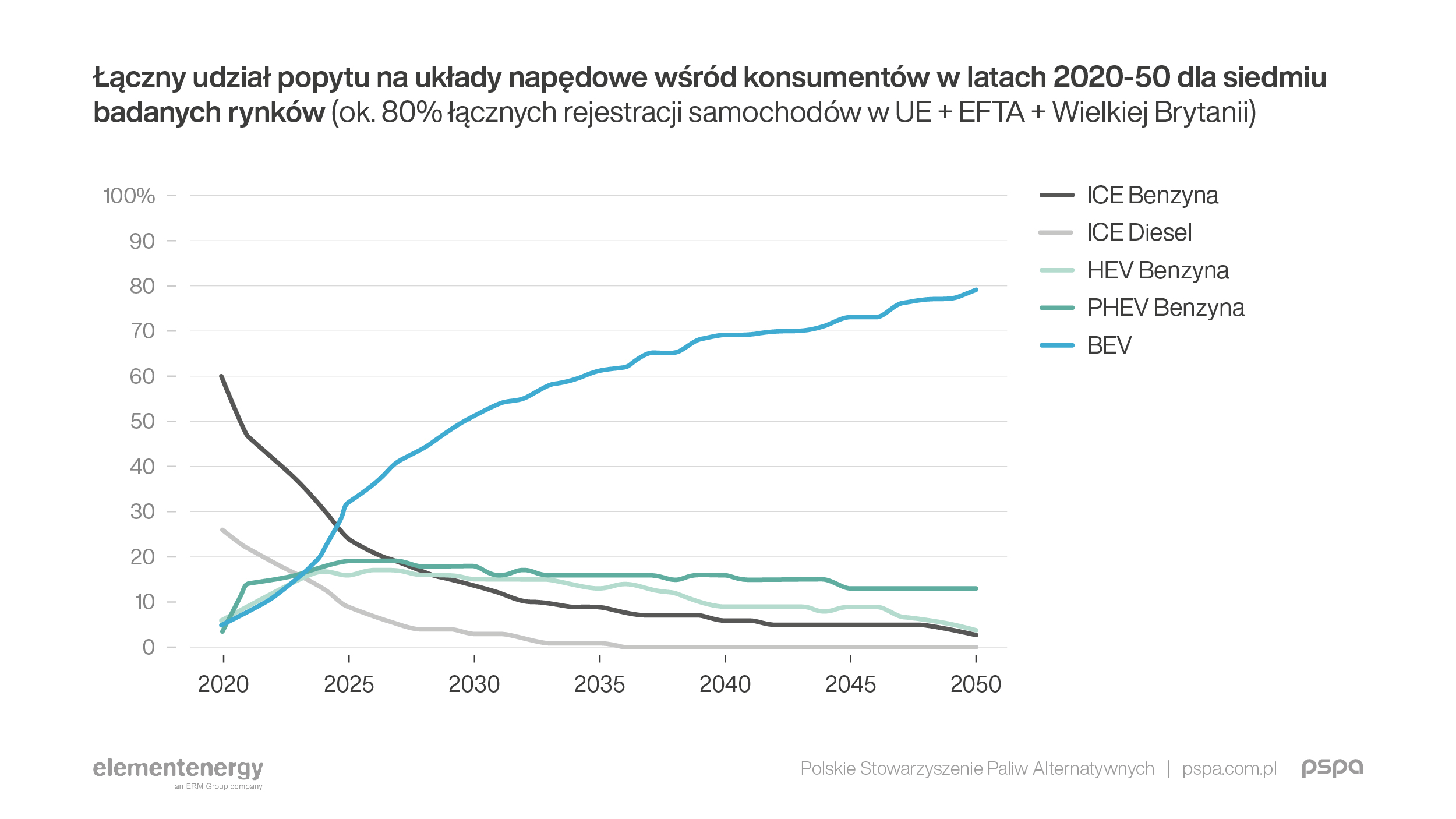
Demand for battery electric vehicles (BEVs) in Europe will rise to approximately 50% by 2030 and to about 70% by 2040, according to an analysis by Element Energy and the Polish Alternative Fuels Association (PSPA), which covered seven European markets. The authors of the report, “Electric Mobility – Is It the Only Way?”, further point out that demand for zero-emission vehicles could be boosted by approximately 30% through the early adoption of dedicated platforms, or by 8% through the intensified development of public charging infrastructure. The purchase price remains a key challenge for the e-mobility sector.
The report “Electric Mobility – Is It the Only Way?” contains a series of market development scenarios regarding demand for various types of powertrains up to 2050. The analysis covered seven European markets (Spain, France, Italy, the Netherlands, Germany, the UK, and Poland), which together account for approximately 80% of new car registrations in Europe annually.
– The consumer survey conducted as part of this report has been the largest project of its kind in Europe to date. Over 14,000 respondents, all of whom are buyers of new cars, participated in the survey. In total, over 112,000 responses were collected, which served as the basis for 35 variant analyses for each market studied – says Maciej Mazur, Managing Director of the Polish Alternative Fuels Association (PSPA).
On the course to electromobility
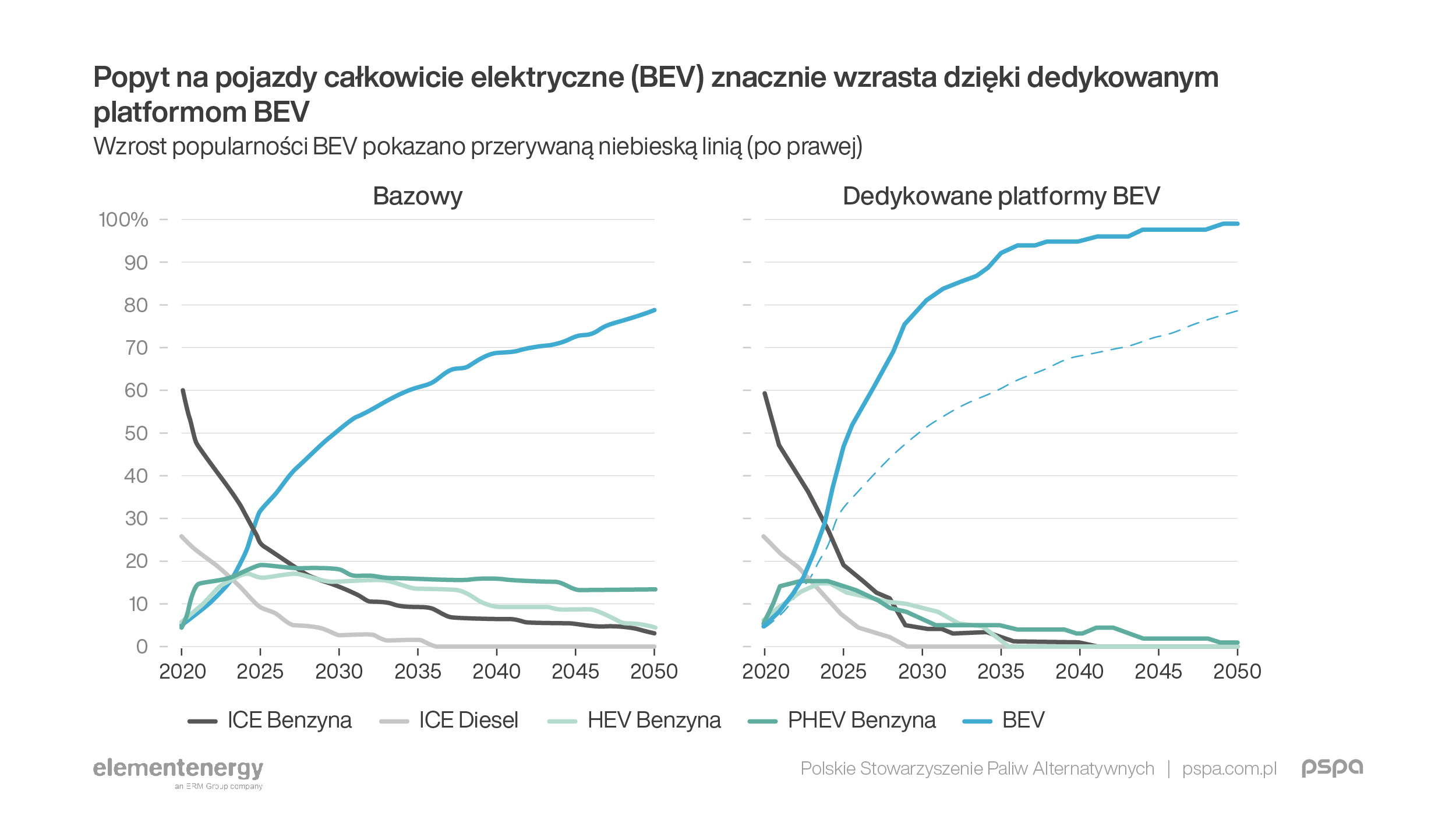
The authors of the report predict that from 2025 onwards, demand among European new car buyers for battery electric vehicles (BEVs), which accounted for about 5% in 2020, will surpass other powertrains, reaching approximately 50% by 2030 and 70% by 2040. Regarding other electrified powertrains, demand for conventional hybrids (HEVs) will peak in 2024 and decrease to below 10% by 2040. For plug-in hybrids (PHEVs), demand will rise in the short term to 20% (in 2025), driven by falling battery prices, and then decrease to 10% by 2050.
– The results of the study clearly refute the claims that European new vehicle buyers do not want to purchase fully electric cars. The key factor influencing purchasing decisions remains the vehicle price, which is largely determined by the cost of traction batteries. In this regard, we expect the downward trend observed since 2010 to continue. The report shows that BEV production costs will be reduced by 25%, and by 2028, purchase prices across all car segments will equalize. This is influenced, among other things, by lower battery production costs. Between 2010 and 2021, the cost of one kWh (lithium-ion battery) fell by 89%, and between 2020 and 2030, we can expect further declines of 58%, which, combined with EU and local regulations, could contribute to the rapid development of electromobility – comments Maciej Mazur.
Boom for electric vehicles in Poland
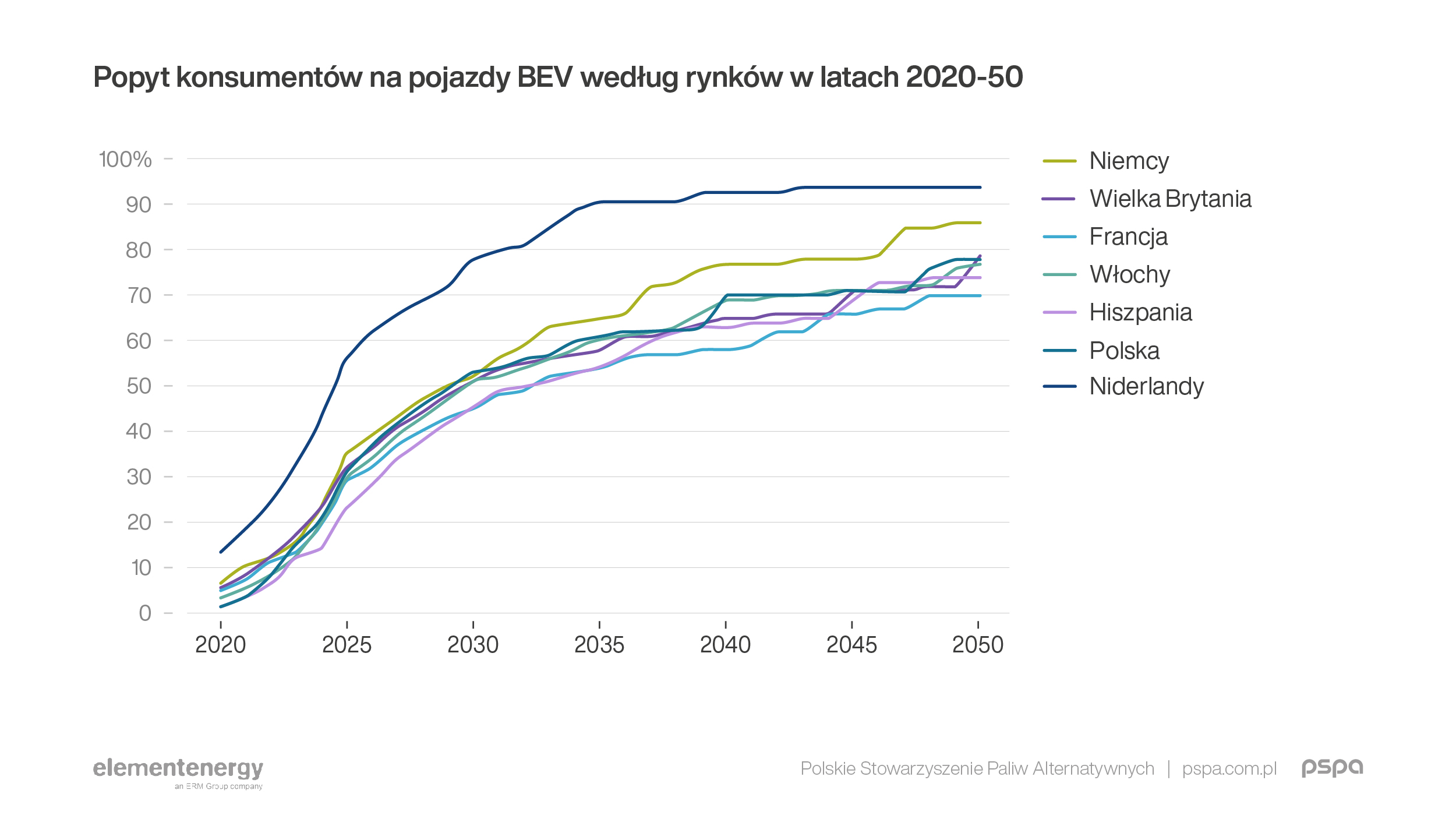
In the coming years, we can expect the Polish market to develop with a similar trend to the Spanish, Italian, British, or French markets, according to the Element Energy analysis. It is predicted that by 2025, demand for BEVs will be higher than for any other powertrain, and by 2035, it will reach between 54% and 91% of total demand for new cars, depending on the market. This is also confirmed by the latest edition of the cyclical “Polish EV Outlook” report developed by PSPA, which shows that the share of new BEVs in Poland will reach 13.9% in 2025. The growth potential of this segment was already noted in previous years. In 2021, almost twice as many fully electric cars were registered on the domestic market than in 2020, and almost four times more than in 2019.
– The fleet of fully electric cars in Poland will continue to grow, and this is an extremely positive signal for our entire market. Furthermore, the fact that we are not lagging behind the rest of Europe in terms of demand levels gives cause for optimism for the coming years. In this regard, we cannot, of course, expect sales volumes similar to those of, for example, France or the UK, where over 1.5 million new cars were sold in 2020, while in Poland it was about 0.4 million units. We must remember that the data presented in the report are percentage ratios of total sales, so the final results in our country will be several times smaller, corresponding to the pool of newly registered vehicles – comments Maciej Mazur.
Synthetic fuels are not the solution
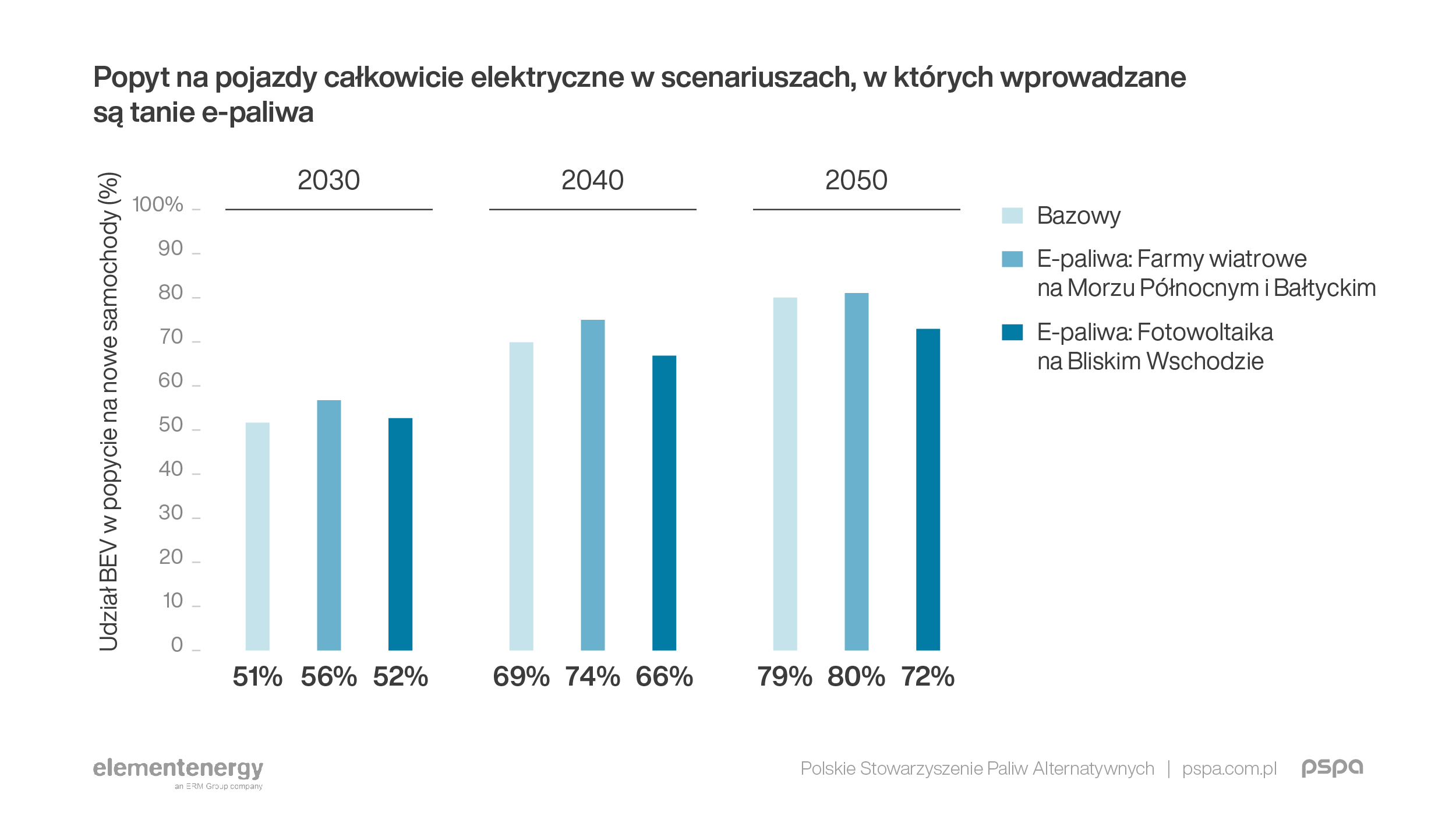
The Element Energy report also addresses the issue of e-fuels, i.e., carbon-neutral synthetic fuels produced from renewable energy sources. Even in optimistic scenarios regarding the future costs of synthetic fossil fuels, internal combustion vehicles powered by e-fuels do not represent an attractive alternative to fully electric variants in the eyes of consumers. The introduction of e-fuels increases vehicle operating costs for all consumers, encouraging new car buyers to choose fully electric variants while hitting the poorest social groups the hardest. According to the report, e-fuels could become economically viable with long-term government subsidies and the abolition of fuel taxes until prices align with conventional gasoline. However, experts assume that this could only happen by 2037. New BEVs are more cost-effective from the consumer’s perspective. According to an optimistic scenario, savings in terms of total cost of ownership (TCO) could be as high as 23% compared to conventional variants powered by e-fuels.
Factors that can increase demand for BEVs
For the purposes of the report, additional scenarios were also assumed to indicate how key factors from the consumer’s perspective, such as price or access to extensive charging infrastructure, can affect EV demand. The analyses showed that the widespread adoption of dedicated platforms for electric vehicles allows for a demand increase of up to approximately 30%, while the early development of charging points allows this indicator to be increased by 7%.
Full results of the analysis are included in the report “Electric Mobility – Is It the Only Way?”, which is available in two language versions (Polish and English) on the website pspa.com.pl:
https://pspa.com.pl/raporty/elektromobilnosc-czy-to-jedyna-droga/
https://pspa.com.pl/raporty/electric-mobility-inevitable-or-not/