









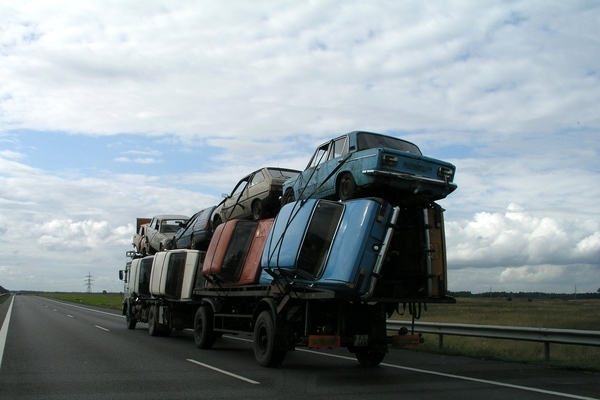
After 1989, following the introduction of market mechanisms into the Polish economy, cars from Western European countries began to enter the Polish market. Thousands of Poles started importing used cars, some of which were over a dozen years old. The Polish state attempted to prevent this situation by introducing regulations regarding the import of used vehicles.
It should be emphasized that these regulations were intended, in the view of the legislators, to prevent the import of cars that were dangerous not only to humans but also to the environment. However, in some cases, the goal was to maximize revenue for the state budget.
Companies importing used cars must comply with occupational health and safety rules. These requirements concern the technical condition of transport equipment, the organization of driver workstations, and environmental hazards. Proper transport documentation must be provided, and a professional risk assessment must be carried out for the driver’s position, as well as for loading and unloading operations.
Occupational health and safety rules for entities organizing the import of used cars
1. Technical requirements for equipment
The equipment of a roadside assistance vehicle, as well as the equipment used for importing used cars, is specified by the Regulation of the Minister of Transport and Maritime Economy of April 1, 1999, on the technical conditions of vehicles and the scope of their necessary equipment. Paragraph 38, section 1 states that a roadside assistance vehicle and a ballast tractor should be equipped with a yellow flashing warning light, visible from all sides of the vehicle from a distance of at least 150 m in good visibility conditions and not causing glare to other road users.
A roadside assistance vehicle (car transporter) should have:
– a driver’s cabin or bodywork in yellow or marked with a distinctive yellow stripe,
– bodywork structurally designed for transporting damaged vehicles or be equipped with:
– a flexible tow bar for towing a motorcycle and a rigid tow bar for towing a vehicle,
– a yellow flashing warning light with a design allowing it to be placed on the towed vehicle;
– an additional set of lights to be placed on the towed vehicle in case the lights of the towing vehicle are temporarily obscured.
Towing is covered by Article 31 of the Road Traffic Act. According to it, the speed of a towing vehicle in a built-up area cannot exceed 30 km/h, and outside it, 60 km/h. The towing vehicle must have its low-beam headlights on regardless of the time of year. The towed car must have a driver with a valid driving license (unless a specialized vehicle – a tow truck or a recovery vehicle – is towing it). The connection between the cars must be solid, preventing detachment during driving (the opposite applies to towing a motorcycle – here there should be a possibility of immediate disconnection).
The article contains 30,760 characters.
Source: Logistyka Magazine