











Managing a company involved in the distribution of goods imported from Asian countries comes with specific challenges. The nature and geographical distance of supplier countries (e.g., China, India, Taiwan, Japan, Malaysia, Vietnam, Thailand, etc.) have a significant impact on running such a business. Therefore, companies offering articles imported from outside our country often encounter the following difficulties:
1. Proper order planning due to inventory levels (surpluses – shortages).
2. Fast sales – long accounting settlement processes.
3. Overloaded warehouse – delays in shipping goods.
4. Specifics of sales to retail chains.
5. Large volume of courier shipments.
6. Equipment sensitive to damage.
Every company whose operation depends to a greater or lesser extent on imported batches of goods develops its own ways of solving the aforementioned difficulties. However, there are certain methods for dealing with them that focus on automating processes related to inventory turnover management and warehouse management.
ACCURATE ORDER PLANNING
Importing goods from outside our country makes it necessary to predict in advance which products and in what quantities will be needed by the entrepreneur in the coming weeks or months. Depending on the geographical distance from the supplier’s country and the mode of transport (air or sea), the waiting time for ordered goods can vary significantly (from a few to even several dozen days). Importers forecast order volumes based on historical sales data. However, if they order too much, it will sit in the warehouse. If they order too little, they risk running out too quickly. In such a situation, every importer develops their own ways of calculating the necessary order quantities. It is worth remembering, however, that developing such a method is significantly facilitated by an IT system. Based on historical data regarding orders, sales, and warehouse capacity, the system presents analyses that facilitate and accelerate human decision-making. Thanks to them, it is possible to forecast the required product order levels for the coming months. A well-planned and implemented system will allow for supply planning, taking into account different types and categories, as well as product sizes or the issue of replacing older models of a given assortment item with newer ones. The system minimizes the number of human errors and mistakes. It automates the collection and compilation of data necessary to make accurate decisions. It facilitates and speeds up human work. With the appropriate design of system functions, when forecasting subsequent orders, they can be converted into purchase orders sent to the supplier. All that is required is the operator’s (procurement specialist) approval of the suggested items and quantities of the ordered assortment.
FAST SALES, LONG SETTLEMENTS
The price of imported goods consists of production costs and acquisition costs. For example, when importing goods by sea, the entrepreneur pays for freight, but there are also expenses for customs duties, port storage, and transport from the port to the company’s warehouse. Let’s assume now that the goods arrived at the warehouse on Monday, and by Tuesday half of them are sent to customers. Invoices for acquisition costs will reach the distributor only after a few days, and the company wants to sell. Therefore, the delivered products are entered into stock only on the basis of the supplier’s invoice. A complication that the importer must deal with is accounting settlements specifying how much the imported products actually cost. Due to the need to subsequently track which assortment items have already been sold and which have not, at what price, and with what margin, calculating these costs is a long-term process occupying resources both on the side of accounting and warehouse staff. Such calculations are performed retroactively using correction notes and markdowns of issued goods, but they are labor-intensive and take a very long time.
Good IT systems allow for the automatic allocation of these costs regardless of whether the goods have already been issued or not. Such capabilities are provided by IT software used for sales and distribution management. In such a case, after entering invoices for additional costs into the program, the system automatically distributes them to each piece of goods and adds the appropriate value to the price of a single product. Thanks to this solution, the entrepreneur receives information immediately after entering data into the system about how much each individual product actually costs. This allows for realistic planning of the margin level and selling the goods with the profit assumed by the company.
UNLOADING THE WAREHOUSE
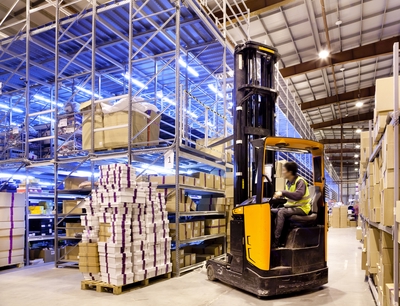 Other significant difficulties that can be encountered with importers of articles from Asia are significant warehouse congestion causing delays in fulfilling customer orders and a long waiting period for unpacking and entering goods delivered from outside our country into stock. Such situations occur very often in companies that are developing dynamically, thereby constantly increasing their product catalog and the number of shipments made to customers. In such a case, the warehouse organization cannot keep up with the company’s development – often there is a lack of space on shelves and in the warehouse hall. The solution to the above-mentioned complications is to introduce changes regarding warehouse management. A support and tool for efficient warehouse work organization is a dedicated IT system that automates most of the processes occurring in this area. The implemented system will take over the management of goods placement and will support the manager in distributing tasks to individual employees.
During order picking, the warehouse employee is supported by the system, which directs them to the locations from which they should pick a given product. Moreover, they move along an optimally designated route – so as to cover the path through all locations from which they must pick goods in the shortest possible time. In addition, a larger number of employees can be assigned to fulfill larger orders – specifically as many as needed so that the order is completed and prepared for shipment by the scheduled transport arrival time. Neither too early (then the goods take up space in the packing area) nor too late (then the transport waits for loading). The implementation of ERP-class IT software in an enterprise enables, among other things, efficient warehouse work with increased goods rotation and significantly speeds up order fulfillment.
SALES TO RETAIL CHAINS
Usually, a very favorable sales channel for distributors of products imported from outside our country is sales to retail chains. However, due to the high bargaining position of supermarkets, cooperation with such a recipient is often a challenge in itself.
First of all, due to the size of the potential sales channel, manual handling of orders from such a Client takes a lot of time and human resources. For example – after receiving a fax with an order (usually several dozen product items), it is passed to the warehouse, where it is manually checked whether all assortment items are in stock. Then, the document with the actually available products marked is directed to the accounting department for invoicing. Only then can the shipment be picked, shipping documents issued, and the goods sent to the Client. All this takes time, and the order is usually fulfilled in days, not hours – as a chain representative would like to see.
A very good solution is to implement an ERP IT system in the company, on the one hand integrating the software of various departments (e.g., finance and accounting, sales, or warehouse), and on the other hand, integrating with the IT software used by a given retail chain through the EDI system (electronic data interchange). In such a case, the supermarket system generates an order, which the distributor’s software receives electronically. The correctness of the order issuance is automatically checked, and after verification, it goes to fulfillment (in case of negative verification, a human is called to check the order document). The entire process takes place automatically – from checking warehouse stocks, through issuing appropriate documents for fulfillment (documents for release from the warehouse, shipping, invoices) to transport documents. Automating the order process allows the distributor to speed up order fulfillment and execute them in the fastest possible terms (expected by Clients), eliminates human errors, and reduces the labor required for operation. As a result, this leads to the satisfaction of chain Clients with the cooperation with the distributor (from whom they always receive goods on time) and increases the profitability of running the company.
AUTOMATED SHIPPING
In order to send goods to their Clients, distributors use various modes of transport, among which shipping via courier companies is most common. With a significant number of shipments, their handling (ordering a courier, editing waybill data in the forwarder’s program or manually, etc.) takes a lot of time. This type of typically administrative and repetitive activity engages company employees to a significant extent, who instead could deal with work requiring actual human intervention or supervision.
Therefore, it is worth automating activities consisting of recording or filling out documentation. A very good solution is to integrate the IT system – on which the distributor works – with the forwarder’s software. In such a case, there is an automatic data exchange with the courier company, which receives ready-made shipping documents compliant with its own procedure directly from the system. The distributor’s system will print appropriate shipping labels accepted by the forwarder’s systems. The system operator (customer service specialist or salesperson) selects the appropriate transport option in the system when accepting an order from a Client – which generates the appropriate shipping form automatically sent to the shipping company. The forwarder immediately receives a complete set of information – they know when, where, and in what quantity and size the goods are to arrive. Such a solution eliminates tasks that, instead of people, can be performed by IT systems designed for distribution handling or warehouse management. Instead of ordering subsequent shipments, the salesperson can fully engage in activities that can bring the company income, i.e., simply in selling the offered assortment.
ATTENTION – HANDLE WITH CARE!
 Importers of products from Asia – depending on their industry – import various types of goods. Some assortment categories are articles potentially sensitive to mechanical damage (e.g., electronics, glass and porcelain, stationery), which must be handled with care. However, a situation often occurs where a warehouse employee, while picking a shipment, places individual products on a cart or pallet one on top of the other – without any reflection – whether the assortment placed on top will not crush the items placed at the bottom – thus potentially damaging them.
Therefore, as part of modern warehouse management, solutions have been created to minimize the risk of situations where damage resulting from incorrect shipment picking may occur. Such a solution is a WMS-class IT system that manages the correct order of picking from the shelf and then packing the shipment. This takes place both at the moment of picking and transporting to the packing area, and then during the actual preparation of the shipment for sending in accordance with the customer’s order. A properly programmed system suggests and indicates to warehouse employees which assortment item should be picked first and which next. This, of course, allows for avoiding unnecessary mechanical defects of equipment while still at the distributor’s premises, as well as – thanks to its proper packing – also during transport to the client’s premises.
SUMMARY
The implementation of IT tools in a distributor’s company, aimed at streamlining and facilitating activities taking place in the company – e.g., in the areas of warehouse management, distribution, or accounting settlements – has a significant impact on the pace of tasks performed, enables faster company development, and allows for increasing the efficiency of its operation. Through the introduction of reporting and planning functions, potential difficulties are eliminated, and sales continuity is ensured. Thanks to this, distributors can serve their Clients on time and in accordance with their expectations.
Developed based on: http://www.sente.pl