








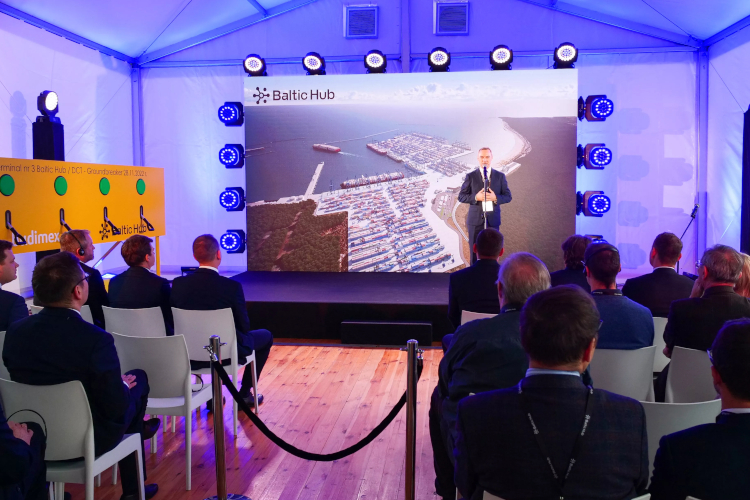
Thanks to this new investment, Baltic Hub will not only be the largest container terminal on the Baltic Sea but also one of the largest in Europe. The investment, worth approximately PLN 2 billion, will be commissioned in 2024. However, within the next few months, Poland’s land territory will expand by 36 hectares.
The ceremonial commencement of the construction of T3 – the third deep-water terminal at the Port of Gdańsk, attended by, among others, Marek Gróbarczyk, Secretary of State at the Ministry of Infrastructure, took place on November 28, 2022.
At the beginning of its operations in 2007, Baltic Hub had one deep-water terminal, reaching an annual handling capacity of 500,000 TEU. Today, it is a true hub on the Baltic Sea, with two deep-water terminals and a result of approximately 2.1 million TEU handled in 2021. The total length of the terminal’s two deep-water quays is 1.3 km, which allows for the simultaneous handling of 4 ships. Baltic Hub has become a transport gateway to Central and Eastern Europe, serving Germany and landlocked markets such as the Czech Republic, Slovakia, and Hungary. More than 600 ships call at the terminal annually, including 100 of the world’s largest container ships.
– Just 10 years ago, Poland did not appear as a significant country in container handling – said Marek Gróbarczyk, Secretary of State at the Ministry of Infrastructure and Government Plenipotentiary for Maritime Economy. – Today, we are starting a historic investment in the construction of the largest container port. I think this is not the last word, because the development plans for Baltic Hub are ambitious.
Baltic Hub CEO Charles Baker, speaking about the start of construction, assured that Baltic Hub and its partners would carry out the investment while maintaining the highest environmental protection standards.
– Baltic Hub is a true twenty-first-century terminal, where the latest generation of low-emission technology will be used, which any European port would be proud of. We emphasize once again that we will take all internationally recognized precautionary measures to protect the environment, marine life, and habitats in the area covered by the investment. This construction, from A to Z, will reflect our commitment to sustainable investment, for example, through the use of low-emission concrete and the delivery of environmentally friendly equipment – such as electric yard cranes – he assured at the conference.
Baker also added that T3 will enrich the service offering of Baltic Hub. Moreover, the company will be able to acquire new services and attract new shipping alliances, as well as reach new markets.
– By developing additional handling capacity and opening new connections, we also provide an impulse for the development of the Polish economy – he added.
Full completion of the investment is planned for the end of the second quarter of 2025. However, T3 will be open for commercial operations after the completion of the first phase of construction, i.e., in the first half of 2024. The handling capacity of Baltic Hub will then increase by 1.5 million to 4.5 million TEU (20-foot containers) per year.
36 hectares more of Poland
The construction of T3 will be divided into two stages. In the first phase, a consortium of Budimex and DEME will build a 36-hectare platform adjacent to Terminal No. 1 (T1). It will be built entirely at sea, and its construction will be completed in the first half of 2024. In the second stage, the construction of a quay wall with a length of 717 m and a depth of 17.5 m will begin. Work is scheduled to start in the first months of 2023 and will be completed in the second quarter of 2025.
The T3 project also includes the purchase of 7 quay cranes capable of loading and unloading the largest ships in the world and 20 semi-automatic RMG cranes operating in the storage yard. Operators will be able to control them remotely from ergonomically designed stations. This will allow for a safer, more efficient, more modern, and comfortable working environment 365 days a year.
– We are witnessing another milestone. After a long procedure of selecting an investor, we chose DCT Gdańsk (now Baltic Hub) as the entity that submitted the most favorable offer for us. Today, we are moving to the next stage – the start of work. We keep our fingers crossed, wish you success, and assure you of our support at every stage of the investment. I hope that in two years we will meet at the ceremonial opening of the next terminal – said Łukasz Greinke, President of the Port of Gdańsk Authority S.A.
Project partners were present at the conference.
– We have finished the design and preparatory work. It is time to start the main work on the construction of the Baltic Hub T3. Over the next few months, we will increase Poland’s land territory by 36 hectares. We have unique experience in hydrotechnical work on the largest investments in the country. We will use this knowledge and the experience of our engineers, along with equipment, in the construction of the new terminal. The construction work itself involves dredging works with a volume of over 4 million cubic meters and the construction of a mooring line over 700 m long. The T3 terminal itself will have an area of over 360,000 sq m, an operational depth of 17 m, and will be semi-automatic, which is a novelty in Poland and a trend currently present in the world – said Cezary Łysenko, Director of the Infrastructure Construction Division at Budimex SA.
– We are proud to help build this terminal, where we will perform dredging and land reclamation work. We look forward to working with our partner in the consortium, Budimex, so that the combination of our knowledge contributes to the realization of Baltic Hub’s ambitious development plans. – added Laurent Closset, Regional Director for Northern Europe at DEME.