











An interview with Marcin Czerwiński, IT Director at ID Logistics Poland
Tomasz Janiak: The extremely dynamic development of e-commerce, manifested by spectacular growth, has accelerated the evolution of IT systems necessary to handle the streams of goods flowing through a warehouse. In this context, how do you perceive the functionality and implementation aspects of today’s WMS?
Marcin Czerwiński: Indeed, over the last few years, B2C has become the main distribution channel, the development of which was accelerated by successive lockdowns introduced in 2020–2021. For ID Logistics, e-commerce is currently a strategic direction for development and an area for providing sustainable solutions for clients. WMS systems used in the e-commerce distribution centers we manage had to be expanded with additional functionalities, which allows us to fully process our clients’ orders and adapt even better to serving them.
T.J.: Another aspect of IT solutions in warehousing and distribution is efficiency. To what extent, in your opinion, can the choice and operation of a specific integrated warehouse management system influence the operating margin for logistics operators on one hand, and the level of customer service on the other?
M.C.: Choosing the right WMS is one of the most important aspects affecting efficiency. The key here is to design an optimal process tailored to the client’s requirements. Furthermore, one must remember that not every WMS will be the best solution for every process. Therefore, the ID Logistics Group has certified four market solutions and, based on conducted analyses, classified which WMS is best for a given industry and a given distribution channel. Thanks to this, we can provide dedicated solutions that are effectively adapted and tailored to a specific project.
T.J.: In a very short time, literally over the last few years, we have been dealing with an increasing number of devices, whether mobile or stationary, installed in distribution centers. Basically, in almost every “traditional” warehouse area, we see a major acceleration. On top of that, there is an increasingly important area, which is returns management. How does ID Logistics process returns, primarily from the IT perspective?
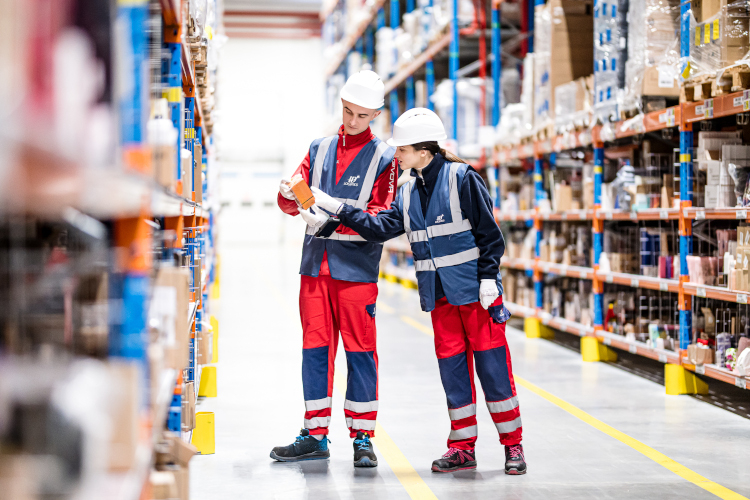
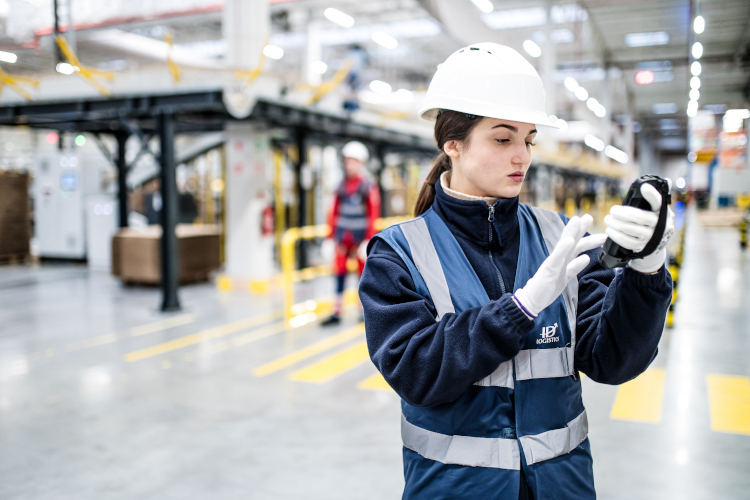
M.C.: The last few years have also been a period of replacing scanners (mobile terminals) with the latest models that fully utilize the capabilities of the Android system. Mobile scenarios are now more intuitive and similar to everyday smartphone usage. Thanks to this, the onboarding of a new employee is more effective, and productivity is much higher than average. ID Logistics has dedicated RMS (Returns Management) modules and specializes in processing returns from e-commerce customers. We are increasingly launching warehouses 100% dedicated to handling only this process. We manage them using appropriately adapted IT systems, also introducing support for a range of value-added services (VAS). An example could be assessing the condition of goods, refreshing them, and repairing them when possible, e.g., using ironing stations or re-labeling (sewing).
T.J.: As far as I know, in 2022, ID Logistics decided to expand its cooperation with the current supplier regarding solutions for transport management. What solutions does ID now have for processing transport shipments, particularly for distribution?
M.C.: For ID Logistics, transport is just as important as contract logistics, which is why our TMS team provides solutions that also optimize processes for transport operations. In 2021–2022, we reviewed transport solutions available on the market to verify them against the expectations of our operations. We decided to continue cooperation with our existing TMS system provider, while we designed and implemented a number of improvements and new functionalities, particularly for the distribution network. This enables us to continue developing in this transport channel.
T.J.: Let’s move to the operational level now and talk about the mobile applications you are implementing. How can the functionality of web applications introduced at your locations be briefly characterized at three levels: administrator, shift leaders, and warehouse employees?
M.C.: Along with the transition to smartphone-class scanners, ID Logistics has also developed further mobile applications, fully utilizing new hardware capabilities. At the same time, this was a starting point for us to analyze current processes based on scanners and an impulse to prepare additional improvements. They were designed and implemented together with WMS suppliers. We also took on transport solutions, both for drivers and transshipment hub employees. From an administrator’s point of view, an important achievement was the implementation of an MDM-class system. On one hand, this allowed us to automate scanner configuration management, and on the other, it enabled our helpdesk to provide assistance more efficiently. From the shift leaders’ level, a major improvement is the dashboards designed for them within Business Intelligence tools, which allow for better management of the subordinate team and reacting in situations of deviations from the plan. In turn, a major improvement for warehouse employees is the full intuitiveness of Android-based solutions.
T.J.: What qualifications and competencies must members of teams responsible for implementing increasingly sophisticated logistics software in logistics centers have, and at various levels – from making strategic decisions related to software selection to ongoing operation?
M.C.: The golden mean here is an interdisciplinary project team consisting of both experts with technical education and operational experience. Thanks to competencies such as understanding business requirements and specifics, soft skills that improve communication with clients and colleagues, while maintaining assertiveness, we are able to better implement the designed systems. Analytical thinking and creativity in designing solutions are also very important. Thanks to this, we provide an ecosystem of connected and highly advanced IT systems that collectively create a comprehensive solution.
T.J.: Let’s look into the future. If we were to analyze trends in the area of information and communication technologies used in the warehouse, what in your opinion will be the biggest challenge for development teams, suppliers, and solution integrators, but also for logistics operators?
M.C.: In my opinion, by far the biggest challenge will be “taming” artificial intelligence. In recent months, this has been the fastest-growing technological area. The challenge for us will be the development of systems that can work with AI as add-ons, or even as the heart of the application. The goal will be to prepare the best possible transport and warehouse solutions that will accelerate and improve daily operational work.
Article originally published in the magazine LOGISTYKA 6/2023.