











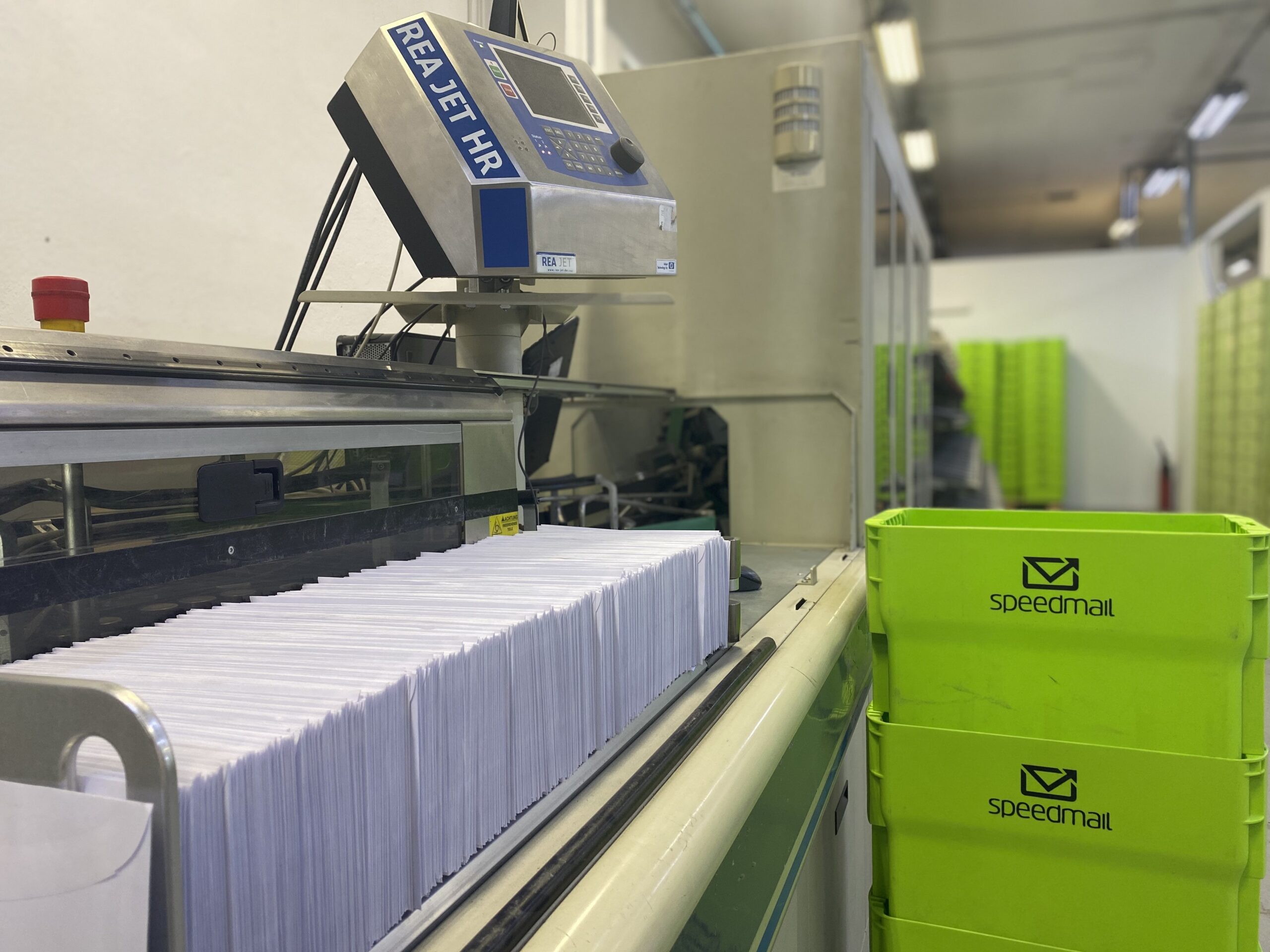
Over the last 15 years, the Polish postal market has undergone fundamental changes: from a partial monopoly on letter mail, through opening up to competition, to the spread of digital communication. With the progress of digitalization, the number of letters sent has decreased. Back in 2014, operators handled nearly 1.5 billion letter items1, and in 2025 as few as 731 million2 – more than half less. Despite this, traditional correspondence still plays an important role, especially in the communication of companies and institutions with recipients. In these changing realities, Speedmail, the largest independent postal operator in Poland, which celebrates its 15th anniversary this year, has been growing.
Originating from Piotrków Trybunalski, Speedmail reaches over half of Poland’s residents with its services through its own distribution network, covering more than 100 locations across the country. The company also handles international shipments, which, thanks to cooperation with foreign postal operators, can reach recipients in Europe and around the world. The company specializes in handling business, institutional, and marketing correspondence. Its services are used by, among others, banks and financial institutions, telecommunications operators, city offices, water supply companies, insurance firms, and foundations.
The history of Speedmail is, in a sense, a reflection of the changes that have taken place in the Polish postal market over the last 15 years. We started our operations in 2011, in the era of Poczta Polska’s partial monopoly. Later, we witnessed the opening of the market to competition, and today we function in a reality where digitalization is redefining the role of traditional correspondence. Contrary to market trends defined by the falling number of letter shipments, we are consistently developing, increasing our territorial reach as well as the number of branches and clients.
– says Janusz Konopka, CEO of Speedmail.
From a partial monopoly to an open market
A breakthrough moment for the Polish postal market was January 1, 2013. That was when the new Postal Law came into force, implementing the EU Directive 2008/6/EC, which aimed at the full opening of the postal services market to competition3. This abolished the reserved area for Poczta Polska, which covered letter items weighing up to 50 grams. Independent operators, such as Speedmail, gained the opportunity to compete also in the segment of the lightest letters, and companies and institutions gained a wider choice of postal service providers.
It is worth remembering that independent postal operators were active in Poland even before the full opening of the market. In 2012, there were 153 of them4, and two years later, 1655. These were both local companies and entities operating on a larger scale. However, the removal of legal barriers alone did not guarantee success. The market quickly verified the business models of many operators, and not everyone managed to sustain their operations. Over these 15 years, we have not only remained on the market but have consistently developed our delivery network and adapted our services to the needs of companies and institutions. This shows that in the postal industry, what counts is not just the ability to seize new opportunities, but above all the capacity for long-term development.
– says Janusz Konopka, CEO of Speedmail.
Liberalization, however, was only the beginning of changes. In the following years, the development of electronic communication limited the demand for traditional letters, while the growing popularity of online shopping drove the courier segment. The scale of e-commerce development in this short period is shown by data from Statistics Poland (GUS) – in 2013, 31.6 percent of Poles aged 16 to 74 shopped online6, and in 2025, 69.7 percent7. In the face of these changes, letter operators had to adapt their business models to new realities. Specialization in handling business and institutional correspondence, efficient organization of deliveries, and the use of technology to track shipments became increasingly important.
Technology changes the way letters are delivered
Changes in the postal market concerned not only the number of letters sent but also the way they were handled. With the development of technology, tools enabling shipment tracking and verification of the delivery process became increasingly significant. Especially for companies and institutions carrying out mass mailings, access to information about the progress of the entire process became essential.
Over the last 15 years, not only have the needs of senders changed, but so have the technological capabilities of postal operators. When we started our operations, shipment tracking was primarily associated with registered letters. We began to develop solutions allowing for the monitoring of ordinary letters and marketing correspondence as well. We implemented, among others, the Speedmail Targeo Report system for analyzing postmen’s routes, and in 2020 we launched online GPS monitoring. This solution was recognized by the Polish Logistics Society, which was a confirmation for us that technologies can realistically change the way traditional correspondence is handled.
– explains Janusz Konopka.
Digitalization changes the role of traditional letters
Despite the progress of digitalization, paper correspondence remains an important channel of communication with recipients. This is confirmed by the results of a study conducted in 2024 by the Ariadna National Research Panel commissioned by Speedmail. As many as 79 percent of respondents believed that some items should still be delivered the traditional way. Moreover, 68 percent of those surveyed advocated for maintaining the paper form of official letters, and 61 percent – court documents8. This shows that although private letters are giving way to electronic messages, paper still plays a significant role in formal communication.
The future of the postal market does not lie in the competition between paper and electronic communication, but in the skillful combination of both channels. We are handling more and more matters digitally, but in contacts with companies and institutions, a traditional letter still has its application. However, expectations regarding its handling are changing. Today, senders need not only efficient delivery but also transparency of the entire process. That is why we see the future of postal services in the further use of technologies that allow combining traditional delivery with modern correspondence management.
– summarizes Janusz Konopka.
1 “Report on the state of the postal market in 2016” by the Office of Electronic Communications.
2 “Report on the state of the postal market in 2025” by the Office of Electronic Communications.
3 “Report on the state of the postal market in 2023” by the Office of Electronic Communications and Directive 2008/6/EC of the European Parliament and of the Council
4 “Report on the state of the postal market in 2012” by the Office of Electronic Communications.
5 “Report on the state of the postal market in 2014” by the Office of Electronic Communications.
6 “Information society in Poland in 2013” by Statistics Poland
7 “Information society in Poland in 2025” by Statistics Poland
8 Study by the Ariadna National Research Panel conducted for Speedmail. N=1145 people. Quotas selected according to the representation in the Polish population aged 18 and over for gender, age, and size of the place of residence. Completion date: May 17–19, 2024 — method: CAWI.
Source: Speedmail