








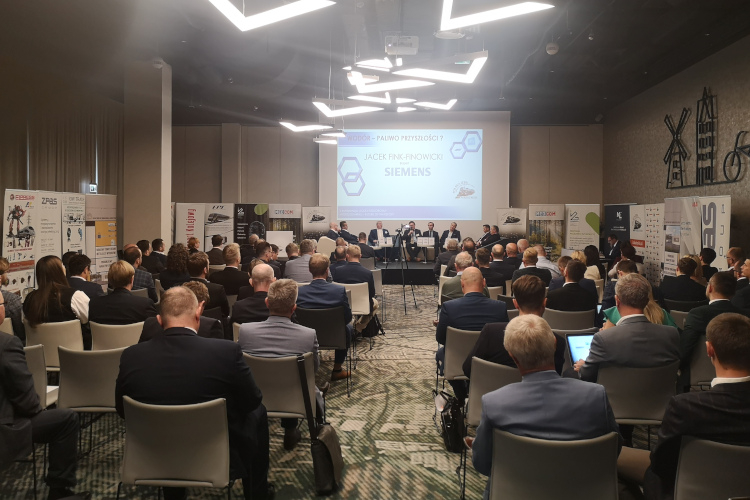
The second edition of the “Hydrogen Railway. Hydrogen4Rail Future of Transport” conference is now behind us. A strong highlight concluding this extremely important event – not only for manufacturers and operators of rolling stock and railway infrastructure – was an interesting debate titled “Is hydrogen the fuel of the future?”
Seven representatives of companies from the railway industry: Pesa Bydgoszcz (Krzysztof Zdziarski), Siemens Mobility (Jacek Fink-Finowicki), Alstom (Artur Fryczkowski), H. Cegielski FPS (Maciej Andrzejewski), ML System (Paweł Kwaśnicki), PKP Energetyka (Piotr Obrycki), and PKP Intercity (Jarosław Oniszczuk) shared their initial experiences in the field of hydrogen technology, the conditions for its implementation, and the adaptation of rolling stock and infrastructure for the operation of hydrogen-powered rail vehicles. There was also reflection on the economic aspects of the railway transformation in Poland, capital expenditures and the profitability of using hydrogen vehicles, as well as the necessity of taking educational actions in this area, aimed at training the personnel necessary to operate the locomotives.
The participants of the debate agreed that the pursuit of low-emission railways is a consequence of technological development, while hydrogen propulsion itself is a reasonable alternative to diesel vehicles, despite various scenarios regarding the timing and conditions of operating hydrogen as a power source in rail vehicles. In this context, experts pointed out, for example, the depleting oil reserves and other global factors, as well as pressure from manufacturers for changes towards achieving ecological goals at the European level.
Company representatives do not forecast dynamic development of the hydrogen market, but rather its slow, linear growth, which will be visible in the implementation of specific projects by individual manufacturers. A significant example of such action – appreciated by the panel participants – is the hydrogen shunting locomotive produced by Pesa from Bydgoszcz.
An important voice in the discussion was the statement by one of the participants: – The operation of hydrogen vehicles itself is not a problem, and its costs are comparable to an electric vehicle. The condition for success is the availability of hydrogen. In Poland, we are at the beginning of this road.
“Is hydrogen the fuel of the future?” is the first very fruitful debate this year in Poland by a representative group of experts, important primarily from the point of view of setting standards, defining solution scenarios, and development perspectives for the railway hydrogen market.
The organizer of the entire event was the Polish Chamber of Railway Equipment and Services Manufacturers, the substantive patronage was provided by Łukasiewicz-PIT, and the media partners included the Media Logistyka editorial team.