










Data from two independent sources point to a clear recovery in both the global and European contract logistics markets. The improvement following the declines in 2023 is expected to be visible in global sea and air freight, as well as in European road transport. Ultimately, the condition of the TSL sector will be determined by key growth factors, including GDP dynamics, inflation, fuel prices, access to financing, and the situation in the industrial sector, with the final major unknown being the developments in the Red Sea.
Things are looking up, but very slowly
The projected improvement in global economic conditions heralds a rebound in all major areas of the logistics sector this year. Despite the fact that the beginning of the year was marked by severe disruptions to goods flows and a sharp rise in freight rates resulting from the situation in the Red Sea, the current estimates regarding global GDP and trade still look relatively optimistic, even in the face of numerous threats and hindering factors.
In January, the International Monetary Fund (IMF) estimated in its updated economic forecast that this year’s global GDP growth would reach 3.1% and 3.2% in 2025. Although this is a 0.2% improvement compared to the October forecast for 2024, it is still below the historical average of 3.8% for the years 2000-2019. Among the main risk factors, the IMF mentions the transport crisis in the Red Sea, which is slowing down the global supply chain for goods and energy raw materials. With the continued attacks on the commercial fleet, this could affect the results of global trade, whose growth was estimated at 3.3% in 2024 and 3.6% in 2025. In both cases, these are indicators below the historical average of 4.9%, although from the perspective of emerging from a slowdown while facing an increasingly stringent global sanction regime weighing on trade flows, this is still very good news. Trade growth looks decent even in the context of data collected by Global Trade Alert, which shows that in the years 2022-2023 alone, countries imposed approximately 6,200 trade restrictions on each other. In 2019, there were about 1,100.
Good news for the global logistics sector
According to the IMF, average oil prices are expected to fall by 2.4% in 2024, and prices of non-fuel commodities by 0.9%. Inflation will also ease, falling to 5.8% in 2024 and to 4.4% in the following year. In 2023, it averaged 6.8%. Interest rates controlled by the FED, ECB, and the Bank of England will remain at their current levels at least until the second half of this year, but will be lowered as inflation weakens.
Of the many factors important to the health of logistics, somewhat closer to the Polish economy, it is worth noting that the IMF forecast suggests the Eurozone GDP will begin to rise from the bottom. While estimates for 2023 speak of growth at a level of 0.5%, this year it is expected to be 0.9%, and 1.7% in 2025. The regeneration of the Eurozone economy will be driven primarily by strong household consumption, the easing of the price shock in the energy market, and falling inflation. Our country’s economy will also revive, partly due to increased consumption. The Fund estimates this year’s economic growth in Poland at 0.9% and at 3.2% in 2025. The estimate for 2023 is currently at 0.6%, although the Central Statistical Office (GUS) recently assessed the condition of the Polish economy last year much more harshly. According to preliminary GUS data, the domestic GDP grew by only 0.2% in 2023, with domestic demand experiencing the most significant decline (-4.1%). It is expected to be definitely better this year. Estimates from the PIE (Polish Economic Institute) show that the market consensus for Polish economic growth this year oscillates around 2.8%, and 3.3-3.4% in 2025.
How forecasts affect global, European, and Polish contract logistics
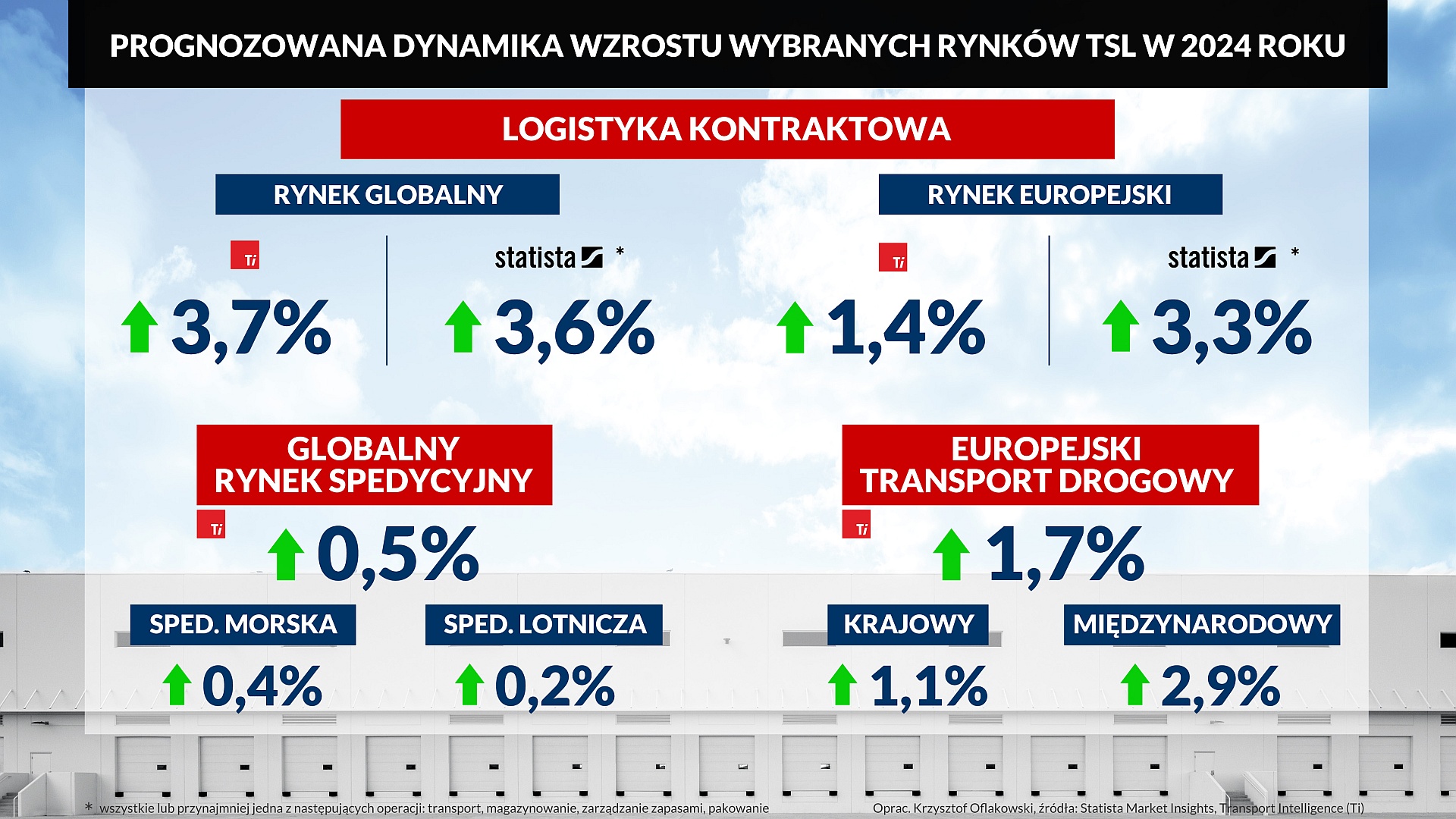
Regarding this year’s contract logistics market, analysts from both Transport Intelligence and Statista Market Insights have ventured their own forecasts. According to the former (a December forecast), the global contract logistics market recorded its lowest annual growth in 2023 since 2016. The market grew by 2.4%, but is expected to accelerate by 3.7% this year. This will be the fastest pace of growth since 2021. As for the average annual dynamics from 2022 to 2027, it will amount to 3.8%. At the end of the forecast period, global contract logistics will be worth over 329.5 billion euros, while this year it will be 290.9 billion euros. Decisive growth factors will be economic results, including primarily GDP, inflation, interest rates, and as standard, the geopolitical situation—essentially the full package of predictive assumptions published in January by the International Monetary Fund.
Where to expect the greatest growth?
Regional sector dynamics point to a clear lead for Asia-Pacific. The economies of this part of the world, led by China, will be the driving force of global contract logistics. This year’s value of services provided by Far Eastern operators will reach nearly 119 billion euros, with a 6.5% growth. Far behind will be Europe with over 81.8 billion euros in revenue and 1.4% growth, and North America (led by the USA), which will generate 72.2 million euros in revenue with a 1.9% growth. The podium layout will not change until 2027, with the one note that Asia-Pacific will increase its advantage over other regions, and the revenue structure will shape up as follows: Asia-Pacific 146.6 billion euros, Europe 86.6 billion euros, and North America 77 billion euros.
It is also worth adding that regarding last year, of the three major markets, only Asia-Pacific maintained growth (6.1% y/y). Ti’s calculations show that in both Europe and North America, the market shrank by 0.3% and 0.2% y/y, respectively.
As in previous years, this year the largest slice of the European contract logistics pie, despite very weak economic results, will belong to Germany. The value of services provided by our western neighbor will reach just under 18.9 billion out of more than 81.8 billion euros, or 23% of the entire market. Subsequent places in 2024 will be held by: the UK 18.4 billion (22.5% of the market), France 10.9 billion (13.2%), the Netherlands 6.9 billion (8.4%), and Italy 5.5 billion (6.8%), followed by Belgium, Spain, and other countries.
Despite the decline in the dynamics of global revenues and even the shrinkage of the European contract market, not all players complained about an excess of free time and production capacity. Some operators on the Old Continent, despite the slowdown visible especially in the second half of the year, performed quite well.
“We closed the last quarter of the year with revenue growth of 14.5% and 11.9% on an LFL (like-for-like) basis, i.e., with the same base, without acquisitions, mergers, or launching new facilities during the year. Ultimately, this translated into an annual revenue growth reaching 10.7%. Considering the not-so-good economic condition of Europe, where 10 international branches of our group are located, this is a result that clearly stands out in a weakened contract market. The merit of such good results, besides the successful last months of 2023, was also the launch of 22 new facilities, most of which were located in Europe. Among the European markets, Poland, Italy, and the UK deserve special attention, thanks to which we managed to achieve 10.5% LFL growth in Q4. Also significant for the final revenues was maintaining the development strategy in the asset-light model and the implementation of contracts for large players, undisputed leaders in their industries. Operational efficiency combined with retail, e-commerce, fashion, consumer goods, and luxury goods handling brought the desired results even in difficult times. We are convinced that with the improving purchasing power of European consumers, the chosen specializations will be important growth factors this year as well. We are simultaneously aware that the situation in European logistics is becoming complicated and will not be without challenges, which we have been closely monitoring since the beginning of 2024 and for which we are prepared,” says Carlos Tavares, Chief Financial Officer (CFO) at ID Logistics Poland, which provides comprehensive logistics and transport solutions, e-commerce handling, and supply chain management in 18 countries.
Other forecasts also show an increase in market value
Analysts from Statista Market Insights are also looking at the dynamics of the contract market. According to data published in December 2023, the global market for logistics services provided by external operators, i.e., so-called Third Party Logistics (3PL), will be worth 1.31 trillion dollars this year, which is a 3.6% increase compared to 2023. Statista researchers estimated last year’s growth at 2.6%, however, it should be noted that the analysis covered only specialized operators providing all or at least one of the following operations: transport, warehousing, inventory management, packaging. Although a number of service models, including 4PL and 5PL, were omitted in the analysis, they still obtained a similar growth dynamic as in the Ti study (i.e., 2.4% in 2023 and 3.7% in 2024). Data published by Statista shows that over the next four years, the sector will reach an average annual growth rate of 2.39% and will be worth 1.44 trillion dollars in 2028.
Looking at individual players, China will be unrivaled when it comes to this year’s revenues. The value of their market will amount to 328.8 billion dollars. In second place, with a result of 294.5 billion dollars, will be the United States. In 2028, the layout on the top two places of the podium will not change. As for the European market, estimates are significantly more modest. The entire market this year will generate 279.8 billion dollars, an increase of 3.3%. Average annual growth until 2028 will amount to 2.61%, and the market itself will record 310.2 billion dollars in revenue.
Again, despite troubles, the clear European leader is and will remain Germany, where the 3PL market will reach revenues of around 41.01 billion dollars this year. That is 14.66% of the entire European market. By 2028, the estimated average annual growth will reach 2.22%, and in 4 years, German operators will reach revenues of 44.77 trillion dollars, which will constitute 14.43% of the entire sector in Europe.
Despite the dynamic development of logistics services in Poland, we still fall short compared to our western neighbors. Although our medium-term growth rate is almost twice as high (4.17%), this year our domestic 3PL market will reach revenues of only 7.72 billion dollars. In 2028, it will be 9.09 billion dollars. The entire Polish 3PL is therefore less than 19% of the German market and only 2.76% of the European one.
Revival in Europe is coming, but it will be worse first
In the second half of January, analysts from ING forecasted that in 2024, the European transport and logistics sector faces relative normalization in terms of demand, although due to the situation in the Red Sea, the beginning of the year will not avoid turbulence. Especially the weak condition of the German economy and industry continues to affect the demand for industrial goods, which logistics operators need for growth. It is worth emphasizing that the industrial sector is one of the most important growth factors for the entire TSL sector.
At the beginning of February, the ING prediction was confirmed by PMI readings, not only for Germany but also for the Eurozone and Poland. As a reminder, the Purchasing Managers’ Index (PMI) is a composite index based on five individual indicators covering: new orders, production, employment, delivery speed, and purchased stocks. A PMI value above 50 indicates growth, while below 50 indicates a decline in industrial activity.
As for Poland, the index amounted to 47.1 points in January, a decrease from 47.4 points in December. This is the sharpest decline since October 2023 and confirmation of eroding business conditions in the Polish industrial sector at the start of the year. The industrial PMI value has remained in negative territory for 21 months in a row, which is the second longest negative sequence in the history of the study, i.e., since 1998. In January, the number of new orders and the volume of production fell. Purchasing activity also weakened, and to make matters worse, the crisis in the Red Sea caused the longest delivery time extension since August 2022. For consolation, only a slight decrease in employment and stocks was recorded, and the forecasts regarding the next 12 months were the best since February 2022.
In January, the main source of export weakness in domestic surveys was the German direction; however, the preliminary PMI reading for German industry reached 45.5 points, the best in 11 months, which may indicate that the worst is already behind German producers. If this trend continues, the conditions for Polish producers will also improve, and subsequently, for the logistics sector. Just like in the rest of Europe, producers from Germany reported delivery delays from Asia in January. In a broader perspective, industrial PMI also rose in the Eurozone, from 44.4 points in December to 46.6 points in January, although delivery time lengthened for the first time in a year.
What about other areas of the TSL market this year?
According to Ti’s November calculations, the global forwarding sector shrank by as much as 5% in 2023 compared to 2022. The main culprit for such large declines was sea freight, which recorded a 5.3% decline. Air freight did not fare much better (-4.5%). Lower demand, economic slowdown, and the same factors that slowed down the entire global logistics also manifested in this area.
The situation is expected to improve this year, and global forwarding, in the face of falling inflation, better economic forecasts, and the vanishing prospect of a major recession, is expected to achieve slight growth of 0.3%. The sea transport market is expected to grow by 0.4%, and air by 0.2%. Little impressive, but still growth, is also expected in the medium term. In the years 2023–2027, the entire global market is expected to reach an average annual growth rate of 1.5% and a value of over 399 billion euros. Sea freight is expected to grow on average by 1.2% annually until 2027, while air freight by 1.8%.
Road transport also without crazy growth
Spectacular growth is not predicted in road transport either, especially in Europe, where the economic slowdown was more severe than in the Asia-Pacific region and North America. This year’s real growth of the road transport sector on the Old Continent was estimated by Transport Intelligence at 1.7%, and its value at the end of the year is expected to reach over 456.1 billion euros, of which domestic transport is expected to grow by 1.1% (to 313.5 billion euros), while international by 2.9% (to 142.6 billion euros).
Also in the medium term, regeneration after the slowdown will proceed relatively slowly. Average growth of 1.7% is expected to result in a value of the European road transport market at a level of 490.5 billion euros in 2027. Analogously to current estimates, international transport will develop slightly faster, at an average rate of 2.2%. Domestic transport will speed up to 1.5% on average annually.
There will be no shortage of development barriers for Polish companies
At the beginning of February, the National Bank of Poland announced that banks plan to tighten criteria for short- and long-term lending for large enterprises in Q1 of this year, and at the same time, stricter conditions for long-term loans for SMEs and consumer loans. The NBP also stated that banks expect an increase in demand for all types of corporate loans.
Such an announcement does not look very encouraging in light of current GUS analyses, which show that the higher cost of obtaining financing is one of the main factors that will affect the total operating costs of companies in the transport and warehousing sector in Poland. In the January business climate survey, 44.4% of entities pointed to a direct negative correlation between the increase in financing costs and the general increase in operating costs in the upcoming quarter. In the perspective of the next 12 months, more restrictive financing conditions will also affect: postponing investment decisions (for 26.4% of entities), a decline in service sales (16.9%), and limiting employment, which was indicated by 23.9% of the surveyed enterprises.
If the banks’ announcements materialize, it may be that not only the TSL sector but also other large and medium-sized enterprises in Poland will have additional problems returning to the path of dynamic growth.
Escalation in the Red Sea may slow down the economic rebound
Complications on the shipping route leading through the Suez Canal have already led to delivery delays from the Far East, the necessity to change routes and port call schedules, a radical increase in insurance and freight rates in sea transport, and rearrangements in the structure of transport models used. Traffic on this route has not ceased, but currently, only 39.7% of global forwarders have not introduced any changes to their existing scheme of operations on this route. Such a significant change on a marine highway that carries 12-15% of global trade, with even 25-30% of containers, cannot go unnoticed in terms of its impact on the global structure of goods flows, including energy raw materials.
The United Nations Conference on Trade and Development (UNCTAD) believes, for example, that the combined events in the Panama and Suez Canals have sparked a complex crisis affecting key trade routes around the world. The organization calculates that in December and January alone, the handled freight volume in the Suez Canal fell by 42%. It is not just about container ships, whose weekly transit fell by 67%, but also about the trade in oil and grain. Simultaneously, in January, due to the lack of water to fill the locks, the Panama Canal reduced transit by 36%. UNCTAD believes that long-term difficulties will eventually hit global supply chains, increase the risk of delays and higher transport costs, and deregulate the gas and food market.
The European Union will feel the turbulence especially
Valdis Dombrovskis, Executive Vice-President of the European Commission responsible for an economy that works for people and Commissioner for Trade, recently pointed to the threats to the EU economy. Dombrovskis indicated, among other things, that due to the situation in the Red Sea, the EU is facing a risk of rising consumer prices, a slowdown in economic growth, and a slower pace of exiting the inflationary crisis. So far, cost increases are only affecting freight rates, but they may also concern energy and prices of goods on shelves, which is one of the risk factors for the European economic rebound. The EU Commissioner noted that the potential impact on the European economy depends to a large extent on the duration of the disruptions, but the transport crisis may be one of the factors influencing the update of the EC’s winter economic forecast.
And so it happened. The forecast from February of this year assumes EU GDP growth at 0.9%, and 0.8% in the Eurozone. In autumn 2023, it was 1.3% and 1.2% respectively. In the latest document, the EC further points out that increasing geopolitical tensions and the conflict in the Red Sea are increasingly tipping the balance of risk towards unfavorable scenarios, and further trade disruptions could burden supply chains, hinder production, and increase price pressure. The matter is treated very seriously, which is confirmed by the cited import data. They show that in 2022, approx. 23% of the Union’s total goods imports came from ships arriving from Asia, most of which traveled through the Red Sea. Last year’s Eurostat calculations also leave no doubt about the key role of this route. Suffice it to mention that in Q3 2023, 20% of the Union’s goods imports came from China alone. The Commission has no doubt that the continued necessity of sailing around Africa and all the costs associated with it will eventually be passed on to individual consumers.
This will be important for the logistics and trade sector because the announced rebound of the Polish economy, as well as the German one, is supposed to be the result of a revival in individual consumption. Officials reassure, however, that the direct impact on inflation in the Union will be relatively small, i.e., 0.2-0.3 pp. On the other hand, the J.P. Morgan Research team recently estimated that if the shipping crisis is not resolved, it could result in adding 0.7 pp. to global core goods inflation and 0.3 pp. to overall core inflation in the first half of 2024. Despite the calming tone regarding inflation, the EU forecast clearly sounds a warning that further escalation poses a serious risk to economic prospects, particularly if the conflict disrupts energy raw material supplies, causing a sharp rise in oil and gas prices.
The World Trade Organization (WTO) also points to potential undesirable consequences, noting that due to the breakdown of transport in the Red Sea, this year’s estimates regarding goods trade are expected to change, unfortunately for the worse. In October, forecasts assumed growth of 0.8% in 2023 and 3.3% in 2024. Chief Economist of the WTO Ralph Ossa said, however, at the end of January that these estimates now seem overly optimistic. Goods trade fell by 1.4% y/y after the first three quarters of 2023, and despite the fact that the last three months were slightly better, in Ossa’s opinion, this will not translate into a final growth of 0.8%. Additionally, growth in Europe did not meet expectations, and the revival in China was not as strong as predicted. Goods trade in 2024 is expected to be better than in 2023, especially since supply chains, despite numerous obstacles, have shown extremely high resilience.