








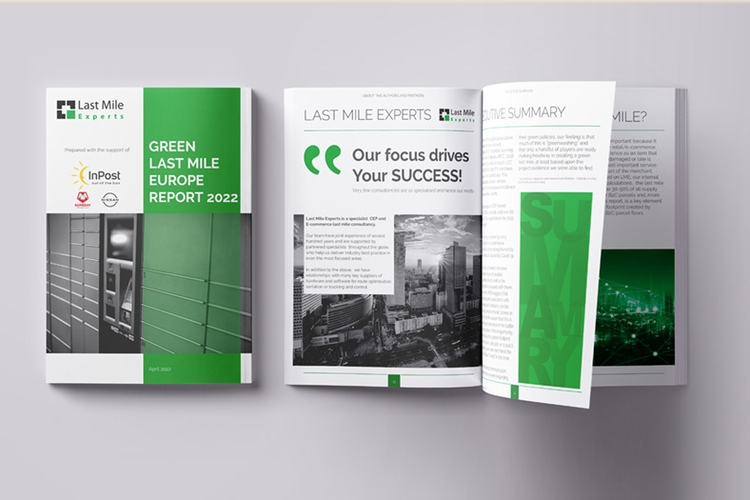
In the coming years, we can expect an expansion of electric delivery vans in the courier services market, especially in large cities where the rise in pollution, CO2 emissions, and noise is becoming a key problem to solve. Parcel lockers are also gaining importance as the most sustainable way of delivery in the out-of-home model. The “Last Mile Experts” report on the latest trends and innovations in the courier industry and the closely related last-mile delivery sector has just been released. The “Green Last Mile Europe Report 2022” is likely the first comprehensive study of its kind that gathers the experiences and opinions of experts and major market players, setting standards that entrepreneurs will follow in the coming years.
– Our report shows that there is no single “silver bullet” for solving the problem of exhaust emissions in the “last mile” area. Of course, one of the main trends will be the increasingly wider use of electric vehicles, especially in urban areas. The fleet replacement must proceed gradually, if only due to the lack of energy infrastructure in cities (transmission networks) as well as the charging devices themselves. It will be an evolution, not a revolution. Another aspect is the optimization of B2C parcel deliveries, which is very inefficient in the “door-to-door” delivery model. Here, undoubtedly, the best solution to date is the expansion of out-of-home delivery networks, i.e., PUDO points and parcel lockers – says Mirek Gral, partner at Last Mile Experts. – Furthermore, it should be expected that city authorities will influence carriers to reduce road traffic and exhaust emissions by introducing cargo bikes, urban electric vehicles, and microhubs. This is already happening in Austria and the Netherlands.
The last-mile delivery market has the largest share of CO2 emissions in the entire supply chain. The creators of the “Green Last Mile Europe Report 2022” cite data according to which total carbon dioxide emissions in the European Union alone exceeded 2.5 billion tons in 2020. By 2032, the level of CO2 emitted into the atmosphere in this way could reach as much as 5.5 million tons. Remedies for the growing threat related to the negative impact on the environment could include: widespread consumer education, investment in electric delivery vehicles, and greater emphasis on the development of out-of-home delivery. It is worth noting that one Paczkomat® reduces 13,845 kg of CO2 annually, which corresponds to the air purification provided by 2,769 trees.
Consumer education regarding the carbon footprint generated during the delivery of ordered goods is of key importance in the fight for a clean planet. One good example of action is the “InPost Green City” program, which has been successfully implemented since last year. The program, which covers 30 large and medium-sized cities in Poland, aims to support changes in consumer behavior and help local governments with pro-ecological education for residents.
– We want to change the attitude of society and convince them that as consumers, we must take care of the environment because it is about our common future. Paczkomaty® are the most ecological form of online shopping delivery. Thanks to them, we not only limit the emission of hundreds of thousands of tons of CO2 but also significantly reduce courier car traffic on the streets of European cities. One courier distributing parcels to Paczkomaty® delivers about 1,000 of them in a working day, visiting 4 to 5 addresses, whereas one courier in the traditional door-to-door model delivers an average of 75 parcels in the same working day – says Rafał Brzoska, CEO of the InPost Group.
Other initiatives worth noting in the context of education are the Lean&Green program represented by ECR Polska and the recently launched Klimatopedia.pl, which, among other things, explains the issue of carbon footprint and teaches how to measure it.
In addition to detailed information on the pro-ecological role of InPost Paczkomaty®, the report contains numerous green initiatives undertaken by all participants of the logistics and CEP sector, as well as analyses of the impact of last-mile deliveries on the environment and key trends and actions aimed at protecting the planet. The authors of the report point to InPost Paczkomaty® as the most sustainable delivery method in the out-of-home model. In 2020 alone, in Poland, deliveries to Paczkomaty® reduced carbon dioxide emissions by over 180,000 tons.
Analysis conducted by the European Commission proves that passenger cars and light commercial vehicles are responsible for a double-digit share of CO2 emissions. Based on this, it can be assumed that a transition to 100% electric commercial vehicles would allow total emissions to be reduced by more than 62 million tons. However, electric vehicles are not only a benefit for the environment but also for the companies themselves. As the authors of the report note, the total cost of ownership of an electric car is significantly lower than that of its combustion engine counterpart. Considering the current high fuel prices, traveling one kilometer using electricity is definitely cheaper than covering the same distance with a vehicle powered by gasoline or diesel. Furthermore, an electric car is a simpler construction, containing fewer potentially failure-prone components than a combustion engine car; it also does not require periodic engine oil changes, and due to regenerative braking, brake discs and pads wear out much slower. This brings measurable benefits to courier company fleets, whose vehicle maintenance expenses consume a large part of their budget.
– The courier industry, and in particular the last-mile delivery sector, has been an area of extremely dynamic development in recent years. We can already observe a visible increase in the number of electric vehicles on city streets, which couriers use to deliver parcels to customers – says Maciej Klenkiewicz, Managing Director of Nissan Sales CEE.
The report prepared by Last Mile Experts contains over 140 pages of expert analyses, inspiring data, comparisons, and conclusions. The publication also includes concrete examples of solutions aligned with the sustainable development trend that are being implemented across Europe.
– In 2021, online orders generated over 150 billion parcels worldwide, which translated into billions of kilometers driven by delivery vans and millions of tons of packaging and packaging material used. After all, every ordered product must be collected, packed, and sent to the recipient, and the increasing number of parcels directly translated into an increase in CO2 emissions. For this reason, it is impossible to talk about further e-commerce development without discussing the need to invest in sustainable development. The authors of the Green Last Mile report analyze this topic in great detail, and the report itself is a true compendium of knowledge, with very interesting examples of pro-ecological actions in the CEP industry and insightful conclusions. I am very glad that we have finally seen such a study and that our Institute also participated in the preparation of its part – adds Arkadiusz Kawa, Director of the Łukasiewicz – Poznań Institute of Technology.