










Global sales and e-commerce growth dynamics are weakening, yet at the same time, sellers and providers have inherited pandemic-era customer habits that increase pressure on logistics chain efficiency and raise its costs. This is particularly visible in the world’s largest e-commerce segment, the fashion market. It is not about faster deliveries, but about guaranteeing the expected standard of order returns. These must be stress-free, require no contact with the seller, and absolutely be free of charge; otherwise, the customer will go to the competition. The problem is that processing returns is difficult and lowers margins.
After the lifting of pandemic restrictions, it was expected that traditional outlets would reclaim some customers from online shops, but after the first quarter of this year, it was clearly visible that online trade was slowing down. This was confirmed by the results of major industry players, such as Amazon, which recorded a 3% decline compared to Q1 2021, and eBay, whose sales fell by 5.9%. The weakening was global, and the Salesforce Q1 Shopping Index published in mid-April indicated that the global value of e-sales in the January-March period fell by 3% compared to the same period the year before. Incidentally, this was the first significant decline in the index’s 9-year history. Additionally, traffic in online stores fell by 2%, while the volume of orders shrank by 12%.
The blame for the declines was placed on inflation, supply chain disruptions, and global economic uncertainty, which dampens consumer sentiment and purchasing power. Against the backdrop of global declines, Europe stood out significantly, with e-sales value falling by 13% and order volume plunging by 17%. The source of such significant perturbations, alongside global causes, was identified as rising fuel prices and the war in Ukraine. Naturally, one cannot forget about the unlocking of traditional trade, which naturally weakened e-commerce.
Changes in online trade were also noted by the International Monetary Fund, which calculates that last year’s share of online spending in total consumer expenditure fell from 14.9% in 2020 to 12.2%. In Poland, this downward trend is confirmed by Statistics Poland (GUS) data. According to the Office, the share of the online channel in retail sales fell from 11.1% in January this year to 8.9% in May. With the exception of a rebound in March (+14.9%) and a slight increase in May (+0.8%), the value of online sales at current prices is also melting away. It fell by 15.5% in January, by 8.9% in February, and by 4% in April. Among entities with the largest share of online sales, those in the textiles, clothing, and footwear categories suffered the most, where the pool of assortment sold online shrank from 28.6% in January to 22.3% this May.
Global e-commerce is driven by fashion, which fuels the growth of the entire e-trade and logistics sector
This year’s declines are obviously bad news for e-shops, especially those in the fashion industry, which accounts for about 30% of online purchases worldwide and represents the largest segment of global e-commerce. According to recent analysis by Shopify, in the USA alone, this market generated as much as 29.5% of total online sales in 2021. The situation is similar in Poland. According to JP Morgan, the category of products most frequently purchased by Poles online is precisely fashion, and its share in total sales last year was 32%.
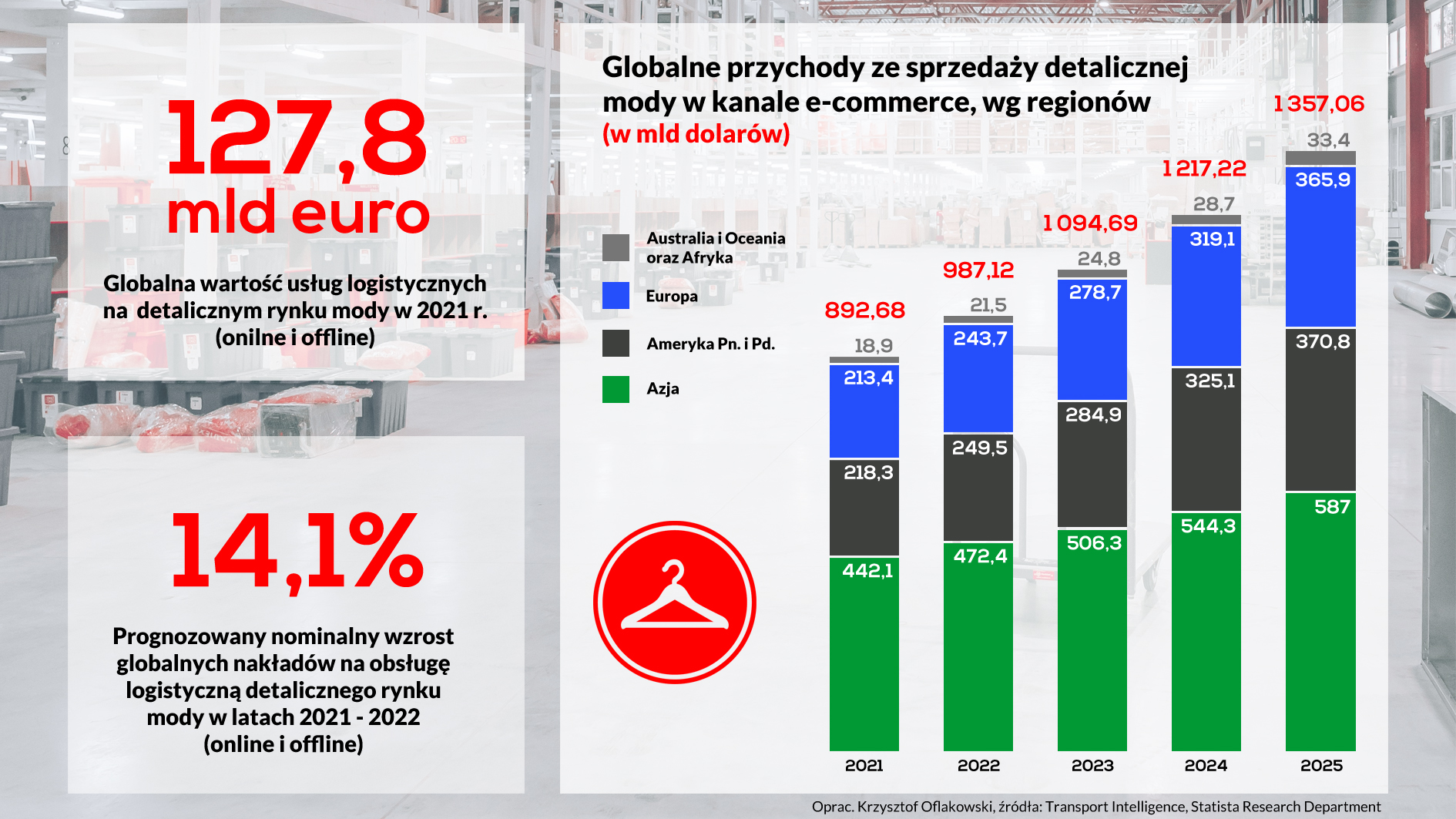
This segment is already worth a lot, and despite temporary problems, it has an optimistic growth outlook. April estimates from the Statista Research Department indicate that the global value of the fashion market in the e-commerce channel reached nearly 892.7 billion dollars last year, with the largest share held by Asia (442.1 billion – 49.5%), the Americas (218.3 billion – 24.5%), and Europe (213.4 billion – 23.1%). By 2025, however, online sales in this category are expected to increase significantly, reaching nearly 1.36 trillion dollars. That is a jump of over 52%. By then, the percentage distribution of sales will change slightly, but Asia (587 billion – 43.1%), the Americas (370.8 billion – 27.3%), and Europe (365.9 billion – 26.9%) will still dominate.
– Like many fashion companies in Europe, we also experienced a quarterly decline in online sales at the beginning of the year, which was 18% lower compared to the corresponding period in 2021. However, sales in stationary stores increased by 100%, which is proof that interest in our offer is not waning. The decline in the e-commerce channel is simply a natural consequence of the lifting of restrictions on stationary trade, as some customers returned to traditional shopping. For us, this is good news because the nature of the VRG brands’ offer means that the consumer needs the opportunity to interact with our range and service in the store. This is also where the margin, which is our priority, is primarily built – says Michał Zimnicki, Vice President of the Management Board and CFO of Vistula Retail Group.
– Importantly, while the online channel’s share has fallen, the volume of our total sales is growing. In the first quarter alone, we managed to double our year-on-year revenue in the clothing segment in the offline channel. At the same time, online sales still account for about 30 percent of the sales of our clothing brands. E-commerce remains at the center of our attention, and maximizing sales in this channel is one of the most important goals for this year. We want to build a stronger relationship with the consumer through an omnichannel approach, i.e., integrated management of online and offline sales. By the end of the year, we plan, among other things, to implement mobile sales applications across all VRG brands and loyalty systems that link customer activities in online and offline channels. Tools enabling interactive size matching will appear in the clothing segment’s e-shops. All these efforts are intended to contribute to the double-digit sales growth of the Group – adds Michał Zimnicki.
In the next few years, it will be possible to earn a lot not only on fashion sales online but also on the logistics support of this market, especially if it involves multi-channel support (online and offline). According to Transport Intelligence, in the 2021-2022 period alone, the fashion industry (clothing and footwear) will record one of the highest nominal increases in logistics spending (+14.1%). The global value of such support in 2021 already amounted to 127.8 billion euros. However, the success of logistics providers in this market will cost a lot of effort because the expectations of e-consumers are growing.
E-commerce service for the fashion industry is becoming increasingly difficult, especially in the context of returns
A McKinsey State of Fashion 2022 survey conducted among fashion industry procurement directors worldwide shows that while the online channel is still considered the greatest business development opportunity (32% of responses), managing logistics, the supply chain, and inventory resources is considered the greatest challenge (30% of responses). Among operational factors related to supply chains, rising transport prices (74%), rising material costs (71%), available transport capacity (69%), and port closures and disruptions (58%) are considered the biggest challenges.
Due to the scale, processing returns in this market, which gained intensity and importance during the pandemic in both the USA and Europe, also keeps fashion e-sellers and logisticians awake at night. This is confirmed by the Statista Global Consumer Survey conducted in the USA between April 2021 and March 2022. It shows that the most frequently returned items purchased online are clothing, footwear, and other fashion accessories. Out of over 7.6 thousand respondents aged 18-64 who made purchases online in the last 12 months, as many as 26% identified clothing as a product that was eventually returned. It is not much better in the case of footwear, as 19% of respondents returned goods from this category. Bags and accessories followed with 13%.
– In this respect, markets in Europe and the USA have many features in common. Fashion products also make up the largest part of e-commerce for us. Eurostat data on European e-trade in 2021 state that out of the percentage of people who bought goods or services online in the last 3 months, as many as 68% decided to order clothing, shoes, or fashion accessories. This category had the largest share in purchases across all age groups. This is, of course, associated with the highest percentage of returned assortment, and in the case of clothing, the procedure of re-introducing a product into the sales cycle is not at all that obvious, as it does not go directly to the shelf like, for example, a book. Leaving aside the fact that a return must be organized in such a time and form as the customer wishes, every returned garment is subjected to verification and a so-called refinement procedure. It takes various forms, from cleaning the clothing, replenishing packaging elements, to ironing, and even repairs. In our warehouse centers, we carry out minor repairs of clothing, footwear, or accessories on-site; then, each item is re-verified and prepared for sale in a stationary store or online. From the perspective of the last few years, it is clear that the tendency to return clothing purchased online is growing, and due to the increased volume of such processes, they pose an increasing challenge and require ever greater investments, e.g., in automation, personnel, or ironing tunnels – says Marcin Bąk, President of the Management Board at Spedimex, a Polish operator serving retail chains, e-commerce, and less-than-truckload (LTL) and full-truckload (FTL) transport in Poland and Europe.
Interesting data on online returns was also recently provided by The National Retail Federation (NRF). Data from the world’s largest retail trade association indicate that in 2021 in the USA, as much as 16.6% of all goods purchased at retail were returned. This is 6% more than the year before, however, the percentage of returns in e-commerce remains at a much higher and unwavering level, reaching as much as 20.8%. These were goods worth as much as 218 billion dollars, with total retail e-sales in the USA reaching 1.05 trillion dollars. As many as 10.6% of all e-returns were considered fraudulent (23.2 billion dollars). NRF calculates that on average, for every 100 dollars of returned goods, sellers lose as much as 10.3 dollars as a result of fraud. As the organization reports, among the most frequently returned product categories both online and offline were; auto parts (19.4%), obviously clothing (12.2%), and home furnishings (11.5%).
The wave of online returns is a consequence of the pandemic habits of mature e-commerce market customers
The report “E-commerce Returns and Exchanges 2022” sheds a bit more light on this issue. A study conducted at the beginning of the year in the USA indicates that returns in mature e-commerce markets have become a mass phenomenon, and e-consumers who have used this possibility in the last 6 months only returned one item in 20% of cases. As many as 73% of shoppers returned between 2 and 9 products, and 70% returned more than 10 items. Moreover, return policy has started to significantly influence purchasing decisions. Currently, as many as 84% of local e-consumers want to know how the return procedure works before finalizing a purchase. Out of this group, as many as 44% of customers are willing to cancel their purchase and go to the competition if they are dissatisfied with the seller’s proposal in this regard.
At the same time, 96% of buyers are more inclined to use a store’s offer if the seller declares a completely free return, and 91% of customers claim that the general ease of making a return determines their willingness to use the store’s offer again. If, however, the return is accompanied by bad experiences, 67% of customers will stop using the seller’s offer.
Returning a purchased product is therefore supposed to be free, easy, and stress-free, and the customer does not want to contact the store to initiate the whole process – this is the least preferred form of handling the matter according to 38% of customers. As many as 21% of e-consumers also do not want to make returns at a stationary store. On the other hand, the most desired convenience is using a label prepared by the seller for the return (30%) or initiating the process online and using a ready-made QR code at the drop-off point (22%).
The phenomenon of Bracket Buying is not yielding, also in Poland
Although stationary stores in the USA have long remained open, the pandemic practice of simultaneously ordering multiple variants of the same product, e.g., several sizes or colors of clothing, with the calculated intention of returning at least some of them (the so-called Bracket Buying) does not cease. As many as 50% of e-consumers made online purchases in this way, and 80% of those who made a return sent back some piece of clothing.
– In Poland, there are no exact statistics on this phenomenon, but it is perfectly known to logisticians serving the online fashion market. This process intensified significantly during the pandemic, which is partly understandable, as there was no possibility to go to a stationary store to view or try on a product before purchase. Traditional trade has finally started up again, but the pandemic habit of consumers unfortunately remained, which from the point of view of e-sellers is a generally unfavorable phenomenon. Above all, because it doubles the cost of logistics support, which ultimately lowers the seller’s margin. The product is shipped to the customer, but part of the order comes back, and if the return is free, the seller pays for the return journey. Every returned piece is also subjected to verification and refinement, which also generates cost. The situation is even worse if the customer cancels the order in its entirety, which assumed both free delivery and return. In such a scenario, the seller earns nothing, while covering double shipping costs. In the case of an exchange, such a cost is incurred 3 times, but at least the seller retains part of the margin. The phenomenon is becoming so common in Poland that some sellers include a dedicated field describing such a process in the exchange form. It has already permanently entered the canon of habits of Polish e-consumers, and giving up free returns or shipping for many e-sellers could mean losing a customer – explains Marcin Bąk from Spedimex.
Bracket Buying is not the only pandemic habit of e-consumers that affects e-commerce logistics
A study conducted by Nielsen and Sendcloud indicates that as many as 74% of European consumers will not make purchases in an online store if it involves covering the costs of a potential return. In the case of products from the fashion segment, a free return is a necessity according to 76% of consumers, the effect of which is the highest percentage of returns among all categories, amounting to as much as 58%. Returns have therefore become an inseparable part of European e-commerce culture as well, which is reflected by the fact that 52% of Europeans return a product if they are not fully satisfied with it, and 32% do so only sometimes.
Analogously to expectations across the ocean, also on the Old Continent, conveniences in the return procedure are preferred, and 60% of e-customers believe that the seller should be responsible for the full organization and covering the costs of the entire process. Only 14% claim that this is a responsibility on their side. Interestingly, although the Union has regulations setting a statutory 14-day deadline for withdrawal from a distance contract, as many as 40% of e-consumers claim that they will not order a product if the time for cancellation is not at least 30 days, while 26% will not make a purchase if this period is not at least 60 days.
The e-consumer in Europe, similarly to the one in the USA, wants to be well-informed, which is why the percentage of people who always check the return policy before making a purchase is as high as 52%. 33% do this only sometimes. For those consumers who want to know how this policy works, the most important element is definitely the potential cost of sending back the product (67%), a prepared return label (59%), the time of funds return (46%), and the period for dropping off the package (43%). However, customers do not want to come to the store with the product (10%); they definitely prefer to leave the package at any drop-off point (45%) or wait for it to be collected from home or work (36%).
It is also worth emphasizing that the Nielsen and Sendcloud report also proves that the European e-commerce sector is driven by the fashion market. According to the analysts of these organizations, the most frequently ordered category during the last year in Europe was precisely fashion and accessories (29%). Far behind, with a result of 15%, was the next most popular segment, i.e., electronics, and slightly behind it were toys, books, and games (12%).
The e-commerce market is fickle, but it is still worth serving
March estimates from Transport Intelligence show that last year’s global market for logistics services for e-commerce reached a value of nearly 441.5 billion euros and grew by 19.9% over the year from the level of 368.1 billion euros. The forecast until 2026 assumes an average annual growth of 11.8% and a value at the end of the forecast amounting to 770.8 billion euros. In 2021, 3 key regions still played a dominant role, i.e., Asia-Pacific, North America, and Europe, which account for 95% of the global market. Last year, Asia was once again the largest logistics market for e-commerce in the world (nearly 178.2 billion euros), but by 2026, it is to be overtaken by the American market, which will be worth over 312.1 billion euros. At the same time, the Asia-Pacific market will reach nearly 251.3 billion euros. Europe will also remain on the podium, which, from the level of over 88.2 billion euros, will grow at an average annual rate of 13.2% to reach nearly 164.2 billion euros in 2026. On the Old Continent, the cards are invariably dealt by the largest economies: the UK, Germany, France, Spain, and Italy, which account for over 70% of the value of the regional market serving online orders. According to TI, Poland is the 7th largest e-commerce logistics market in Europe.