










Current sector analyses and the latest forecasts for the global economy and e-commerce bring good news for contract logistics. The contract market will accelerate to 4.2% this year, but the world, and especially Asia, is pulling away from Europe. The gap is widening in terms of GDP growth, revenue from the contract sector, and the development of e-commerce. As usual, there is no shortage of challenges, and besides China, India also deserves special attention.
The global contract logistics market grew by 3.5% in real terms in 2023, exceeding the expectations forecast back in December 2023, when a growth of 2.4% was announced. Data from the British analytical center Transport Intelligence (Ti), revised at the end of May 2024, ultimately placed last year’s market value at 293.98 billion euros. This is nearly 12% more than the sector’s total revenue before the pandemic. However, analysts at Ti emphasize that the past year was difficult for the market, due to, among other factors, central bank policies aimed at fighting inflation, which weighed on the economy. The industry’s development was also not aided by geopolitical tensions, staff shortages, disruptions in transport on key routes, and other external factors that hindered growth dynamics.
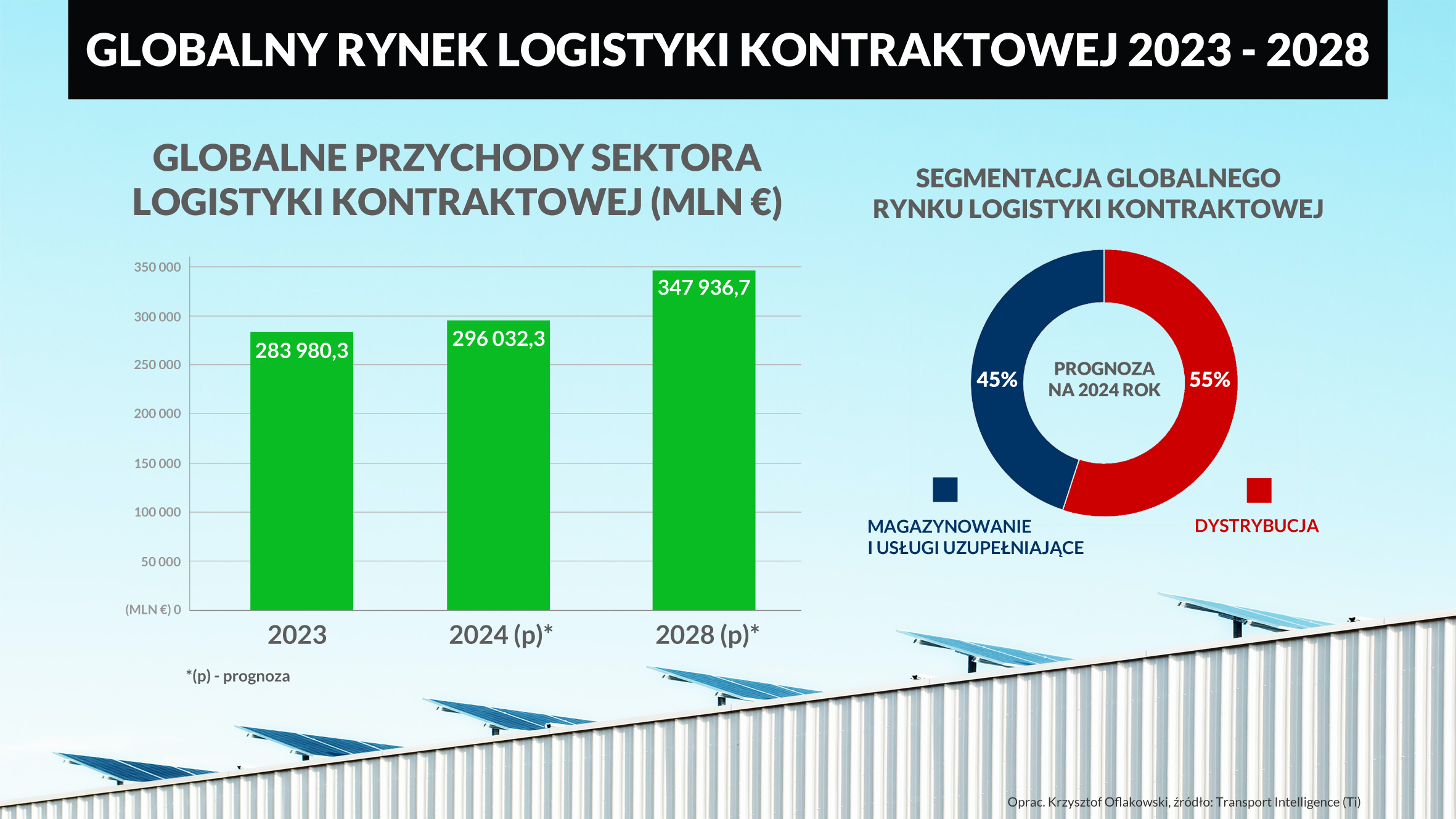
This year we will observe a slight improvement, and the growth of the global contract market is expected to reach 4.2%, showing more normalized dynamics, similar to those observed before the pandemic. The current forecast is also 0.5 percentage points better than the estimates presented in December, when this year’s growth was predicted at 3.7%. Ultimately, global contract logistics revenues at the end of this year may reach just over 296.03 billion euros, but the condition of the market will depend on overall global economic growth.
Out of the three most basic segments of the contract landscape, i.e., distribution, warehousing, and accompanying services, such as fulfillment, packaging, or e-commerce returns handling, distribution will account for the largest slice of the pie this year at 55% of the market value. This will translate into over 162.8 billion euros in revenue. The share of the remaining elements will not change significantly compared to historical data. Warehousing will not exceed 40%, and accompanying services will account for the rest of the contract pool.
– In relation to the sector’s condition last year, the first quarter of the current year brought an improvement to the contract market, which is stabilizing after numerous disruptions, both in the field of global fiscal policy and geopolitical tensions. This is not yet an optimal scenario, but the improvement is noticeable. Due to the weak results of the largest economies of the Old Continent in 2023, we observed a clear slowdown in the European contract market, nevertheless, at the group level, we managed to generate a double-digit revenue growth of 10.7%, with the North American market recording the best dynamics reaching 34.3%, but we recorded positive dynamics in all regions of the world where we operate. As for the current year, both the first and second quarters brought better results than the corresponding periods in 2023. Certainly, the entire industry in Europe feels better business conditions and stable economic growth forecasts for this and the next year. For us, the favorable situation in the currency market and the launch of new projects, which are already ahead of the schedule adopted for this year, have helped so far. After the first half of the year, this resulted in a global revenue growth of 18.7% compared to the same period in 2023, of which 14.3% was generated on a like-for-like basis, i.e., excluding takeovers, acquisitions, and new projects. If no dark clouds gather over the European and global economy by the end of the year, it will be a good year for us and other operators providing contract services – says Carlos Tavares, Chief Financial Officer at ID Logistics Polska, which provides comprehensive logistics and transport solutions, e-commerce handling, and supply chain management.
Forecasts for 2028 and regional growth leaders
In 2028, the global contract logistics market is expected to be worth over 347.9 billion euros and will grow at an average annual rate of 4.1%. This is a better result than the one announced in December 2023, when the average annual growth in the years 2022-2027 was estimated at 3.8%. Both last year and this year, the leaders of growth will be emerging markets and developing economies, especially those located in Asia.
It was the Asian region that was the engine of the sector in 2023, achieving real growth of 7.5%, which resulted in revenues of 107.7 billion euros. The enormous potential of local operators is evidenced by the fact that they achieved a clearly better result than in 2022, when the local market grew by 4.3% to over 100.2 billion euros. Other residents of the contract podium may envy such results, i.e., Europe, which increased revenues by only 0.2%, and North America, which grew by 1.6% last year.
There is no indication that this year’s podium layout will change, and certainly not in the leader position. The real growth in the value of the contract market in the Asia-Pacific region is expected to be 7.1% against a global average of 4.2%. This will happen mainly due to China and India, whose contract markets grew by an impressive 12.1% and 12.3% last year.
The heart of the contract market beats in Asia, right next to the global GDP engine
It is no surprise that the condition of individual contract markets is reflected in the economic situation of individual regions, and the entire sector is dependent on the growth of global GDP and trade. This is clearly visible in the updated GDP data published by the International Monetary Fund (IMF) in mid-July. The Fund maintained its April estimates regarding global GDP in 2024, and they still assume growth at 3.2%. The new assumptions for the next year look a bit more optimistic; the forecast jumped by 0.1 percentage points, and according to the new data, growth next year (2025) will reach 3.3%.
As with contract logistics, the situation looks best in emerging markets and developing economies, mainly in Asia. This year, Asian economies will achieve growth of 5.4%, and next year 5.1%. In the same period, the Eurozone will grow by 0.9% and 1.5% respectively, and the US economy by 2.6% and 1.9%. The growth of Asian economies is primarily due to China and India, exactly as in the case of the contract market. Due to good consumption and export results in Q1, the forecasts for China were raised by 0.4 percentage points to 5% in the current year. In 2025, the Middle Kingdom’s economy is expected to grow by 4.5%, which is also a jump of 0.5 percentage points. India’s GDP was revised upwards by 0.2 percentage points, to 7% in 2024. In 2025, it will be 6.5%.
Improvement is visible not only in Asia but also in the Eurozone. The negligible this year’s growth of 0.9% is still an advance of 0.1 percentage points relative to the IMF’s April forecast. This happened due to the trade in services and better-than-expected export condition in the first half of the year. The projected growth in 2025 will, in turn, be responsible for stronger consumption, wage growth, and higher investments.
The third largest contract logistics market in the world, i.e., the USA, recorded a cut in GDP growth. The IMF subtracted 0.1 percentage points from the April forecast, and this year’s is currently 2.6%.
Global GDP is looked upon more kindly not only by the International Monetary Fund but also by the Organization for Economic Cooperation and Development (OECD). According to the OECD, global GDP will grow by 3.1% this year and will gain an additional 0.1 percentage points in 2025, reaching 3.2%. Growth is expected to be supported by a rise in real incomes and lower interest rates.
Trade also has good news for the contract market
According to new data from the International Monetary Fund, in the years 2024-2025, global trade in goods and services is expected to grow at an average rate of about 3.25% per year and match the global GDP rate. This year, estimates talk about 3.1% growth, and for next year 3.4%. In both cases, these are better results by 0.1 percentage points. Once again, the forecasts, both the data on economic growth and trade, harmonize with the predictions for contract logistics. Trade will grow faster in emerging markets and developing economies, where the pace will reach 4.2% in 2024 and 4.5% in 2025. Among developed economies, trade will grow by 2.5% this year and 2.8% next year, respectively.
The WTO also has a handful of gifts for the logistics sector. Global trade in goods will grow by 2.6% this year and 3.3% next year. It will be driven by growth in real income and greater purchasing power for goods. The situation will be slightly different than in 2022 and 2023, when Europe was responsible for most of the declines in global trade in goods, which subtracted 1.7 percentage points from global import growth while reducing global export growth by 1 percentage point. This year, the Old Continent will stop slowing down global trade, and all regions of the world will have their share in both export and import growth. Without surprise, Asia will be at the head of the peloton, which will add about 1.3 percentage points to global export growth and 1.9 percentage points to import growth. The dynamics of local exports will amount to 3.4% this year and next, while imports will gain 5.6% and 4.7% respectively.
North America will perform worse, whose export growth was estimated at 3.6% and 3.7%, while imports at 1% and 3.3%. Among the main markets key to contract logistics, Europe will perform worst in terms of trade, where exports in 2024 and 2025 will gain 1.7% and 2.8% respectively, while imports 0.1% and 3.1%.
Expected growth is accompanied by risks
Like other international organizations, the WTO also points out that the forecasts are still threatened by numerous factors slowing them down, including regional conflicts, geopolitical frictions, and trade wars. They can thwart the fight against inflation, causing a further increase in food and energy prices. As an example, the WTO mentions difficulties in the Suez Canal, which were partially mitigated, but some sectors, especially retail, fertilizer, and automotive, felt delays and an increase in transport rates very strongly.
The same applies to the growing tension between the USA and China, which led to a decrease in the growth of bilateral trade by as much as 30% compared to the trade of these countries with the rest of the world starting from 2018.
The mood in this context is not improved by the July report by UBS Group AG, which predicts that the introduction of a 60% tariff on Chinese imports by the USA would lead to a reduction in local GDP from the forecast 5% to 2.5%. GDP would also slow down in 2025 and 2026, and a trade war would slow the Chinese economy from 4.6% and 4.2% to about 3%.
Contract logistics can still count on e-commerce
Perhaps not yet key, but certainly an inherent and important part of the global contract logistics market this year will be the e-commerce sector, which has been significantly contributing to the industry’s development for years.
– It is in vain to look for significant players in the global contract market in 2024 who do not include the potential of the e-commerce sector in their development strategies. Handling online trade has already become an inherent element of the logistics landscape in all its forms, from transport through warehousing to supplementary services. In our case, e-commerce accounted for as much as 25% of global revenue in 2023 and, alongside FMCG and the fashion market, is among the three main areas that we already identified in 2022 as showing the greatest growth potential. However, e-commerce is strongly dependent on the condition of household budgets, which is why we received the latest forecasts of international institutions regarding the expected growth of real wages, consumption, and the fall in inflation with even greater satisfaction. The existing financial results of the largest sales platforms also look very good, so we expect that e-commerce will also make a significant contribution to the development of the contract logistics sector this year, both globally and regionally – adds Rafał Lewandowski, Contract Management Director from ID Logistics Polska.
A number of recently published forecasts confirm that e-commerce will maintain positive growth dynamics in the coming years, although, of course, this will not be the growth observed during the pandemic.
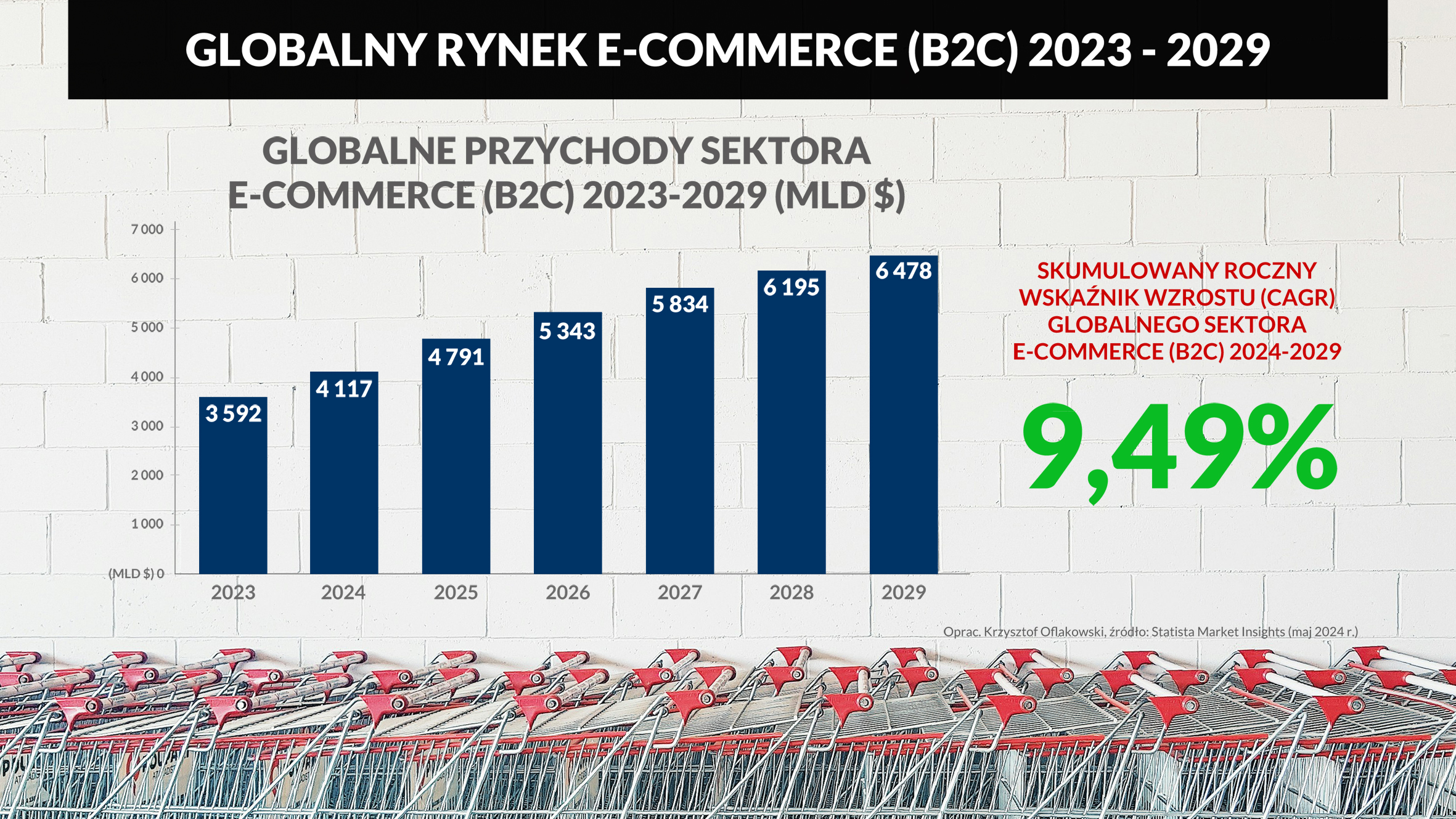
According to Statista Market Insights calculations from May of this year, revenues from the online sale of physical goods offered to individual clients by companies (B2C) will grow by 14.6% this year, reaching a value of over 4.12 trillion dollars. By 2029, the average annual growth will be 9.49%, and the market value will reach nearly 6.48 trillion dollars. The largest share in global e-commerce, both this year and in 2029, will belong to China, where e-commerce in the B2C model will be worth 1.47 trillion and 2.36 trillion dollars respectively. This year’s TOP10 will also include the USA, Japan, UK, Germany, South Korea, France, Canada, Italy, and the list will be closed with revenues of 58.97 billion dollars by India, which has recently begun to climb in the most important global rankings.
The US Department of Commerce also predicts that global B2C e-commerce will develop at a good pace. This year’s estimates assume an average annual growth of 11.16% in the years 2023-2027 and a sector value at the end of the forecast of around 5.5 trillion dollars. American analysts pay special attention to the Indian market, which, with a result of 14.11%, took 1st place in terms of average annual growth rate until 2027. China, with an average dynamic of 12.17%, took seventh place, and out of the European Union countries, only Italy entered the TOP10, achieving a result of 11.59%.