








Payment methods
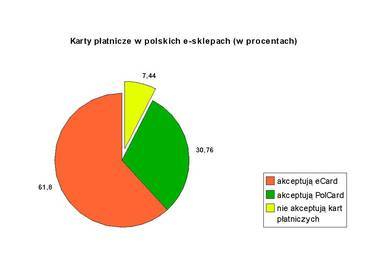
Approximately 92% of e-shops in Poland enable payment for goods and services by payment card, with over 60% of these being handled by eCard and over 30% by PolCard.
Approximately 92% of e-shops in Poland enable payment for goods and services by payment card, with over 60% of these being handled by eCard and over 30% by PolCard.
Source: IAB Poland 2004.
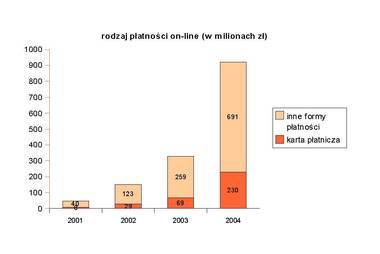
The growth rate of new eCard clients has remained at 9% per quarter for two years, while the company’s revenues have been growing at a rate of several hundred percent annually. The main reason for the revenue growth is the increasing attractiveness of online store offerings. The increase in the availability of payment cards, driven by the development of banking services in Poland, is also of great importance. At the end of 2004, there were almost 17 million payment cards in use in Poland. Unfortunately, only a small portion of them, just 2 million, were accepted on the Internet.
– Accelerating the development of e-commerce in Poland is good news for stores offering this form of sales – says Małgorzata O’Shaughnessy, General Manager of Visa Europe in Poland. – However, it leaves something to be desired that only a small part of e-commerce in Poland is still paid for with cards.
Undoubtedly, such a low share of cards accepted online contributes to hindering the development of the e-commerce market in Poland. Changing this situation lies with the banks issuing payment cards. In stores with a diverse customer profile and a wide product portfolio, every fourth customer pays with a payment card. An example of such an entity is Merlin.pl, where about 25% of customers use a card. Others choose bank transfer, payment on delivery, electronic wallet, or Premium SMS.
Source: eCard 2005.
How others do it
Unfortunately, we are far from the e-commerce boom noticeable in Europe and the USA. According to Jupiter Research, as many as 61% of Internet users in the USA have used the option of purchasing online at least once. The same indicator in Western Europe looks slightly worse, reaching 49%. In turn, the value of the entire sales market in the USA is estimated at 66 billion dollars, while in Europe at approx. 38 billion euros. Perspectives predict a steady, roughly 10-percent increase in the number of Internet users who will make purchases online. This is happening despite high market saturation. As predicted by Jupiter Research, by 2009 the American market is to record a 71% growth compared to 2004, and the number of users is to reach 159 million. In the same period, Western Europe will record a growth of 62%, reaching 138 million Internet users making purchases. According to information provided by RSA Security, consumers from Great Britain make more purchases in electronic stores than other Europeans, including the French and Germans. The spending of British island residents also exceeds the spending of Americans. Research conducted in September 2005 showed that the average Briton spent about 231 pounds online, while the average of all surveyed countries was 153 pounds. The American consumer on average “lightened” their wallet by the equivalent of 129 pounds. The biggest barrier to the development of e-commerce for the respondents is the fear of cybercrime. About 16% of surveyed Americans, 13% of residents of Great Britain, and 6% from Germany and 9% from France admitted that they currently spend less on this form of shopping than in the past.
Unfortunately, we are far from the e-commerce boom noticeable in Europe and the USA. According to Jupiter Research, as many as 61% of Internet users in the USA have used the option of purchasing online at least once. The same indicator in Western Europe looks slightly worse, reaching 49%. In turn, the value of the entire sales market in the USA is estimated at 66 billion dollars, while in Europe at approx. 38 billion euros. Perspectives predict a steady, roughly 10-percent increase in the number of Internet users who will make purchases online. This is happening despite high market saturation. As predicted by Jupiter Research, by 2009 the American market is to record a 71% growth compared to 2004, and the number of users is to reach 159 million. In the same period, Western Europe will record a growth of 62%, reaching 138 million Internet users making purchases. According to information provided by RSA Security, consumers from Great Britain make more purchases in electronic stores than other Europeans, including the French and Germans. The spending of British island residents also exceeds the spending of Americans. Research conducted in September 2005 showed that the average Briton spent about 231 pounds online, while the average of all surveyed countries was 153 pounds. The American consumer on average “lightened” their wallet by the equivalent of 129 pounds. The biggest barrier to the development of e-commerce for the respondents is the fear of cybercrime. About 16% of surveyed Americans, 13% of residents of Great Britain, and 6% from Germany and 9% from France admitted that they currently spend less on this form of shopping than in the past.