








Lack of trust in electronic commerce is not the only barrier that keeps us behind the global list of countries developing the e-commerce industry. The results of the Gemius study highlight the following problems encountered by customers of virtual stores: extended delivery times (45%), lack of detailed product information (36.4%), and problems with returning or exchanging ordered goods (15.6%). At the same time, it must be remembered that Polish law imposes significant obligations on the store owner in this regard. Goods ordered online are subject to the right of return without giving a reason within 10 days of placing the order. This does not apply to food products, unpacked audio CDs, and computer software.
The Polish consumer
According to IAB Poland, domestic e-store customers are people with a higher-than-average social and financial status. In this group, the percentage of people with higher education is as high as 16 percent. Furthermore, a large group consists of students, including university students and post-secondary school pupils (22%). The Polish Internet continues to be a medium of large agglomerations and areas with well-developed telecommunications infrastructure. The areas with the highest number of Internet users are the regions of central and south-western Poland. The time that Polish Internet users spend on the Web per week is one of the shortest in Europe – an average of 3.9 hours per week. In this respect, we are surpassed by all Internet powers, but also by countries such as Hungary, where each Internet user spends an average of 5.3 hours a week online. This average is much higher for the countries of the so-called old Union – in Spain it is 11.2 hours per week, in Italy 8.6 hours, and in Sweden 7.7 hours.
According to IAB Poland, domestic e-store customers are people with a higher-than-average social and financial status. In this group, the percentage of people with higher education is as high as 16 percent. Furthermore, a large group consists of students, including university students and post-secondary school pupils (22%). The Polish Internet continues to be a medium of large agglomerations and areas with well-developed telecommunications infrastructure. The areas with the highest number of Internet users are the regions of central and south-western Poland. The time that Polish Internet users spend on the Web per week is one of the shortest in Europe – an average of 3.9 hours per week. In this respect, we are surpassed by all Internet powers, but also by countries such as Hungary, where each Internet user spends an average of 5.3 hours a week online. This average is much higher for the countries of the so-called old Union – in Spain it is 11.2 hours per week, in Italy 8.6 hours, and in Sweden 7.7 hours.
A study of the profile of the Polish e-customer, prepared by the I-Metria company, created a model of an Internet user, who is an professionally active, 28-year-old man. Men account for almost 73% of e-store and auction customers. Only one in five women decides to shop online. This indicator is important for two reasons – firstly, the low share of women in e-commerce proves that Polish e-commerce is still in the initial phase of development, despite the rapid growth of social acceptance of the electronic form of trade. The second issue is the lack of a large number of stores with goods intended exclusively for women.
Among current e-store users, one can distinguish “intensive” customers who frequently visit shopping platforms, navigate them skillfully, compare products and prices, appreciate additional descriptions of goods and their manufacturers, use complex search systems, and carefully read the opinions of other users. The second group consists of “accidental” (sporadic) buyers. These are people who are interested in short and concise information, often relying on store recommendations and suggestions such as “A user who bought this book also purchased…”.
– We observe that Internet users most often make purchases occasionally. Also interestingly, our auction site is most willingly used by young people under 25, while users in their prime (35 and older) prefer to use the WP shopping arcade. Gentlemen are definitely bolder when making purchases on the Web – says Dariusz Zaremba. The intensity of online shopping always increases with the season – Valentine’s Day, Women’s Day, Mother’s Day, Christmas – these are the best times for online stores.
– We observe that Internet users most often make purchases occasionally. Also interestingly, our auction site is most willingly used by young people under 25, while users in their prime (35 and older) prefer to use the WP shopping arcade. Gentlemen are definitely bolder when making purchases on the Web – says Dariusz Zaremba. The intensity of online shopping always increases with the season – Valentine’s Day, Women’s Day, Mother’s Day, Christmas – these are the best times for online stores.
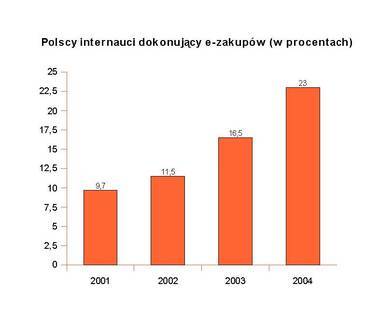
Source: TNS OBOP 2004.