










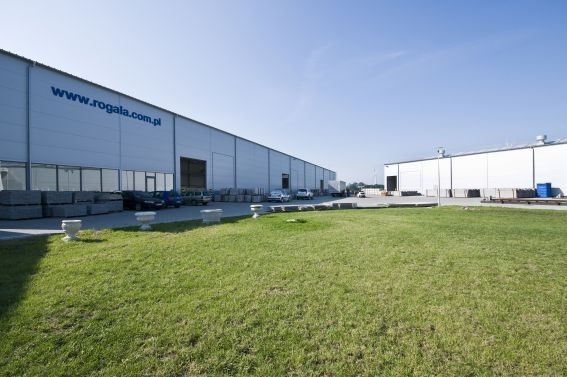
Market development in the field of container services at ports is not just an opportunity for the Polish economy. It is good news for everyone who wants to increase efficiency in cargo handling. More and more companies are participating in the cargo handling process. Recently, the stone company Rogala has also started providing container devanning services.
Container services – the current state
A characteristic feature of the market is the constant search for ways to gain a competitive advantage. In the logistics industry, this means, among other things, shortening the time it takes for goods to be delivered from the manufacturer to the customer in order to increase efficiency in cargo handling. Therefore, the role of efficient goods transport is extremely important. Until recently, transshipment points where goods changed their mode of transport (from land to sea and vice versa) were a problem. Infrastructure development and an increasing number of service providers have streamlined the transshipment process. More and more opportunities are opening up, which is why companies located near ports are efficiently utilizing their location.
Stuffing and devanning vs. economics
Competitiveness in the industry is determined by the efficiency of transport connections between the port and the recipient of the goods. Terminal infrastructure allows for the unloading of containers onto the quay, the completion of appropriate customs procedures, and devanning and loading onto freight vehicles or even trains. Devanning containers on-site (at the terminal or in close proximity to the quay) shortens the time required to prepare the container contents for use, and above all, it is much cheaper. The Rogala company, which owns one of the largest stone warehouses in Poland, is well aware of this.
At ports, the devanning service is significantly more expensive than the price offered by the company. It is also worth noting that not all enterprises have the appropriate equipment to safely unload a container. The Rogala company specializes in demanding materials: stone, facades, slabs, and other raw materials.
Stone specialists
– Our idea was very simple: we utilized the location of one of our warehouses in close proximity to the port – says Karol Rogala, who is responsible for the devanning service at the company. – Transporting a container to southern Poland and unloading it there is much more expensive than organizing the devanning on-site and distributing the goods using so-called tarpaulin trucks. This is due to the obligation to return the empty container to the port. The company has already started offering the service, and more and more companies are using it.
Devanning is part of a larger development strategy for the enterprise. It specializes in the production and sale of slabs and tiles, and imports stone blocks from all over the world. Naturally, it has expanded its operations to include logistics services in the field of handling this material (although devanning services apply to more than just stone). The adaptation of the warehouse near Gdańsk was taken care of at the design stage of the warehouse facilities. The entire complex consists of two halls and external loading and unloading yards. One of the warehouse halls, intended for slabs, has two overhead cranes, and a third one is located in one of the loading and unloading yards. Each of the cranes can lift 10 tons. This allows for the simultaneous loading of freight vehicles. Professional stations have been created for unloading containers: separate ones for extracting slabs and large loads, and a ramp for unloading goods in crates – this allows for a significant reduction in waiting time for cargo loading. Logistics operations run in parallel with processing work and independently of each other. In this way, the handling of internal inter-warehouse transport and customer service is not complicated or delayed.
Opportunity for development
In the Baltic Sea basin, maritime transport plays a leading role. In Europe, it accounts for 44% of all cargo transport. Poland has a share of only 8% in this international exchange of goods. Thanks to the dynamic development of services and the expansion of container bases and terminals, we have the opportunity to change this.