









The most serious risks capable of triggering a global crisis, and directly related to logistics, are beginning to accumulate. Logistics professionals are most concerned about geopolitics and economic disruptions, as the uncertainty gap is widest there. Research shows that market conditions are hardening, optimism is shrinking, and many experts believe that high volatility is now the new normal. Not even the most reliable forecasts help in planning operations, because they lack a coherent set of assumptions, and their validity period is extremely short.
Risk No. 1: Geoeconomic confrontation
It has been only a few weeks since the World Economic Forum (WEF) published its report on the most serious threats in 2026, and at the turn of February and March, the two most dangerous scenarios began to unfold, which, according to the report, have the potential to trigger a severe global crisis. As many as 18% of the 1,300 experts from the fields of science, business, and international organizations identified geoeconomic confrontation as a factor that could initiate such a crisis. The WEF defines it as the use of economic levers to reshape economic relations between countries through restrictions on trade flows of goods, services, technology, or knowledge, with the intent to limit geopolitical rivals, build self-sufficiency, or consolidate spheres of influence.
Risk No. 2: Kinetic conflict
When assessing events capable of sparking a major global crisis, slightly fewer experts (14%) were betting on inter-state armed conflict in January. The conflict in the Middle East, ongoing since February 28, successfully fulfills the criteria for both threats indicated by the WEF—geoeconomic and military confrontation. On one hand, Iran destroying extraction infrastructure in the Persian Gulf and blocking the Strait of Hormuz has taken the global economy hostage; on the other, the kinetic war, limited in its initial phase, has already spilled over into other countries in the region. The consequences of these events were felt instantly by the commodity market, and the International Energy Agency has repeatedly emphasized that we are witnessing the largest energy crisis in history.
Immediate and long-term impact on logistics
The severe consequences of these events were felt not only by the oil and gas market but also by the global transport sector, including road, sea, and air transport. The commodity shock standardly led to significant increases in freight, insurance, and fuel prices, and even the vision of shortages in aviation. The blockade of the Strait of Hormuz also forced a reconfiguration of global transport routes and locked part of the merchant fleet in the Persian Gulf. It is worth mentioning that, according to Project44 calculations, within nine weeks (from March 2 to April 27), as many as 64,070 vessels were forced to change their routes. Meanwhile, statements from the head of the IMO in April suggest that up to 1,600 ships and 20,000 sailors may have been trapped in the Persian Gulf.
It is not just about gas carriers, tankers, and their crews. As early as March, Sea Intelligence analysts calculated that the capacity of ocean vessels that were scheduled to leave the Gulf but did not do so due to the closure of the passage could range between 156,074 TEU and 204,159 TEU. About 2–3% of global container volumes flow through Hormuz, and the dismantling of the regional terminal call schedule was quickly felt by other ports around the world, where not only container ships but also other cargo were redirected, leading to congestion. For example, at the beginning of May, containers destined for transshipment in Mumbai were waiting at the port for an average of 15 days, which is still an improvement over the 30-day average from the end of April.
Accumulation of threats
The consequences for the transport sector and global supply chains are far more extensive than just bottlenecks and rerouting, and their final shape will strictly depend on the duration of the war in the Middle East and the maintenance of the now dual blockade of the Strait of Hormuz. A problem of a separate category is the fact that serious turbulence is beginning to accumulate, and another impulse may be on the way, also linked to logistics, which experts pointed out in the WEF report. This concerns extreme weather events, which 8% of respondents believe have the potential to trigger a global crisis.
Risk No. 3: Extreme weather events
NOAA, the U.S. National Oceanic and Atmospheric Administration, reported in a May alert that the probability of the El Niño phenomenon occurring between May and July is 82% and is expected to rise by the end of the year, reaching 96% between December and February. El Niño is an oceanic weather anomaly characterized by high surface temperatures in the equatorial Pacific. It is El Niño that causes rainfall limitations in Central America and is the reason for the drop in water levels, including in Lake Gatún, which is directly responsible for supplying locks in the Panama Canal. The Panama Canal, in turn, is one of the most important points on the map of world trade, and by necessity, global logistics. It handles 3-6% of maritime trade and 40% of U.S. container traffic, valued at $270 billion annually. The drought of 2023-2024 caused by El Niño was the cause of the largest operational disruption in the canal’s history and forced its administration to reduce the number of vessels passing through from 36-38 per day, first to 24 ships, and in February 2024 to just 18 vessels. The draft was also reduced from 50 to 44 feet, which automatically lowered the permissible weight of cargo. As in the case of the Strait of Hormuz, long-term disruptions affected global supply chains, caused bottlenecks, delays, route changes, and, of course, raised freight transport prices.
Suez Canal capacity still limited by half
Thinking about geopolitical turbulence affecting logistics and the accumulation of disruptions on key transport routes, it is also worth remembering that besides the Strait of Hormuz, where traffic is currently at 5-10% of normal levels, and the high probability of difficulties in the Panama Canal, the Suez Canal has also not yet regained full capacity from 2023, i.e., since the start of attacks by the Yemeni Houthis. In official reports published by the canal administration, a clear decline in transits is visible, from 26,434 in 2023 to 13,213 in 2024 and a further decline to 12,758 units in 2025. In both cases, this is a drop of more than 50%. Also, in Q1 of this year, there is no significant improvement, and only 3,324 units passed through this corridor, which is a clear decline compared to 6,305 ships in Q1 2023. According to UNCTAD, the Suez Canal handles about 22% of global container volume and 40% of trade between Asia and Europe.
Logistics professionals recognize threats and assess their own readiness
This is only a fraction of the complicated reality in which the TSL sector currently operates, and there is little indication that the situation will improve quickly. Opinions of logistics professionals and industry research show that the freedom of market conditions is hardening, pessimists are growing in number, and the high volatility of the geopolitical environment and the atmosphere of uncertainty will remain with us for longer. However, it seems that specialists correctly identify the key threats and are able to respond flexibly to changes.
Already in last year’s Reuters Events analysis on key threats to global supply chains, 74% of 450 logistics managers surveyed identified geopolitical tensions as the factor generating the most serious risks. This was an increase from 33% in 2024. In second place, with 59%, were regulatory changes, which represents a clear rise from 8% the year before. Transport disruptions were indicated by 38%.
However, managers of supply processes declared that their organizations were largely prepared to deal with potential disruptions (40%), although only 5% stated that their preparation was comprehensive. In a separate analysis with a similar profile, conducted jointly with Maersk among 392 specialists in Europe, as many as 90% of respondents claimed that in response to significant changes in conditions, such as port closures or demand fluctuations, they would be able to make adequate decisions within a week, with as many as 23% declaring that this would be within 24 hours. Another 26% announced that an appropriate reaction would occur within 48 hours. Expectations regarding the future of the European supply chain environment were unambiguous, as 68% expected increasing volatility.
What has changed this year?
This question is partially answered by the Supply Chain Compass 2026 report published in March of this year by Blue Yonder. The study, conducted among 678 high-level managers managing supply processes in companies with annual revenues above $500 million in the logistics, manufacturing, and retail sectors operating in North America and Europe, including Poland, also shows that the future condition of supply chains is painted in rather gloomy colors. There are more pessimists than optimists, with a ratio of 54% to 46% respectively. However, the situation is to be improved by choosing the right strategic priorities, which for 35% of respondents means increasing productivity and efficiency, faster decision-making and increased profitability (29% each), as well as cost management (28%) and increasing resilience to risks and challenges (24%).
Readiness to face challenges is growing
The study also asked about the degree of preparation for major disruptions, to which 12% of managers declared that they were fully prepared. This represents an increase of 4 percentage points compared to the same study from the previous year. As many as 45% of respondents also claim that they are able to effectively manage and recover from unexpected and significant shocks. This is a total of 57% of respondents ready to respond to significant volatility in supply chain conditions. However, 42% are still worried about resilience in the face of major disruptions or have taken some preventive measures but still see room for improvement. In turn, 1% openly declare being unprepared and expect difficulties in recovering from high-impact shocks.
Undoubtedly, the time has come for agile organizations that act quickly and have an efficient decision-making apparatus. The events of recent years, in which we observed very high market volatility, have proven that the ability to quickly adapt one’s operations to macroeconomic dynamics and disruptions is now an element of competitive advantage. We believe that the environment in which the logistics industry currently operates will persist at least in the medium term, forcing both operators and their contractors to be more flexible. A key issue will also be deepening relationships with customers, and from the point of view of operational resilience, also the diversification of served industries and balanced geographical exposure.
– says Magdalena Lubańska, 4PL Director, at IDEO by ID Logistics, providing transport services within the Control Tower.
Although we do not conduct business in particularly geopolitically sensitive regions, such as the Persian Gulf countries, the effects of tensions generated there are felt by us and analyzed on an ongoing basis, followed by appropriate decisions and the introduction of adequate solutions. We are well-prepared to maintain long-term growth, but we do not ignore any threats, especially those that have high potential to generate serious and long-term disruptions, both for us and our customers.
– adds Magdalena Lubańska.
From which directions do the concerns of logistics managers flow?
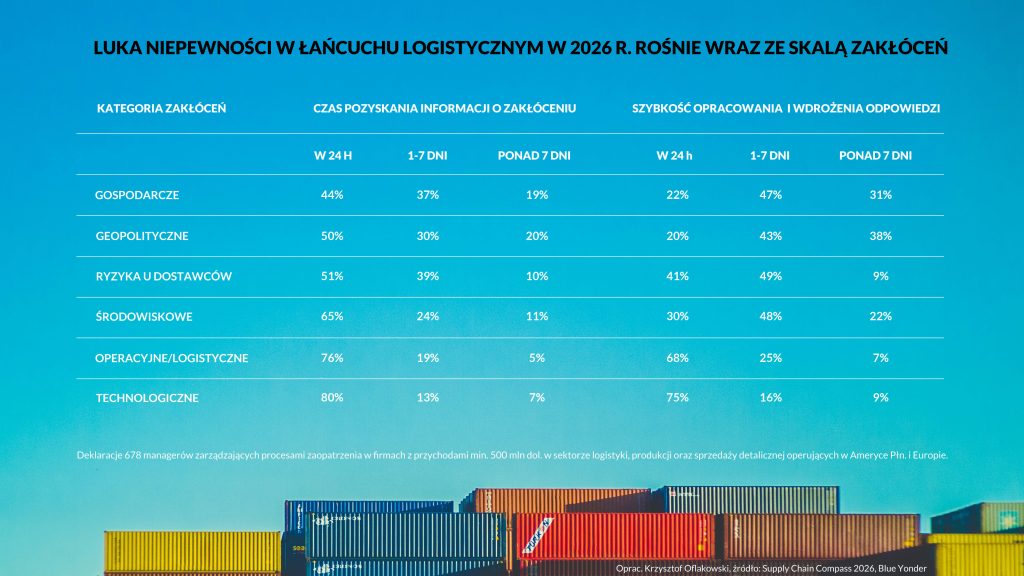
As many as 68% of managers see the greatest threat in economic challenges, including, for example, inflation. The second most serious factor is purely operational elements related to, among other things, transport delays or inventory problems (60%). Slightly fewer, 59%, fear disruptions resulting from geopolitics, which include, among others, barriers imposed on trade. In this group, even optimistically inclined managers fear its negative impact. There are as many as 64% of them.
The uncertainty gap is growing along with the scale of threats
Another serious problem is associated with geopolitics, namely that formulating a position and implementing an appropriate response takes the most time. Therefore, the uncertainty gap is growing—that is, the time from detecting a threat to developing a working solution. While half of the surveyed managers find out about geopolitical disruptions within just 24 hours, only 20% are able to respond to them within one day. As many as 43% need up to 7 days to do so, and 38% need more than a week. Disruptions of this category more often occur on a macro scale, and therefore their effects are broader and require significant structural adjustments. The same applies to economic elements, which 44% of managers find out about within one day, while only 22% of respondents declare the development and implementation of a solution within 24 hours.
Threats and high volatility will remain for longer
A comprehensive diagnosis of threats to supply chain operations is also included in this year’s Agility Emerging Markets Index report. It involved 503 executives from the logistics sector and supply chain managers. One very clear conclusion stands out in the study, namely that market volatility is now perceived as a permanent element of the logistics environment. Nearly 86% of respondents believe this, of which 54.6% are of the opinion that in 2026 and at least in the short term, the situation will deteriorate before one can speak of stabilization. The rest of this group (31%) claims that there is no hope for stabilization and one should rather accept the fact that the current level of volatility is simply the new reality that will remain permanently.
The surveyed managers indicate a similar catalog of threats as in other industry analyses. When mentioning risks for which their organizations are least prepared, trade restrictions in the form of tariffs and protectionism (16.6%), factors such as inflation and rising costs, and staff shortages (13.1% each) appear on the podium. Also high on the list are supply chain disruptions (12%) and economic slowdown (8.1%). It is not surprising, therefore, that at the top of the priorities is strengthening supply chain resilience (19.6%), protecting margins (19.5%), and maintaining growth (15%).
Forecasts do not help logistics
In its report on threats in 2026, the World Economic Forum wrote directly that it is uncertainty that is the main theme of the forecast. Furthermore, the experts surveyed by the WEF evaluated both short-term and long-term global prospects negatively, and 50% of them expect a turbulent or uneasy environment over the next two years. This percentage rose to 57% regarding expectations for the next decade. In 10 years, almost no one expects a climate of political cooperation on global threats, and it is basically the opposite. Protectionism, strategic industrial policy, and active government influence on key supply chains are expected, which will make the world even more competitive.
A multipolar or fragmented order in which medium and great powers compete to establish and enforce regional rules and norms is the vision of as many as 68% of respondents. Another 14% see a bipolar order shaped by strategic rivalry between two superpowers, and 12% predict transformations toward a new international order under the leadership of an alternative superpower. The remaining 6% out of 1,300 surveyed authorities hope for the revival of a rules-based international order led by the USA. This vision, however, seems at least unlikely in the context of the statements of the US Secretary of State, who said over a year ago that unipolar power was an anomaly that was a product of the Cold War.
The validity period of macroeconomic predictions is falling
The problem with forecasts, apart from the fact that they are not very optimistic, also concerns their shelf life. This was the case with the April publication of the International Monetary Fund (IMF), which in each of the scenarios presented assumed a deterioration of the global economy, and one of the main reasons is the war in the Middle East. This, alongside high trade barriers and heightened uncertainty in the international arena, neutralizes positive phenomena, including investments in modern technologies. In a comment to its periodic study, the IMF even noted that the document, due to difficulties in establishing a coherent set of assumptions in real time, publishes only a reference forecast based on the presumption that the war will have a limited duration, intensity, and scope, and the disruptions caused by it will cease by mid-2026.
In such an approach, the average oil price for the entire current year was to reach the level of $82 per barrel (bbl), and global economic growth in 2026 was to fall from the level of 3.4% in 2025 to 3.1% and maintain the level of 3.2% in 2027, i.e., below the historical average of 2000–2019 of 3.7%. Global core inflation was to rise to 4.4%, and then a decline to 3.7% was planned. Unfortunately, little remains of the forecasts, because shortly after the data was announced, it was declared that the assumptions might already be outdated, which was finally confirmed at the beginning of May by the head of the IMF. Therefore, the so-called adverse scenario applies, in which GDP growth in the current year slows down to 2.5%, and inflation is 5.4%. The average oil price reaches $100/bbl. This also means that the cost of fertilizers is already 30-40% higher, which may raise food prices by 3-6%.
It should be remembered at the same time that the volatility of economic and geopolitical conditions, which a number of important analyses and prestigious institutions point to, remains at a very high level, and the third, most severe scenario prepared by the IMF is still on the table. In such a simulation, the average oil price reaches approx. $110/bbl, GDP growth this year falls to approx. 1.8%, and in a year it is 2.2%. In turn, global inflation jumps to 5.8%, and in 2027 it reaches 6.1%. In total, this will mean that the world will stand on the brink of recession, which has happened only four times since 1980, with the last two cases coinciding with the global financial crisis and the COVID-19 pandemic.
Other major centers also talk about crisis
The realization of further adverse scenarios will be decided by the conflict in the Middle East, including the ongoing paralysis on key transport routes, but other institutions also talk about recession. For example, Oxford Economics conducted a simulation assuming that as a result of the war, oil prices would stay at an average level of approx. $140 for two months. This factor, along with secondary effects, would lead to a worsening situation in financial markets, a deterioration of economic sentiment, and a further intensification of disruptions in supply chains. This would be enough to push part of the global economy toward a mild recession. If this happens, inflation will rise sharply, reaching an average of 5.1%, and at its peak even 5.8%. There will also be a significant increase in natural gas prices, and these and other side effects will lead to a decline in global real GDP by 0.7% at the end of 2026.
Restriction of raw material supplies is already very severe
Kpler states, for example, that just until mid-April 2026, due to the suspension or disruption of supplies, the global market lost over 500 million barrels of oil, which is the largest supply disruption in history. This is also a loss of approx. $50 billion in commodity trade revenue, which is roughly the same as the GDP of Latvia (48.59 billion) or Estonia (47 billion). Other analyses, this time by Wood Mackenzie, show that the unproduced 500 million barrels represent the equivalent of a scenario assuming the complete suspension of road traffic of all vehicles in the world for 11 days. Alternatively, it also corresponds to limiting the demand for global air transport for 10 weeks or completely cutting off the global economy from oil for 5 days. The missing volume would also be enough to power the entire global international shipping sector for approx. 4 months. In turn, the effects of current disruptions may be visible for many months or even years, affecting not only the global energy market and trade but also the logistics supporting it.
Source: Krzysztof Oflakowski