









Free delivery in e-commerce is one of the elements of the market battle for the customer. This option has become firmly embedded in consumer awareness and often represents one of the main reasons for either completing or abandoning a shopping cart. What do experts think about this?
<\/strong><\/p>
 Wojciech Topolewski, Marketing Director at Oponeo.pl
<\/em><\/strong><\/p>
Currently, the majority of online stores, not only in Poland but also globally, offer free shipping from a set shopping cart value regardless of the customer’s place of residence. Analyses clearly indicate that shipping costs that are disproportionate to product prices are one of the reasons for abandoning orders, and consequently, losing potential customers and profits.
Leading brands, which were among the first to calculate delivery costs into product prices and offer customers not only free shipping but also returns, have built a strong market position in their segment.
Customers, wanting to obtain the free delivery option, are often willing to purchase additional products. It happens, in the case of lower-value products, that buyers encourage family or friends to shop together precisely so as not to lose money on delivery costs.
This is a benefit for the buyer, but also for the online store itself, as it provides an opportunity to increase sales due to the effect of adding products to reach an amount that allows exceeding the free delivery threshold. It can be said that OPONEO.PL was ahead of this trend, as it has offered free shipping on purchases from the very beginning of its operations.<\/p>

Jadwiga Żurek, Sales Director, Arvato Supply Chain Solutions<\/strong>
<\/em><\/p>
All Gemius reports from recent years analyzing the e-commerce market in Poland clearly emphasize that free delivery is one of the main motivators for online shopping. Its absence, in turn, discourages customers from making purchases or finalizing them (shopping cart abandonment).
Free deliveries and returns were first adopted in online stores of fashion brands. Enabling customers to order multiple items in different sizes, try them on at home, and send back those that didn’t fit became, among other things, a distinguishing feature of Zalando, which focused particularly on delivery in its first advertising and image campaigns. Subsequent brands operating in e-commerce, not just those in the fashion industry, understood that the customer wants to pay for the product, but not for delivery. Therefore, they introduced either completely free shipping or an amount above which the ordering party does not pay for shipping.
The development of diverse forms of package collection and the decrease in their prices have also had an impact on the increase in the number of free deliveries in e-stores. Large e-commerce companies naturally carry out their deliveries door-to-door; while smaller ones successfully use forms such as: parcel lockers (Paczkomaty) or so-called “pick-up points,” giving their customers the ability to choose both the price, time, and place of delivery.
Allegro, the Polish marketplace, perfectly understood the problems of its customers and in 2018 introduced an annual subscription, thanks to which users can count on free deliveries. In turn, the popularity of the so-called “free delivery days,” introduced on various occasions, clearly showed that customers expect this.
This was the case before the pandemic, which turned consumer shopping habits upside down all over the world. Online shopping began to be the standard, and once customers got used to it, they declared that they would continue to use this form of shopping as their preferred one. This is very good news for the entire e-commerce sector and at the same time an opportunity to convince users that the entire online purchasing process (including returns) is simple, safe, and user-friendly.
In my opinion, new times are forcing e-sellers to change their company policies. In an era of such strong competition, it will not only be the price of the product or the quality of service in the e-store that counts, but also the delivery price; therefore, it should be free, without any conditions (basket product prices, destination, or size of the e-store). Customers are still able to understand symbolic fees in small e-commerce stores, while large players may have no choice. The next year or two will strongly verify the e-commerce market. We will see who gained not only during the crisis, but above all – how they coped in times of stabilization.<\/p>
 Karol Robaczewski, Distribution Center Director, x-kom sp. z o.o.<\/strong><\/em><\/p>
Free deliveries are a trend that will develop and will be taken into account in e-commerce profit calculations. Many analyses point to free shipping as a customer’s criterion for choosing a specific seller. In order to minimize the costs incurred by companies, more and more significant players are offering their customers subscriptions that guarantee free deliveries. This element is now perceived as a must have<\/em>, and not – as it has been so far – a nice to have<\/em>. Extending the service to areas outside major cities is only a matter of time. In the constant race for the customer and their requirements, infrastructure and delivery methods minimizing the sender’s costs will change. Currently, we are observing the development of research on drone deliveries or the transition to couriers using electric car fleets, which in the near future will translate into a huge range at minimal costs.<\/p>
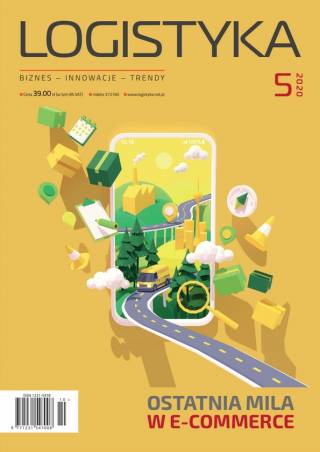
We write about deliveries and returns – including free ones – in issue 5\/2020 of the Logistyka magazine.<\/h4>
– Table of contents for the issue<\/a>
– Electronic version (e-book)<\/a>
– Magazine subscription<\/a><\/h4>
– Electronic version (e-book)<\/a>
– Magazine subscription<\/a><\/h4>
 <\/a><\/p>