











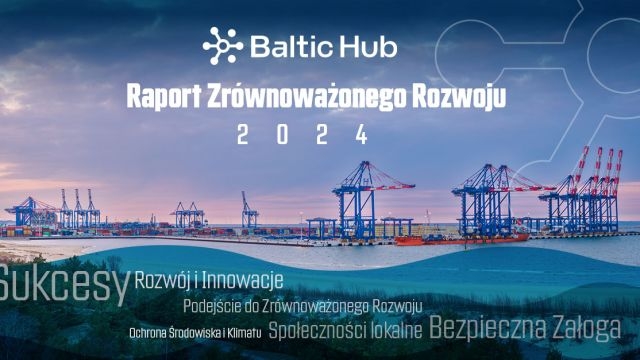
The Gdańsk container terminal, Baltic Hub, is publishing its Sustainability Report for the seventh time. The year 2024 was one of the most dynamic periods in the company’s history – both in terms of infrastructure development and commitment to social and climate initiatives.
In 2024, Baltic Hub handled 2.24 million TEU. This is the highest result in the company’s history. Handling operations were carried out on a record scale – the terminal serviced 642 vessels, including as many as 147 ocean-going units, and in July of last year, a record 20,459 TEU were handled during a single vessel call. During the reporting period, the terminal expansion – T3 – was also underway, which will reach full operational capacity in 2025, increasing the total capacity of Baltic Hub to 4.5 million TEU per year. As part of intermodal development, the terminal launched its fourth RMG crane, increasing the rail siding capacity to over 800,000 TEU per year. Two more RMG cranes are planned. In parallel, the company increased energy efficiency and implemented CSR and ESG activities, focusing on caring for employees, the local community, and the environment.
ESG Strategy at Baltic Hub
In 2024, the Gdańsk terminal began implementing its ESG Strategy for 2024–2026, which is based on six pillars: reducing dependence on fossil fuels, nature conservation, creating attractive workplaces, supporting social development, ESG management, and building a sustainable supply chain. As part of communication efforts in this area, the company conducts, among other things, educational campaigns and training for employees on ESG and decarbonization topics.
At Baltic Hub, we believe that responsible development begins with caring for employees and their safety, effective environmental protection, and building strong, partnership-based relationships with the local community. These are the foundations of our ESG strategy, which is not an addition to the business, but an important element of it. Today, one cannot be a competitive, innovative, and credible partner without an integrated approach to sustainable development. At Baltic Hub, ESG is not so much a tool as it is a way of thinking and acting that provides long-term value to our customers, employees, and the entire environment – says Jan van Mossevelde, CEO of Baltic Hub.
The data contained in the 2024 Sustainability Report highlights how dynamic development goes hand in hand with a deep commitment to a green future and supporting local communities.
Work safety in the DNA of Baltic Hub
Safety remains one of the fundamental pillars of Baltic Hub’s operations. In 2024, the company continued its activities within the OHS management system and implemented the internal “Zero Accidents” safety policy, which includes regular training, occupational risk assessments, and quarterly inspections. The “Safety in our DNA” campaign reminded everyone how important mindfulness and reflection are, especially in such a dynamic work environment. Employees can report irregularities through the OHS Alert system and share ideas for improvements via the IDEA BOX platform. Baltic Hub also promotes safe attitudes through the “Safe Employee of the Quarter” program and the annual Safety Fest, in which over 1,000 employees and their families participated in 2024. Thanks to the commitment of the entire team, Baltic Hub creates an environment where safety is a real value, not just a formality.
The terminal provides ergonomic working conditions, and in the interest of employees’ physical health, it supports company sports teams and co-finances employee participation in sports competitions. Staff development is also extremely important for Baltic Hub – in 2024, over 60,000 hours of training were conducted covering 400 topics, including a series of OHS training sessions, “Samurai at work” workshops, labor and tax law training, machine operation, IT, as well as technical and operational training.
Emission reduction and green energy
The year 2024 was also a year of significant progress for Baltic Hub in achieving its climate goals. The terminal reduced its greenhouse gas emission intensity (Scope 1 and 2) by 8.47% – from 7.2 kg CO₂e/physical TEU in 2023 to 6.59 kg CO₂e/physical TEU in 2024. This is a significant step towards achieving the goal of reducing emissions by 50% by 2030 compared to 2019 levels and reaching full climate neutrality by 2050. All electricity consumed at Baltic Hub in 2024 came from renewable sources – the company purchased guarantees of origin for 100% of its demand. At the same time, tests of electric terminal tractors (e-Prime Movers) were conducted, and the plan for their implementation will begin in 2026. In terms of waste management, Baltic Hub achieves excellent recovery results – out of 640,889 kg of generated waste, 571,221 kg (i.e., 89%) were recycled or recovered. The terminal also implements circular economy principles: it regenerates machine parts and uses elements of used materials from marketing campaigns (e.g., banners) to create bags and backpacks for employees.
Social responsibility in action
In 2024, Baltic Hub allocated over PLN 1 million to social and charitable activities. As part of the third edition of the “Busole” grant program, seven social projects with a total value of PLN 250,000 were co-financed, including educational workshops, pro-ecological activities, and intergenerational projects. The company supported projects implemented jointly with local governments, non-governmental organizations, and local institutions. These included neighborhood festivals, tree-planting campaigns, equipping schools, and purchasing a car for the Pomorze Dzieciom children’s hospice, which allows doctors and nurses to reach young patients within a 100 km radius of Gdańsk. In September, Baltic Hub employees participated in the 4th edition of the Go Green campaign – which included organizing beach clean-ups at Stogi, book drives, a zero-emission day, and tree planting.
The Baltic Hub Sustainability Report is available at the link:
Baltic Hub – Sustainability Report 2024
Source: Baltic Hub