








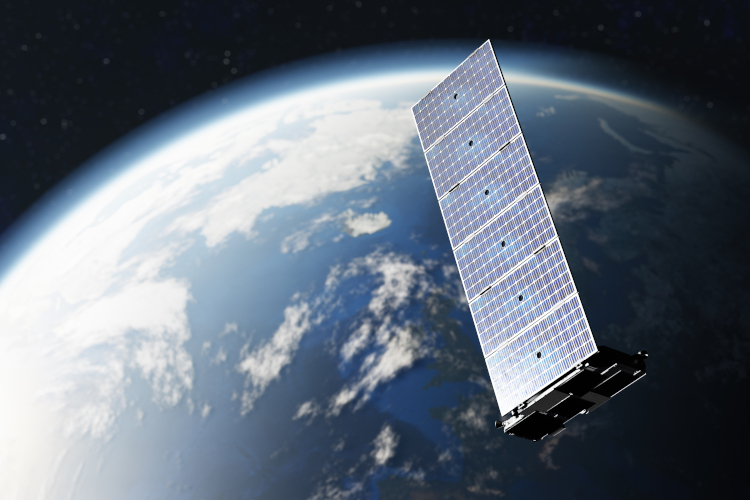
The large number of new communication satellites in low Earth orbit (LEO) opens up many interesting opportunities, including for logistics. In particular, the Starlink network, which can already be used in many parts of the world. The “Laboratory of the Future” presents the results of research by the Corporate Research and Development Department, which works closely with various departments and divisions, technology research partners, as well as the DACHSER Enterprise Lab at Fraunhofer IML.
Far above our heads, the sky is becoming increasingly crowded. There are many more satellites orbiting the Earth than there were just four years ago: there were fewer than 3,000 active satellites in orbit then, and now there are over 7,000. And by 2030, this number could quadruple. The main driver of this strong growth is the increase in the number of LEO satellites.
LEO refers to low Earth orbit – the path taken by fast-orbiting communication satellites. Orbits in the LEO region are located at an altitude of approximately 250 to 2,000 km above the Earth’s surface. This means that these satellites can have short signal transit times compared to those in higher orbits and can be deployed during shorter – and thus cheaper – rocket flights. However, this has its drawbacks. A low orbit means that more communication satellites are needed to ensure coverage across the entire surface of the Earth. Moreover, the air resistance still present in this region leads to greater wear and tear. Modern LEO satellites orbiting at an altitude of 550 km tend to burn up in the Earth’s atmosphere after about five years, whereas a modern, four-meter GPS satellite in medium Earth orbit (MEO), at an altitude of over 20,000 km, will have a lifespan of 15 years.
There are over a dozen global LEO satellite operators offering not only telephony but also a wide range of data transmission, multimedia, and video services. The most well-known and ambitious example of LEO satellites is the Starlink system owned by the SpaceX company of American entrepreneur Elon Musk. Between 2020 and mid-2023, the company installed over 4,500 satellites at an altitude of 550 km above the Earth. Every week, SpaceX launched one of its reusable Falcon 9 rockets, which placed up to 50 of these 300-kilogram Starlink satellites into orbit at a time. A new generation of Starlink satellites is now available, but because they weigh significantly more (1.25 tons each), launching them into space will be less cost-effective than the exceptionally economical method used to expand the system until now. Nevertheless, Starlink plans to place over 7,000 such satellites into orbit. Their launch has already been approved by the relevant US authorities.
Internet from space
Starlink’s specialty is providing people with Internet access without the need for mobile communication networks or stationary devices. Users who want to use this solution need a transmitter and receiver, which are the size of a milk carton, and a satellite dish. Tests conducted by DACHSER Corporate Research & Development showed that the data transmission speed is between 50 and 200 Mbit/s. The availability and reliability of the basic internet connection were rated as “good” to “very good”.
LEO communication solutions are being developed at an impressive pace: Starlink and its partners announced that they would be testing satellite internet for aircraft and smartphones in 2023. The Apple iPhone 14 is already equipped with an emergency SOS via satellite feature, which allows users to exchange short messages with emergency services even when a cellular network is not available. This two-way communication is possible thanks to 48 LEO satellites orbiting the Earth at an altitude of 1,400 km – operated by Globalstar.
Other providers are also trying to compete with Starlink – the market leader in LEO internet. These include the British provider OneWeb, Amazon, and government initiatives implemented in China and the European Union. By 2027, the EU has announced its intention to place about 170 LEO devices into orbit to create an independent satellite data network.
A technology of the future that is gradually becoming a reality theoretically offers logistics the possibility of maintaining data communication with cargo units, vehicles, and transit terminals, even when 4G and 5G networks are unavailable. Which applications will ultimately prove profitable will be largely determined by the size, energy requirements, and cost of the transceiver devices, as well as the actual availability of data transmission bandwidth. DACHSER will continue to work on these options as part of its research and innovation activities.
Source: Andre Kranke, Head of Corporate Research and Development at DACHSER