











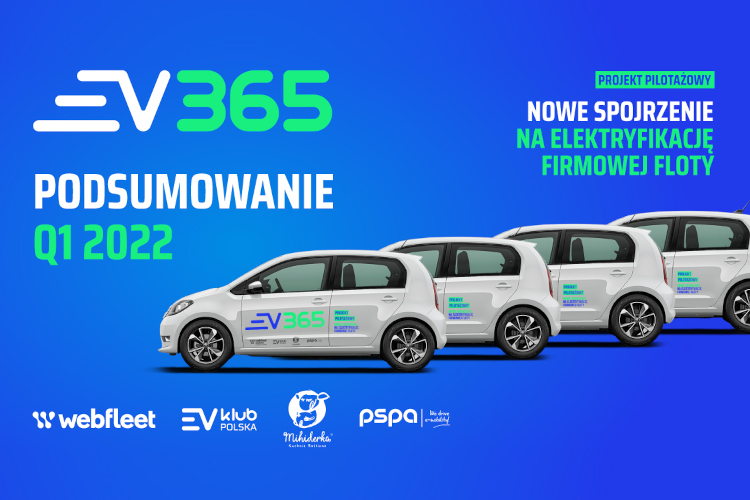
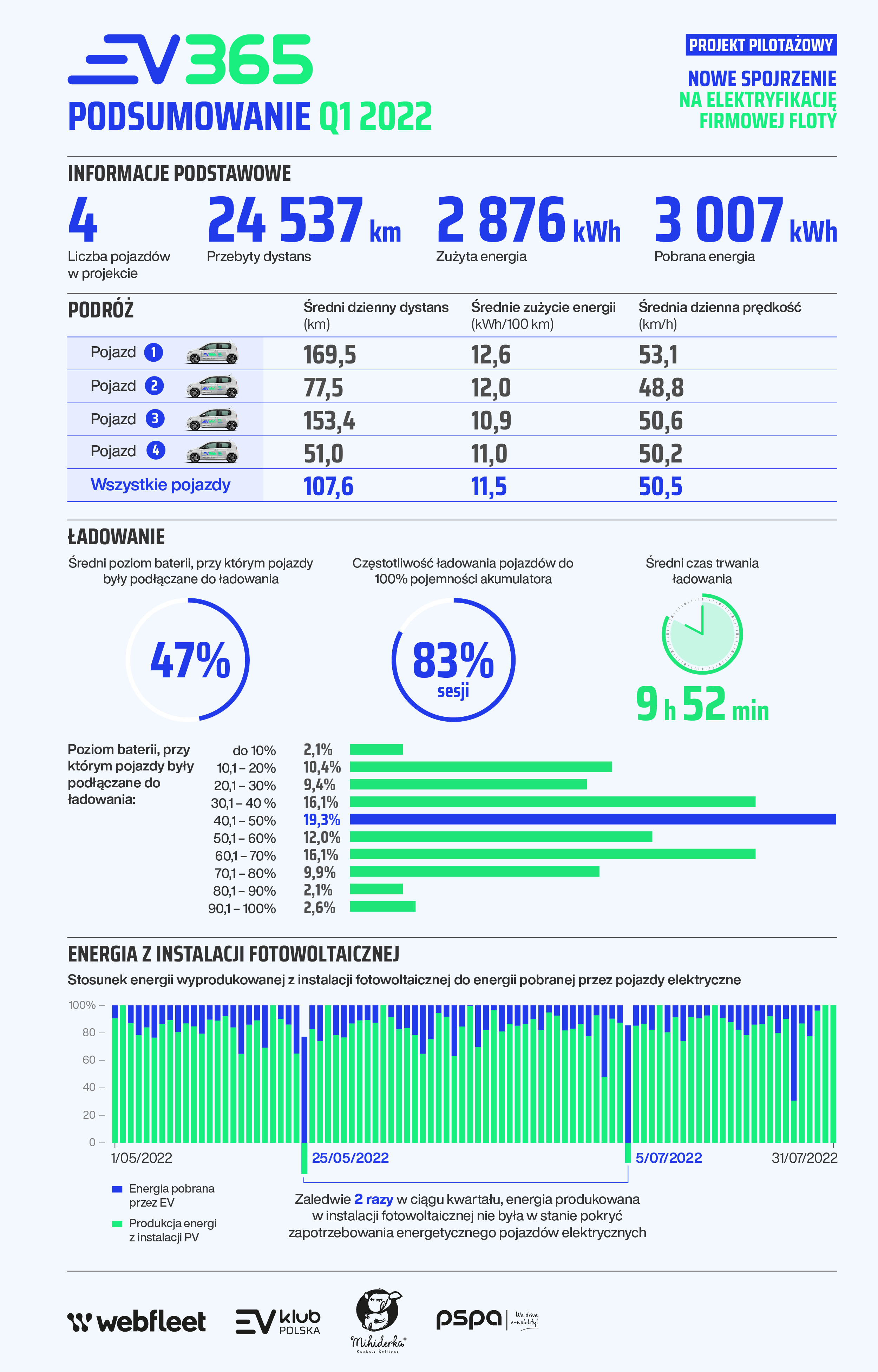
Between May and July, a photovoltaic installation with an installed capacity of 50 kWp was able to cover 100% of the energy demand of four electric vehicles used for catering deliveries. During this time, the vehicles covered a distance of over 24,500 km, consuming 2,876 kWh of electricity.
EV365 is a completely new research perspective on electric vehicles. The goal of the project is to analyze the benefits of fleet electrification from the perspective of an entrepreneur who is already an electric vehicle user. All electric vehicles used in the study perform commercial tasks consisting of delivering meal bags as part of the catering operations of the Mihiderka restaurant chain (Mihiderka W Drodze). In July 2022, the first of four stages was completed, and a general summary can be found below. Detailed data and analysis results will be presented after the entire project concludes in 2023.
Each Škoda Citigo e iV participating in the project covered at least 51 km per day. Drivers moved mainly on urban roads, and their average travel speed was 50.5 km/h. The average energy consumption for the entire range of vehicles studied was recorded at 11.5 kWh/100 km. Vehicles were plugged in for charging when the battery level was approximately 47%. In the vast majority of cases, a charging session, which lasts an average of 9 hours and 52 minutes, allowed the battery to be charged to 100% of its capacity. Energy production from the 50 kWp photovoltaic installation made it possible, with the exception of only two days, to cover 100% of the energy demand of the cars participating in the project. The energy consumed by the vehicles accounted for an average of 18% of the PV installation’s production.
– Almost 25,000 kilometers driven in 3 months shows that if we choose the fleet well for the company, even small, urban electric cars are sufficient. Additionally, this type of drive combined with photovoltaics is an ideal duo. This project shows that in selected cases, it is already possible to successfully implement electric cars into company fleets today. At EV Klub Polska, we are seeing more and more club members who not only drive EVs on a daily basis but are also increasingly willing to replace their company fleets with electric vehicles – says Łukasz Lewandowski, President of EV Klub Polska
– The EV365 project is extremely interesting because it allows us to observe the parameters of electric vehicles in their real-world use in business operations. Additionally, including data on energy production from the photovoltaic installation in the analysis provides valuable information and tips for entrepreneurs, especially now, when facing the challenge of rising fuel prices, we are looking for all options to generate savings. The data for the last quarter is positive in this respect, but only readings in the coming months will give us a full picture of the situation. We are closely watching how EVs consume energy and their charging patterns. We want to use this data to improve our Webfleet telematics system and build new tools and reports that will support the optimization and even more effective management of electric vehicle fleets – says Agnieszka Szwaj, Marketing Manager Poland & EE, Webfleet
– We are very satisfied with our participation in the project. Thanks to this, we can more closely monitor the parameters of our cars. Webfleet’s devices and software enable the collection of a range of data that our drivers previously entered manually into paper reports. Another benefit is the ability to locate vehicles in real-time, which allows us to both monitor speeds and estimate the arrival times of our couriers to individual customers. This is especially helpful when a customer asks when they can expect a delivery. The option for the system to inform about failures, errors, or even low battery levels of a given vehicle is also very useful. And here, for example, the person tracking the movements of the electric vehicle fleet has the ability to suggest to the driver that they should think about charging. This is an important issue, especially in the training phase for new people. The results of the first period of the program show how efficient the Skoda CitiGo E is – consumption at the level of 11.5 kWh/100km places this model at the top of the list of economical urban vehicles. Even with the increasingly expensive electricity, the cost of driving one kilometer with this car is very attractive compared to an analogous internal combustion vehicle. I am looking forward to the results calculated in winter – says Marcin Krysiński, co-owner of the Mihiderka chain.