








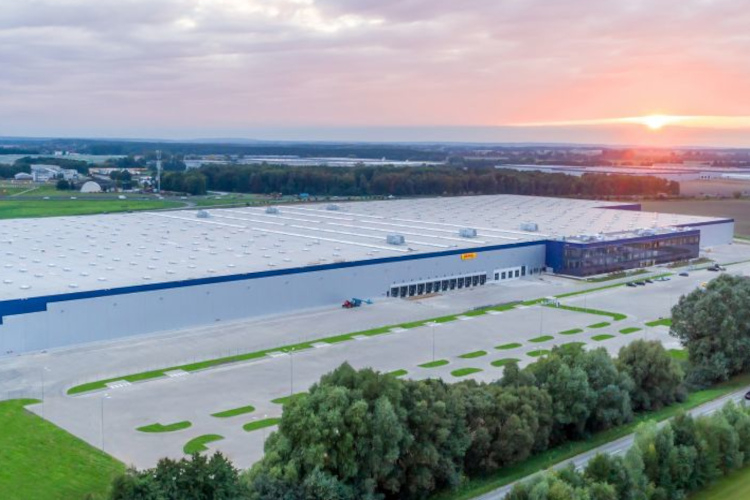
A BREEAM “Excellent” certification has been awarded to a facility built for the e-commerce industry. The investment, covering nearly 108,000 sqm, was developed for DHL Supply Chain, the world’s largest logistics company. In Poland, Panattoni’s portfolio of facilities confirmed by green certifications amounts to approximately 5.3 million sqm, with another 3.5 million sqm in the pipeline.
Time for certification. Since the introduction of the BREEAM Excellent standard, Panattoni has certified over 400,000 sqm of space this way, with an equal amount awaiting assessment. Additionally, since the beginning of this year, thirteen other facilities previously built by Panattoni, totaling over 260,000 sqm, have achieved BREEAM “Very Good” certification. Thus, the developer can boast over 5 million sqm of space that has successfully passed the environmental certification process in Poland, with another 3.5 million planned for this year.
Located in Żerniki Wielkopolskie, the BTS DHL Supply Chain facility is the second to be certified at the “Excellent” level this year. The score achieved by the warehouse is 74.2 percent. However, in three categories, the rating reached the highest “Outstanding” level.
In the “Water” category, the facility scored a maximum of 100 points. This rating is the result of implementing a range of solutions that allow for a reduction in water consumption. On one hand, these include low-flow water devices, aerators, and solenoid valves. On the other, it involves planting native vegetation on the plot. Thanks to the employment of an ecologist and the adaptation of vegetation to local rainfall levels, it does not require watering.
– Such solutions result in water savings at the facility near Poznań reaching as much as 60.5 percent compared to the average consumption model. That is truly significant. We must remember that Poland is one of the most water-poor countries in Europe and is desertifying before our eyes. Moreover, reducing water consumption – besides its ecological dimension – also brings tangible benefits to the tenants themselves, as they save on water fees. Certified facilities also mean energy savings, which in the case of the building in Żerniki reach over 18 percent annually – explains Emilia Dębowska, Sustainability Director, Panattoni.
Sustainable building life. The facility also gained high marks – at the “Outstanding” level – in the “Waste” (86 pts.) and “Health and Wellbeing” (91 pts.) categories. Waste management is extremely important both from the perspective of sustainable development and the level of facility certification. It concerns not only the construction process itself but also the subsequent management of the entire facility.
During the construction of the BTS DHL Supply Chain, as much as 86.68% of waste was recycled. Wood sourced exclusively from legal origins with a known supply chain was used for construction, along with materials holding EPD certificates in quantities exceeding the maximum rewarded in the certification. However, the building and its surroundings were primarily prepared for long-term climate change. The selection of materials and applied solutions are intended to protect it against extreme weather events. At the same time, a Facility Adaptation Strategy for functional changes was prepared. This will allow for the limitation of future construction works related to expansion or changes in the building’s purpose. The Life Cycle Assessment (LCA) result of 88.9% confirms the maximum reduction in energy consumption, emissions, and environmental impact over the entire life cycle of the building.
Caring for employees. Undoubtedly, the long life cycle of the building will be supported by the care with which the developer approached solutions serving its future employees. The facility limits the concentration and circulation of external pollutants, ensures an appropriate level of thermal comfort, and ensures that noise levels in rooms do not exceed permissible limits. Solutions protecting against water contamination have been introduced. The entire facility is adapted to different user groups and designed without barriers.
Transport amenities for park users have been adapted to the building’s location and the lowest possible CO2 emissions. Bus parking has been provided, and their schedules have been correlated with employee shift systems. Infrastructure favoring cycling has been prepared, including conveniently located, illuminated, and covered bicycle shelters. Charging stations for electric cars have been provided, and priority parking spaces for those using carpooling have been designated and marked.