








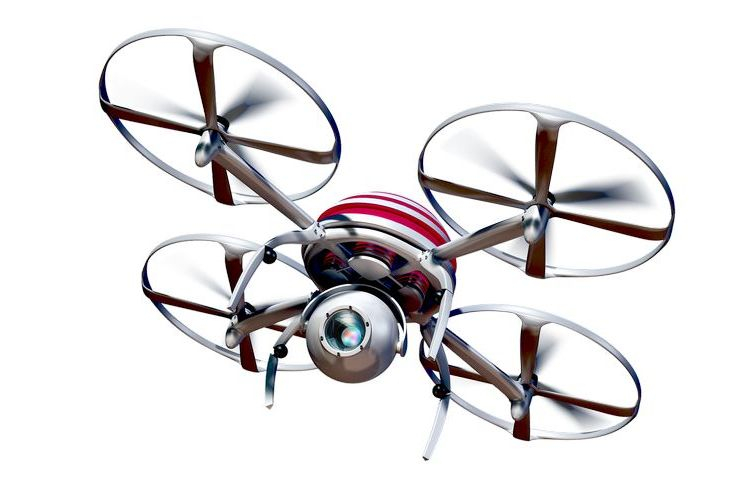
Instead of a team of people equipped with scanners and lifts, warehouse inventory can be performed by a swarm of drones that fly through the rooms and take pictures of the goods. The system then analyzes the image and searches for barcodes. Autonomous aircraft perform their tasks cheaper, faster, and more accurately than humans. An additional benefit is the creation of a so-called orthophotomap of the warehouse, which makes it easier to monitor stock levels.
The use of drones in enclosed spaces is not subject to the same formal and legal restrictions as missions performed in open spaces, such as last-mile deliveries. Therefore, it is easier to introduce to the market as a separate service, e.g., in the field of automatic and autonomous inventory in warehouses.
– Until now, inventory required the preparation of appropriate equipment and human resources. In a large warehouse with 10,000 pallet spaces, lifts were needed to allow employees to access the highest shelf, i.e., up to 4-5 meters high, as well as handheld scanners. The work was performed by 8-10 people over three days. Instead of people, scanners, and lifts, you can use a swarm of drones that flies into the warehouse like a swarm of bees, flies around the rooms, and takes pictures of every shelf with goods – explains Janusz Wrobel, CEO of NeuroSpace.
The system, implemented directly on the drone or in the cloud, analyzes the photos and searches for barcodes or other types of two-dimensional codes that allow for the identification of goods placed on a given shelf.
– At the same time, OCR algorithms, i.e., optical character recognition, can be used to recognize inscriptions in a normal language, which enables double recognition, both of barcodes and legible inscriptions – clarifies Janusz Wrobel.
As he emphasizes, the advantage of a system using unmanned aerial vehicles over inventory performed in the traditional way is both time savings and lower costs. A drone is an automatic and autonomous tool, meaning it costs as much as the material from which it is made. It has low energy requirements, and the investment is one-off, with no need to use additional human resources. Additionally, the machines are more accurate than humans.
– Drones do not make mistakes, while people can sometimes fail to see a carton, not scan it properly, etc. In turn, the system that processes the photos allows for quick recognition of goods and at the same time, which is perhaps one of the biggest pluses, creates a so-called orthophotomap, presenting the structure of the warehouse and the goods that are on the shelves – points out the CEO of NeuroSpace.
Drones will also find their place in so-called last-mile deliveries. Many Polish companies are working on pioneering solutions in this area, but there are significant difficulties in the context of formal and legal conditions. They prevent the use of drones to their full extent, although technologically it would be possible. Therefore, many Polish companies are primarily developing drone technology for indoor applications.
– The scope we are dealing with, i.e., missions in closed rooms, will spread quite quickly. We are trying to initiate international cooperation in the field of autonomous drones. Drones that fly under human supervision are already generally being developed in Europe, and autonomy is a fairly new concept in the field of unmanned aerial vehicles. We want to promote these technologies through international cooperation. We are in talks with the CASUS research institute in Görlitz, which deals with artificial intelligence and the use of drones in this area, as well as with the Wrocław University of Science and Technology and the city of Wrocław, to create an international cluster in Central Europe – announces Janusz Wrobel.
Source: Newseria