








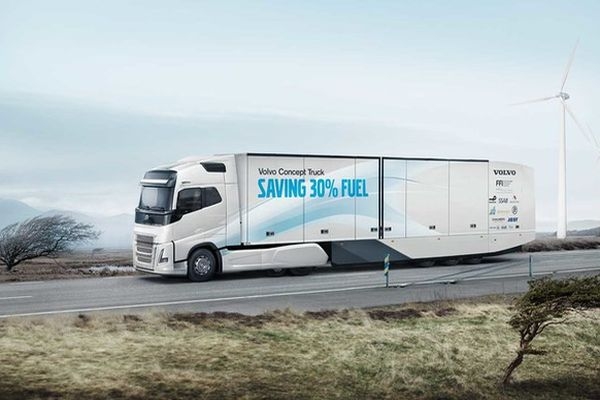
On February 18, the European Union decided to regulate CO2 emissions from heavy-duty vehicles. To accelerate development in this area, Volvo Trucks continues to invest in climate-friendly transport solutions. However, to stimulate demand for low-CO2 vehicles, additional measures are necessary.
– Reducing exhaust emissions from heavy-duty vehicles is an extremely important task that has a fundamental impact on our initiatives in the area of sustainable transport. At Volvo Trucks, we are well prepared to take on this challenge. The next natural step for the European Union will be the introduction of CO2 emission limits. Nevertheless, in order to reach this stage faster, greater financial incentives are also needed for customers who decide to lead the way by choosing more eco-friendly vehicles – says Roger Alm, President of Volvo Trucks.
Electric trucks can play an important role in reducing CO2 emissions. In 2018, Volvo Trucks introduced its first electric-powered vehicle models to the market. Serial production of these will begin this year.
– We are at a stage where this technology will soon reach a state of readiness for wider implementation in road transport. Stimulating demand and expanding battery charging infrastructure would allow for a significant increase in the pace of adoption of these vehicles – emphasizes Lars Mårtensson, Director of Environment and Innovation at Volvo Trucks.
Climate-friendly solutions also include natural gas and biogas. The Volvo FH LNG powered by natural gas emits about 20 percent less CO2 compared to a vehicle powered by a conventional diesel engine. In the case of using biogas for this purpose, the “tank-to-wheel” emissions can be reduced by up to 100 percent.
At the same time, Volvo Trucks continues to develop its diesel-powered vehicles, which account for the vast majority of the company’s sales. Since the early 1990s, fuel consumption and CO2 emissions in a typical Volvo long-haul truck have decreased by about 20 percent*, and there is still potential for further improvement in this area, stemming from more efficient powertrains, lower rolling resistance, and better aerodynamic properties. Every truck must be optimized for a specific transport application.
Although the emission limits imposed by the EU set clear timeframes for vehicle manufacturers, the fundamental goal – improving fuel economy and reducing climate impact – has long been a priority in the industry, partly due to the fact that fuel costs account for nearly one-third of total costs in a transport company.
– Our ambition has always been to offer customers optimal, energy-efficient, and comprehensive solutions tailored to specific transport tasks – says Lars Mårtensson.
Both Volvo Trucks’ customers and buyers of transport services are keenly interested in reducing the climate impact of transport. Therefore, increasing the scale of investment subsidies or tax breaks for those who decide to invest in eco-friendly technologies could make a big difference.
– New technologies enabling the reduction of CO2 emissions must quickly become widespread in the market. A faster assessment and certification procedure would ensure quicker implementation of innovations in the transport sector. The model adopted by the EU covers emissions directly from vehicles, but Volvo Trucks approaches this issue more broadly – claims Lars Mårtensson. – By consolidating all elements of the transport system around the same goal, we could reduce the climate impact to a much greater extent. More efficient logistics, greater access to biofuels, driver training in economical driving, aerodynamic trailers, higher standard roads, or greater opportunities to use high-capacity vehicles are some of the areas where other entities can make a contribution.
Facts:
• New EU regulations on CO2 emissions from heavy-duty vehicles apply to vehicles manufactured and registered in 2019 or later.
• Average emissions are to be reduced by 15 percent starting from 2025 and by 30 percent starting from 2030 (compared to the 2019 level).
• The introduced limit applies to emissions from heavy-duty vehicles produced by a given manufacturer in relation to the 2019 industry average.
• Road transport accounts for nearly 5 percent of total greenhouse gas emissions in the EU.
*Since the early 1990s, Volvo Trucks has reduced fuel consumption in its newly produced trucks by one-fifth. This comparison includes the 1991 Volvo F12 and the 2016 Volvo FH13.