












The primary reason for maintaining inventory in an enterprise is the desire to ensure a set level of service for external customers (product availability) in the context of demand fluctuations, as well as for internal customers (ensuring continuity of the production process) while taking into account variable demand for materials/raw materials.
Proper inventory management is very important for an enterprise because, on one hand, inventory is a source of costs, and on the other, it determines the provision of a high level of customer service. Therefore, rational inventory control by managers and making the right decisions regarding the determination of safety stock levels, order quantities, reorder points, inventory control systems, and generally speaking, the selection of appropriate inventory management methods, becomes an important issue. In literature concerning inventory management, two classic inventory control models are often discussed. The first is the fixed order point model, which involves determining a fixed reorder point and a fixed delivery (purchase) quantity. One of the basic assumptions of this model is the necessity of continuous monitoring of inventory levels and placing orders when inventory falls below a specified level. This level is called the reorder point (ROP) and is calculated as the sum of the average demand observed during the replenishment cycle and the safety stock.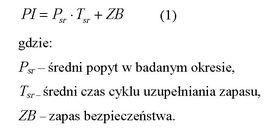
In the fixed order point model, orders for goods are placed in a fixed quantity, which can be defined as the Economic Order Quantity (EOQ). Correct determination of the economic order quantity guarantees keeping the total costs of replenishment and inventory holding at the lowest possible level.
The article contains 13,680 characters.
Source: Logistyka Magazine