











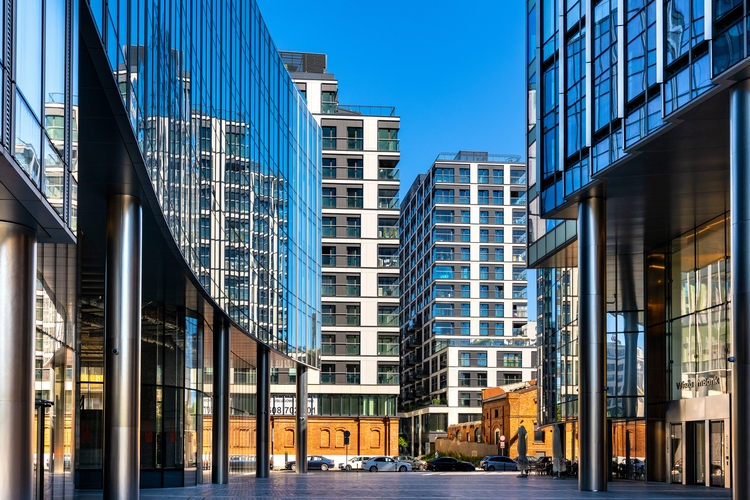
Warsaw is the business heart of Poland. The office space stock in the capital amounts to over 6 million sqm. Despite the fact that new offices are constantly being built, supply remains at a low level. Analysts from Newmark Polska predict that the total supply in 2023 will not exceed 60,000 sqm, which will be the lowest result in the history of the Warsaw office market. Where is it worth looking for an office for rent in Warsaw?
Office buildings in Warsaw – where are the most being built?
Offices for rent in the center of Warsaw enjoy the greatest popularity in terms of tenant interest. This mainly concerns the Western Center subzone, i.e., office buildings located in Warsaw’s Wola district. It is no surprise, therefore, that this is where the most office space (almost 60%) in the capital is being built. Where does such popularity of office space in Wola come from? It is a location that attracts tenants thanks to good communication with the rest of the city (the commissioning of the second metro line was not without significance), but not only that.
Offices for rent in Warsaw’s Wola district are usually part of a larger whole, rather than separate buildings. Browary Warszawskie or Fabryka Norblina function almost like independent, small towns. In these locations, apart from offices, you can find numerous shops, restaurants, cafes, and even a museum and an ecological bazaar.
Office market in Warsaw
If you are looking for office space for rent in Warsaw, consider the following locations:
- Śródmieście (City Center)
Warsaw’s Śródmieście is a prestigious location. Offices in Warsaw’s city center are located around various public institutions, cultural centers, and other places characteristic of the capital, such as the Palace of Culture and Science, Rondo ONZ, or the Central Railway Station. It is in the center that there is also the largest selection of restaurants, cafes, and shopping centers. The M1 and M2 metro lines also intersect in the city center. New offices for rent in Warsaw are being built, among others, near the Gdański Railway Station and along Marszałkowska Street.
- Wola
Wola, the western part of the Warsaw center, attracts considerable interest from tenants. It is in this location that the number of offices for rent in Warsaw is growing. The main reasons for this state of affairs are: good access to public transport (including the metro) and close proximity to the strict city center. New office spaces being built in Wola are located, among others, near Rondo Daszyńskiego and Grzybowska Street.
- Mokotów
Mokotów is a part of Warsaw characterized by a dynamically developing construction market. Rapid development mainly concerns Służewiec, which until recently was identified only as an industrial district. Currently, it is here that many new office investments in Warsaw are being built. You can find both modern office buildings with innovative solutions and intimate buildings here.
- Żoliborz
The main advantage of offices for rent in Warsaw’s Żoliborz over offices located in the city center is the rental price. Rates in Żoliborz are lower. It should be added that Żoliborz is a quiet district, while at the same time located close to the center and well-connected to it. Żoliborz also has a good connection to the capital’s bypass, from where you can quickly get to expressways and the motorway.
How much do you have to pay for renting an office in Warsaw?
Prices for renting office space in Warsaw depend on many factors. The most important of these are location, area, and office standard. For 1 square meter of office for rent in the center of Warsaw, you have to pay from 22 to 26 euros. In turn, the price of 1 square meter in other locations is at the level of 16-18 euros. The given rates apply to the third quarter of 2023. Compared to the previous quarter, they remain at the same level. It is worth adding that in the future, rent price increases should be expected. This is primarily due to growing requirements regarding the use of ESG solutions in buildings.