








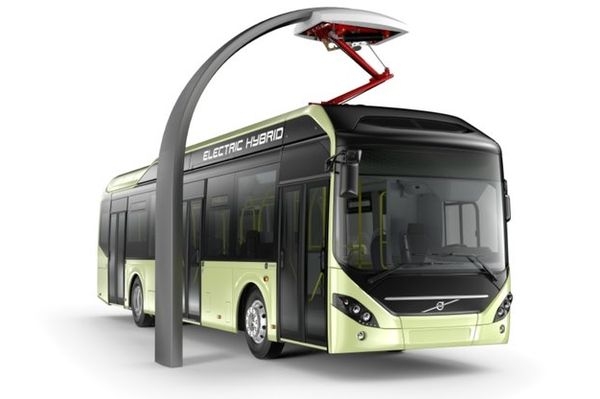
The City of Grudziądz and Volvo Polska have signed a contract for the supply of 7 plug-in hybrid buses (so-called electric hybrids). This is the second order for these buses in Poland this year, following Inowrocław. Volvo will also install fast and slow charging stations in the city.
Following the conclusion of a tender at the end of June for the supply of plug-in hybrid city buses and slow and fast charging stations, in which Volvo’s offer was selected, the City of Grudziądz and Volvo Buses have signed a contract. Volvo will deliver 7 Volvo 7900 Electric Hybrid vehicles to Grudziądz, which will be equipped with, among other things, air conditioning, an electronic passenger information system, a vehicle tracking system, video monitoring, USB ports for charging smartphones, wireless Internet, and a fire detection and suppression system in the engine compartment and the independent heating compartment. Furthermore, Volvo will install 2 fast charging stations in the city along the bus routes and 7 slow charging stations at the depot.
Plug-in hybrids are one of three types of electrified city buses that Volvo supplies to Polish cities. They differ from traditional hybrids in that they are powered exclusively by electricity for most of the route – the small combustion engine serves only as an auxiliary unit. Such a bus can travel about 70 percent of its route in electric mode (depending on the conditions in which the bus is moving), and battery charging takes place at terminal stops and lasts only three to six minutes – after such a short time, the bus can set off on its route. Electric hybrids can also be charged using the plug-in function, e.g., at night in the depot. Both solutions will be used in Grudziądz.
Electric hybrids (plug-in) consume 60 percent less fuel than diesel buses, and carbon dioxide emissions are reduced by as much as 75 to 90 percent. For comparison, traditional hybrids consume about 40 percent less fuel and emit 40-50 percent fewer harmful substances than combustion-engine buses. In the case of plug-in hybrids, there is also the possibility of programming when the bus will use electric drive and when it will use combustion drive. The system allows for precise calculation of energy demand on a given route and uploading an algorithm to the computer controlling the powertrain, which, after reading data from GPS, will automatically switch the drive from combustion to electric in low- or zero-emission zones, e.g., near schools, hospitals, residential areas, or city centers.
– From the perspective of cities, this solution seems very interesting; it allows for a completely different look at design issues. It is possible to create zero-emission zones, free from exhaust fumes – the electric hybrid has the ability to travel fully electrically in such zones. What is more, such a bus can, for example, have a stop inside a shopping mall, where it will move exclusively using electric energy, and thus quietly and emission-free – says Małgorzata Durda.
– For the first time, hybrid buses will permanently hit the streets of our city. Until now, we only had the opportunity to test this type of vehicle; today we signed a contract thanks to which Grudziądz public transport will be enriched with modern and ecological buses. I believe that this is not the last investment of this type, and thanks to the implementation of the project co-financed by EU funds “Construction and reconstruction of public transport infrastructure along with the purchase of bus rolling stock”, we will gain not only modern vehicles and charging stations, but we are also planning the reconstruction of 3 streets – says the Mayor of Grudziądz, Robert Malinowski.
Volvo buses will arrive in Grudziądz within nine months from the date of placing the order – directly from the Volvo factory in Wrocław, where they have been designed entirely by Polish engineers and mass-produced since 2010. In Poland, Volvo hybrids operate in Wrocław, Sosnowiec, Inowrocław, Tarnowskie Góry, and Warsaw, and recently the company has won tenders for the supply of this type of vehicle to Kraków, Jelenia Góra, Białystok, and Krosno. Last year, Volvo delivered 35 hybrids to Sosnowiec – this is currently the largest fleet of hybrid-powered buses in Poland. In addition to Poland, Volvo has so far signed contracts for the supply of electrified buses to the United Kingdom, Denmark, Luxembourg, the Netherlands, Norway, Singapore, and Sweden. Worldwide, Volvo has sold over 4,000 electrified buses to date.