








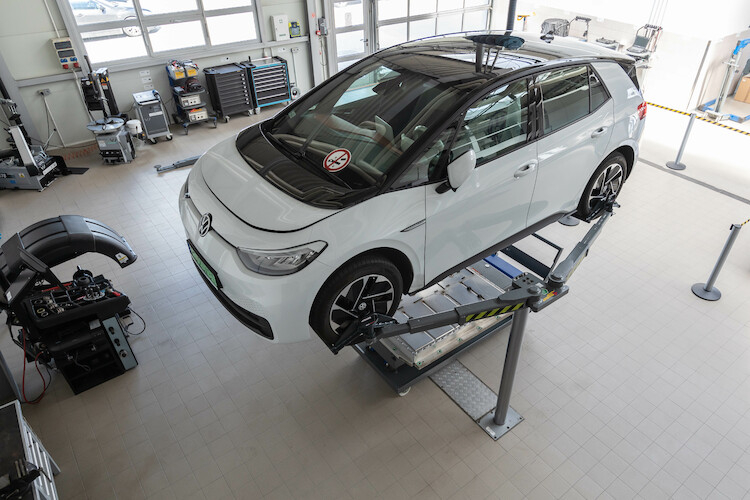
The future of individual mobility belongs to electric cars. Therefore, it is extremely important that the service network is prepared to handle a large number of vehicles with such propulsion in the coming years. Volkswagen Group Polska is developing a network of High-Voltage Battery Repair Centers.
In 2021, the Group delivered 452,900 electric cars to customers, twice as many as the year before. Both the portfolio and the number of vehicles sold will continue to grow. By 2030, the Group plans to achieve a 60 percent share of electric models (BEV) in sales in Europe. While all service partners service electric cars, their staff is appropriately trained and performs inspections or repairs. However, complex operations that require battery repair, such as replacing individual modules, are performed only in specialized centers that have the appropriate tools and knowledge. There are 11 such specialized points operating in Poland within the dealer network and one at the Technical Training and Service Center at Volkswagen Group Polska. Three more will join them soon. The network of Battery Repair Centers is therefore constantly being developed; in the future, every Volkswagen Group Service Partner will be able to obtain the appropriate qualifications.
– A major advantage of the Volkswagen Group is its very extensive service network. The 7 brands we represent, i.e., Volkswagen, Volkswagen Commercial Vehicles, Škoda, SEAT, Cupra, Audi, and Porsche, have a total of almost 400 dealer and service points. Thanks to this, the operation and ongoing maintenance of cars are very convenient, regardless of where our customers live. We want this to be the case for electric cars as well. Repairing high-voltage batteries requires specialized knowledge and tools. That is why we are very intensively developing the network of Battery Repair Centers, preparing to handle hundreds of thousands of cars in the future – said Pavel Šolc, President of the Board of Volkswagen Group Polska.
The rapidly growing popularity of electric cars requires the service network to be fully prepared to handle them, including repairing batteries after a breakdown or road collision. In the event of a strong impact, for safety reasons, a pyrotechnic fuse immediately disconnects the high-voltage battery. A car after such an event requires specialized repair. Consequently, new specialties have appeared in the Volkswagen Group service network, such as the High Voltage Expert (HVE). This is a novelty for car workshops.
– Electric cars bring many changes not only in the way they are used but also in the sales and service process. Repairing electric cars requires expert knowledge. Therefore, as part of the Training Academy, we conduct over 120 training days per year in the field of electromobility for mechanics and service advisors. We use the latest technologies for training on HV battery repairs; the first stage is carried out based on virtual reality, then mechanics gain experience on real batteries – said Krzysztof Rajewicz, Head of Technical Training at the Volkswagen Group Polska Training Academy.
Damaged batteries are also subject to repair. They can be regenerated by replacing individual elements and modules, which is, of course, preceded by a thorough diagnosis of each case. This is much more economical than replacing the entire battery. A failure of individual cells in a battery module can be easily detected: if one cell fails, the module’s capacity is still between 50 and 66 percent. The remaining functional cells in the module must then “work” harder. This causes them to reach a higher temperature at a lower voltage. Individual battery cells cannot be replaced, so if a cell is damaged, the entire module is replaced. A battery used in MEB platforms consists of seven to twelve modules, depending on the capacity.
The second life of a battery
A damaged or “worn-out” high-voltage battery, depending on the capacity measured by the control system, can be reused in a car after repair or can be a donor of individual elements for repairing a battery in another car. Another possibility is to use it outside of an electric car – as an energy storage unit in a charging station, in a mobile charging robot, as home energy storage, or as an element of an emergency power backup system in companies; it can also become a power source for forklifts. There are many possibilities.
Recycling – from old to new
If a battery cannot be repaired or used in any other way, it is recycled. In 2021, Volkswagen Group Components launched the Group’s first pilot line for recycling high-voltage batteries used in electric cars in Salzgitter. Its implementation is another important element signifying the Volkswagen Group’s assumption of responsibility for the entire battery production chain. The goal is the industrial recovery of valuable raw materials such as lithium, nickel, manganese, and cobalt in a closed loop, as well as aluminum, copper, and plastics, achieving a recovery rate of over 90 percent in the long term.
A larger number of used batteries will appear at the earliest at the end of the decade, which is why the new line in the pilot phase can recycle up to 3,600 batteries per year, which translates to approx. 1,500 tons. Later, thanks to constant optimization of the raw material recovery process, it will be possible to recycle on a larger scale.
The innovative and CO2-reducing recycling process does not use energy-intensive smelting of raw materials in a blast furnace. Used batteries are completely discharged and dismantled. The individual elements are then shredded into granules and dried. In this process, besides aluminum, copper, and plastics, primarily the so-called black powder containing valuable raw materials such as lithium, nickel, manganese, cobalt, and graphite is recovered. The separation and processing of individual raw materials using hydrometallurgical methods – using water and chemical agents – take place later in specialized companies.
Raw materials recovered from used batteries have the same properties as new ones. Recycled materials can be used to produce new batteries. And not just once, but many times. In the case of making cathodes from recovered raw materials and using “green” electricity, it is estimated that about 1.3 tons less carbon dioxide is released into the atmosphere for every 62 kWh battery.