












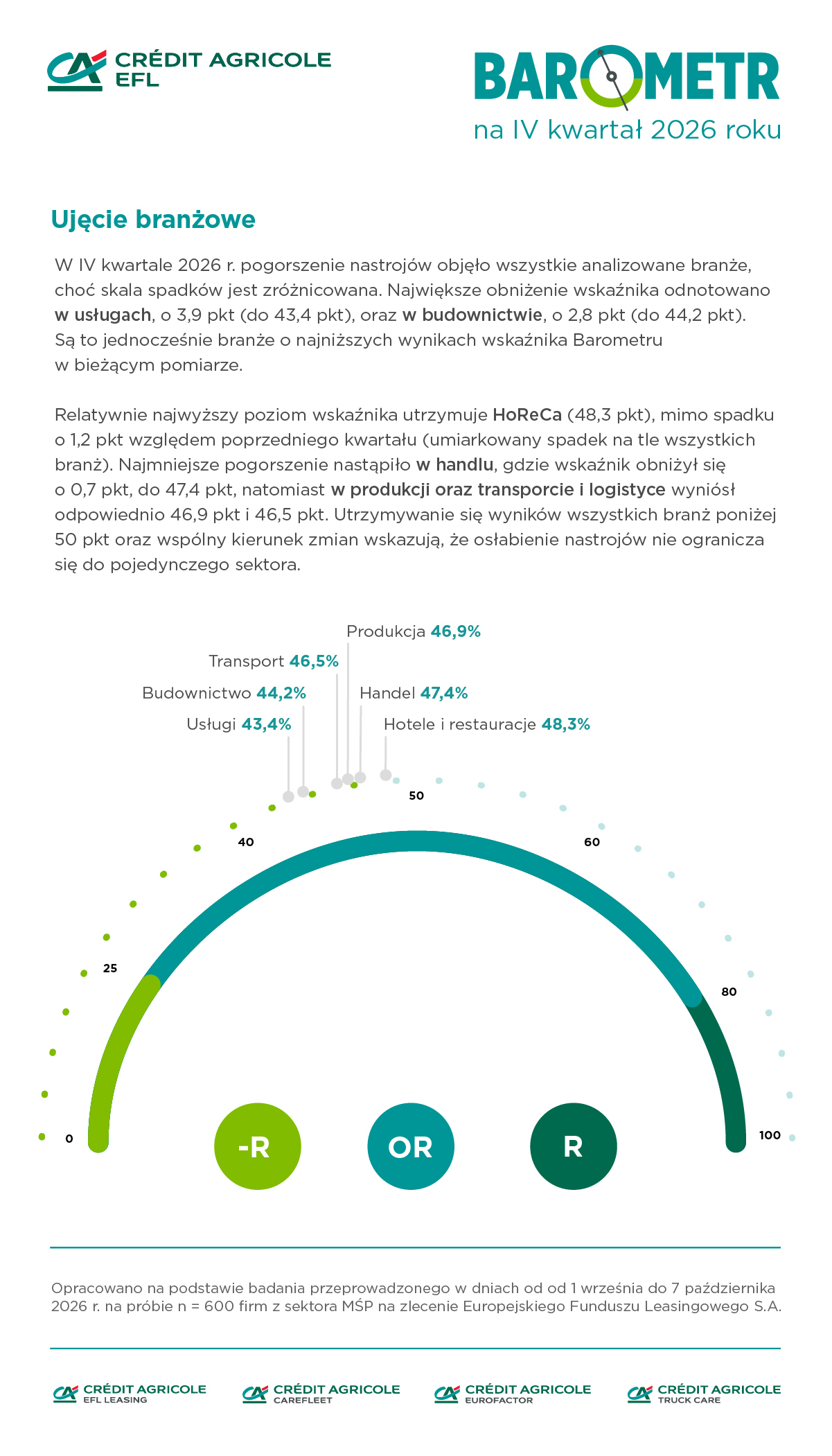
The EFL Barometer sub-index for transport, forwarding and logistics for the fourth quarter of 2026 fell to 46.5 points, down from 47.7 points in the previous quarter. This is the lowest result since 2020 and another reading below the 50-point threshold, which indicates conditions unfavorable for development. More than half of TSL companies (54%) expect a decrease in investments, and three times fewer (18%) count on sales growth. Experts point out that, against the backdrop of weak sentiment across the entire sector, e-commerce logistics stands out positively. According to Statistics Poland (GUS), the value of online sales in September increased by nearly 19% year-on-year, and its share in retail trade exceeded 10% for the first time this year.
In the fourth quarter of 2026, sentiment among entrepreneurs in the transport, forwarding and logistics industry worsened again. The EFL Barometer sub-index fell by 1.2 points to 46.5 points, cancelling out the slight improvement recorded three months earlier. This is one of the weakest results since the beginning of the pandemic. After falling to 46.9 points in the second quarter, the indicator rose to 47.7 points in the third quarter; however, the latest measurement brought another decline. The industry has remained below the 50-point threshold for the third consecutive quarter, and weak sentiment persists despite a slight improvement in some operational forecasts.
The end of the year shows that the situation in transport and logistics remains difficult. After a slight rebound in the third quarter, sentiment has deteriorated again, and the indicator has fallen to its lowest level in several years. The most worrying aspect is the scale of investment reduction. More than half of entrepreneurs expect lower spending, which in the case of the transport industry may mean postponing decisions regarding fleet renewal, vehicle purchases, or expanding operational facilities. Companies are still very carefully analyzing the profitability of contracts and operating costs. Although sales expectations have improved slightly, it is still not enough for entrepreneurs to start investing more boldly.
– says Silvestr Ochrimovic, President of the Management Board of Truck Care from the EFL Group.
Investments on the brake
The largest deterioration concerns investments. As many as 54% of TSL companies expect a decrease in spending, while a quarter earlier this was indicated by 31% of entrepreneurs. At the same time, 30% of those surveyed assume that investment will be maintained at the current level, and 16% plan to increase them, compared to 14% in the third quarter. This means that the group of entrepreneurs expecting a reduction in investment has become by far the largest.
Forecasts regarding sales and financial liquidity look slightly better. 18% of TSL firms expect an increase in sales or orders, compared to 13% in the previous quarter, and the vast majority (83%) expect them to remain at the current level. 11% of entrepreneurs forecast an improvement in financial liquidity, more than double compared to the previous quarter (5%). At the same time, companies remain cautious about using external financing. As many as 83% assume no changes in the demand for additional capital.
E-commerce logistics resilient to weaker economic conditions
Although sentiment in the entire TSL sector remains weak, one of the more promising areas of the industry is e-commerce logistics. It is supported by the growing share of online shopping in retail trade, which increased from 9% in September 2025 to 10.1% in September 2026 (based on GUS data). The strong position of online shopping is also indicated by the “Fulfilio E-commerce Barometer”, which shows that in the third quarter of this year, as many as 80% of consumers bought on Polish marketplaces, and 46% in Polish online stores. Moreover, 62% of respondents declare an intention to shop on domestic platforms in the fourth quarter of this year, and 36% in Polish online stores. Foreign sales platforms, including those from Asia, also remain an important element of the market, attracting younger consumers in particular and generating an additional stream of orders that require logistics handling.
E-commerce logistics remains one of the most promising segments of the market, even if the entire TSL industry is currently facing a weaker economic climate. Poles have become accustomed to online shopping, and the online channel is increasingly becoming a natural choice, not only for clothing or electronics, but also for products requiring more complex logistical handling. On one hand, native marketplaces and online stores are growing, and on the other, foreign platforms, including Asian ones, are gaining importance, especially popular among younger customers. For logistics operators, this means a constant stream of orders, but also growing expectations regarding delivery speed, service costs, and return efficiency. Therefore, companies that can effectively manage the entire order fulfillment process will build a competitive advantage.
– says Arkadiusz Filipowski, President of the Management Board of Fulfilio.
The value of the main EFL Barometer index for the entire SME sector for the fourth quarter of 2026 was 46 points, compared to 47.8 points in the previous quarter. This is the lowest result since the beginning of the COVID-19 pandemic and the third consecutive quarter below the 50-point threshold, which denotes conditions conducive to business development.
The EFL Barometer is a synthetic indicator providing information on the propensity of SME sector companies to grow, understood as companies setting goals related to increasing sales and production, expanding into new markets, and investing in fixed assets. The financial condition of companies projected for a given quarter allows for conclusions to be drawn about the direction of changes favoring or hindering development. The study is prepared by Ecorys on behalf of Europejski Fundusz Leasingowy S.A., and its results are published quarterly. The current edition, conducted from October 1 to 7, 2026 using the CATI method, involved 600 micro, small, and medium-sized enterprises from all over Poland.
Source: Truck Care