











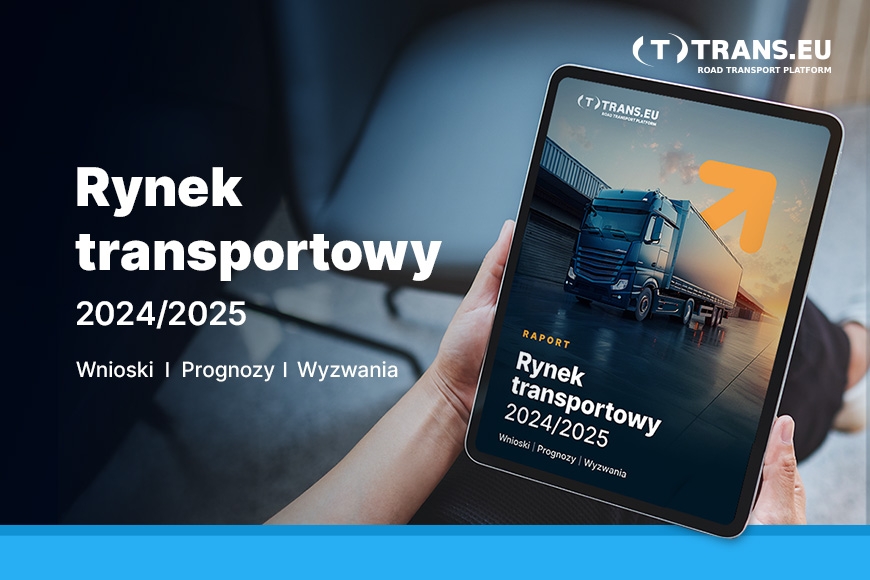
The number of transport offers is increasing because manufacturing companies and distributors are increasingly looking for available trucks. There is a shortage of cargo space in the transport market, and small and medium-sized enterprises are reducing the size of their own fleets. Shippers are therefore looking for vehicles not only on the contract market but also on the spot market. Trans.eu Group has just published its annual report summarizing the situation in the EU transport market.
The number of offers on the transport exchange increased by 23.5% compared to 2023, and freight rates increased by an average of over 10% (period: January – November). The problem is that the rate of increase in rates is not keeping pace with the rising costs of running a transport business. And in 2025, further burdens will appear: adjusting road tolls to CO2 emission standards in subsequent countries, rising labor costs, higher truck prices, etc. As predicted by the Belgian L’Institut Transport Routier & Logistique Belgique and the Dutch consulting firm Panteia, the real increase in costs could be as high as 5%, but experts from Central and Eastern European countries believe that costs could rise by as much as 10%.
Transport companies, especially small and medium-sized ones, are struggling to maintain financial liquidity. According to report data, the debts of the TSL industry in Poland amounted to almost PLN 1.5 billion at the end of 2024, which is spread across 31,000 indebted companies. According to data from the National Debt Register, the debt spiral is intensifying. Transport companies have outstanding receivables related to, among other things, fuel distribution and leasing fees.
– Representatives of the TSL sector are entering 2025 with mixed feelings. The increase in rates is not keeping up with galloping costs. If the European Commission does not ease the pace of implementing the Green Deal, it will finish off many transport companies that are already struggling to cope with the consequences of these changes. A lot of confusion in Europe will also be caused by the replacement of tachographs, because only in Germany, the Netherlands, and the Nordic countries have carriers reported no delays. By mid-August 2025, all tachographs must be replaced with second-generation devices, which will be a huge challenge – comments Marek Szymański, Trans.eu Group expert on the transport market, co-author of the report.
As predicted by the International Road Transport Union, 2025 may turn out to be a breakthrough year for the transport situation. IRU forecasts a 2% increase in transport volume in the European Union, and sees hope in falling inflation and the growth of internal consumption in individual countries of the Community.
The economic situation in Germany, the “sick man of Europe,” seems key, where the PMI for industry is below 50 points, which means economic recession. As Dr. Klaus Wohlrabe from the Ifo Institute for Economic Research in Munich points out in his commentary to the report, the German economy faces 5 main challenges: too little corporate investment, high economic policy uncertainty, consumer caution, declining international competitiveness – especially in relation to China, and structural changes accompanying economic weakness.
– In 2025, we can expect a further increase in transport rates and the number of orders. Such a clear trend could be observed on the Trans.eu Platform as early as 2024, and I think it will continue in 2025. However, it must be honestly stated that in the second half of 2024, the upward trend was halted. Transport traffic is traditionally generated primarily by Germany and France, as well as the Netherlands and Belgium. In these two Benelux countries, the highest rates are also offered. It is also worth noting that Polish carriers are more often choosing southern routes: to Romania, Serbia, Croatia, Slovenia, and Turkey. For European carriers, the Swiss direction was also attractive in the second quarter, which is due to attractive freight rates. – says Jakub Szałek, Trans.eu Group expert on the transport market, co-author of the report.
70%
Despite a significant drop in demand for international transport, this many transport companies in the European Union are struggling with staffing problems regarding the shortage of drivers. The problem is serious: IRU estimates that about half a million drivers will retire over the next five years. Neither the European Commission nor the heads of transport ministries in EU countries have any idea yet how to stop this worrying trend.
Source: Trans.eu/IRU Report
2%
This is how much the volume of transported goods may increase according to IRU forecasts in 2025. Calculated in tonne-kilometers, compared to 2024 data. Increasingly lower inflation and lower interest rates may stimulate the growth of transport. Freight rates will remain unstable due to higher costs for transport companies. Additionally, costs will increase due to the expected price hike for new trucks and the persistent shortage of drivers.
Source: Trans.eu/IRU Report
11%
This is how much the debt of TSL companies increased in 11 months (January-November 2024). Experts believe that the upward trend will continue. The TSL industry has the largest debts to debt management companies, as well as to lessors (unpaid leasing installments) and fuel suppliers.
Source: Trans.eu/National Debt Register Report
– The difficult situation of the transport market in Poland is compounded by unfair and unequal competition. Carriers that do not comply with the applicable rules for remunerating drivers, do not pay taxes and contributions on these wages in the required amount, and do not comply with the applicable rules regarding drivers’ working and rest times, have significantly lower costs than entrepreneurs who run their companies honestly. We also observe fraud on the market related to non-payment of road tolls, reducing vehicle operating costs, etc. For example, one can point to information circulating in the public space that only 30% of Polish carriers honestly pay contributions to the Social Insurance Institution (ZUS). – says Maciej Wroński, President of the Transport and Logistics Poland Employers’ Association.
The report is available for download at the link.
The report is under the media patronage of Media Logistyka.
Source: Trans.eu/National Debt Register Report