









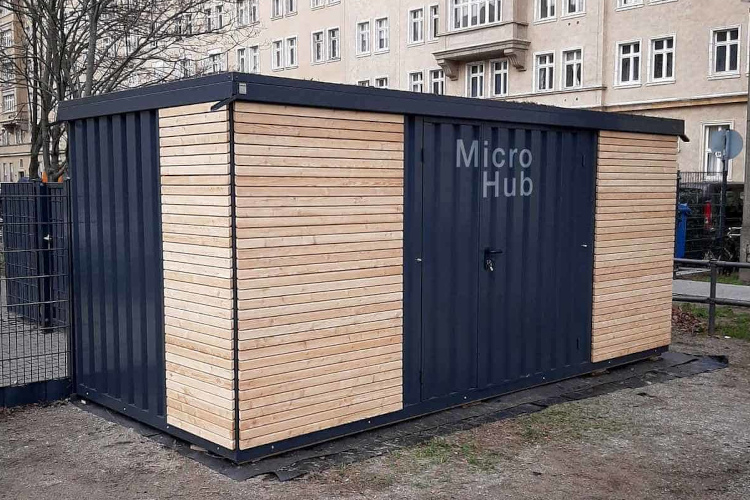
For many years, logistics has not only been an element supporting the development of e-commerce but also one of its main driving forces. Today, customers shopping online have specific expectations regarding not only the products themselves but also the delivery method. Speed and punctuality of deliveries remain highly significant; however, consumers are increasingly paying attention to convenience, choice, transparency of the process, and environmental impact.
Why are microhubs important?
The ecological aspect, in particular, is becoming a significant purchasing criterion. Global studies show that approximately 57% of customers want to know the environmental impact of their delivery. In Poland, this indicator is lower but still significant, as 39% of respondents declare that the environmental impact of delivery matters to them, and half of the surveyed indicate eco-friendly deliveries as a factor encouraging online shopping. Furthermore, the “Responsible E-commerce 2025” report indicates that 60% of Polish e-commerce customers take the online store’s carbon footprint into account, and 83% are willing to wait longer for a shipment if it means a more environmentally friendly way of fulfilling the order. Changing customer expectations place increasing demands on logistics operators.
An equally important factor influencing the development of e-commerce logistics is progressive urbanization. People living in cities make up the majority of e-commerce customers in Poland and account for approximately 65% of all e-shoppers. Data for 2025 shows that nearly 74% of city residents made online purchases. High population concentration in cities means a greater number of orders and shipments to be delivered, but at the same time, it hinders their handling due to traffic congestion, traffic jams, or limited availability of parking spaces for delivery vehicles. Additional challenges include clean transport zones implemented by cities in connection with EU regulations, which restrict the movement of combustion-engine vehicles in central parts of agglomerations.
The combination of growing consumer environmental awareness, the concentration of recipients in cities, increasing traffic problems, and regulatory changes is leading to the transformation of urban logistics and supporting the development of solutions that fit the smart city concept. Their goal is to improve delivery efficiency not only in terms of costs but also environmental and social benefits. One example of such solutions is transshipment microhubs working in conjunction with cargo bikes for last-mile deliveries.
What role does a microhub play?
Microhubs are specially designated places located in urban space, used primarily for transshipping shipments from larger delivery vehicles to more environmentally friendly means of transport, such as cargo bikes. Their implementation is intended to streamline last-mile delivery and simultaneously increase their environmental and social efficiency, without compromising economic aspects or service timeliness. Thanks to microhubs, it is possible to reduce the traffic of delivery vans in city centers by replacing them with cargo bikes. These types of vehicles are characterized by low emissions, quiet operation, and minimal impact on traffic flow. Additionally, they can use routes inaccessible to cars, reach hard-to-access locations more easily, and do not create parking problems. However, for cargo bikes to effectively carry out deliveries, it is necessary to provide space for their storage, charging, maintenance, and efficient loading of shipments. These functions are performed by transshipment microhubs. As a result, the microhub and the cargo bike form a common, complementary system that improves last-mile delivery. Although the idea seems simple, its effective implementation can take many forms and requires the cooperation of many stakeholders.
Examples of microhubs in Poland
In Poland, solutions based on microhubs and cargo bikes are increasingly being implemented in practice. The most advanced projects are currently operating in Poznań and Wrocław.
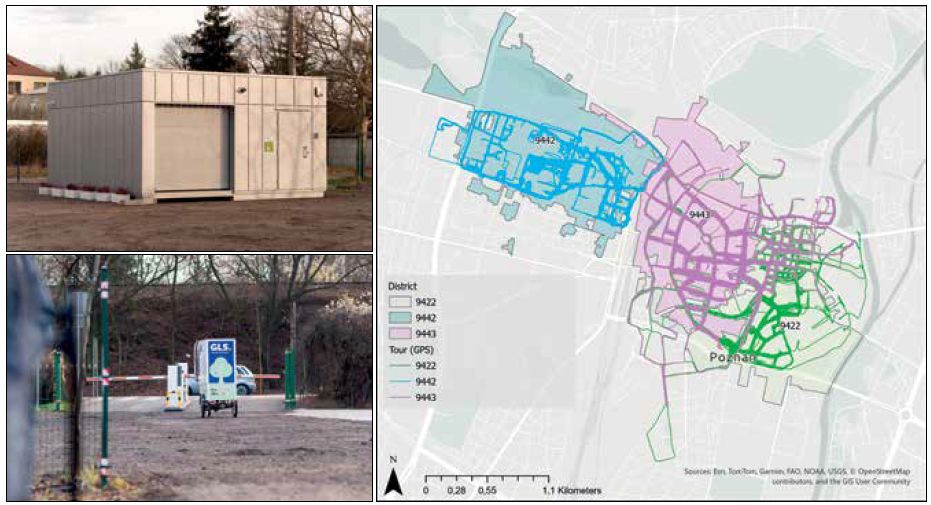
The microhub located in Poznań takes the form of a standalone facility. It is a specially designed building with an area of approximately 36 m², situated on Pułaskiego Street, in the city center. The facility allows for the storage of bicycles and the transshipment of parcels from delivery vans to cargo bikes. It was created as part of the GRETA project, implemented by Łukasiewicz – PIT and the City of Poznań in cooperation with GLS. From December 2024 to May 2025, it was used for a pilot implementation of deliveries in the Stare Miasto and Jeżyce districts.
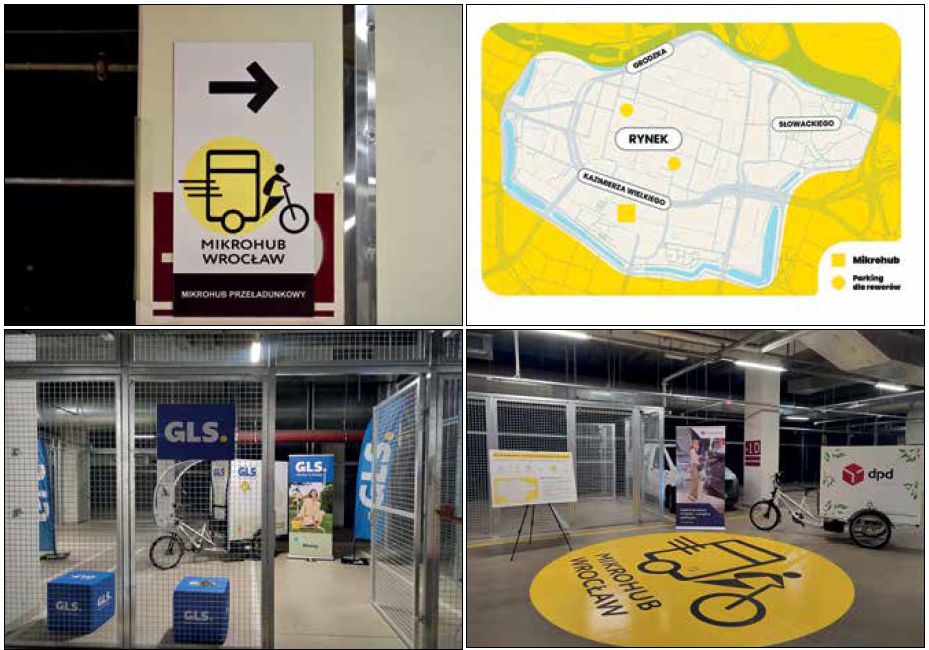
In turn, the microhub operating in Wrocław uses the existing infrastructure of the underground parking lot under the National Forum of Music at Plac Wolności. Approximately 500 m² of space has been separated there, divided into boxes intended for various logistics operators, such as InPost, DPS, GLS, and Allegro. This zone allows for both the storage of cargo bikes and the transshipment of parcels. The microhub began operations in June 2025 and handles deliveries carried out in the Old Town area.
It is worth emphasizing that these are not the only examples of using cargo bikes in Poland. This solution is also used by DPD, which has the largest fleet of cargo bikes in the country. However, the company uses rented urban premises acting as so-called urban depots, combining logistics operations with customer service, instead of dedicated microhubs or adapted urban spaces.
What requirements should a microhub meet?
Not every space that allows for the transshipment of parcels onto bikes can be considered an effective microhub. The effectiveness of such a solution depends on meeting a number of important conditions. Location is of key importance. A microhub should be located close to main communication routes and areas with a high concentration of recipients to ensure convenient access for delivery vehicles. Due to the limited range and load capacity of cargo bikes, the facility must be located in a way that allows for efficient service of central city districts without unnecessarily extending routes. Finding a suitable place is difficult because real estate in city centers is very attractive to investors. Therefore, local governments, which should actively support the development of infrastructure for low-emission urban deliveries as part of sustainable mobility plans, take on special significance.
The form of a microhub can vary. Both standalone facilities and adaptations of existing infrastructure prove effective. However, the most important thing remains ensuring adequate accessibility. A delivery van should be able to easily pull up and park, and transshipment operations must proceed quickly, safely, and without hindering traffic. It is also important to limit the impact of adverse weather conditions and ensure the possibility of smooth departure of cargo bikes onto delivery routes. Appropriate technical conditions are also necessary. A microhub should allow for the storage of bicycles, charging their batteries, and carrying out basic maintenance work. This requires proper space division, access to power, and the use of fire protection measures.
Equally important are issues related to the integration of the facility with urban space. A microhub should not disrupt the functioning of the neighborhood or negatively affect the comfort of residents. In the case of freestanding installations, it is important to maintain aesthetics, compliance with the surroundings, and spatial planning principles. Energy-saving solutions, such as the use of photovoltaic panels, recyclable materials, or appropriately designed lighting, are also desirable. Logistics operations should simultaneously meet applicable noise standards.
Safety is also of great importance. This applies to both employees and couriers, as well as stored bicycles and handled shipments. Therefore, it is advisable to use monitoring, access control, and appropriate area lighting. From a social perspective, it is also worth providing couriers with appropriate social facilities allowing for rest, changing clothes, storing personal belongings, or eating a meal.
A significant challenge related to the development of microhubs also remains their economic profitability. In the initial phase of operation, such solutions require additional investment outlays related to acquiring space, building or adapting facilities, purchasing cargo bikes, and organizing transshipment processes. Economic benefits appear primarily with a sufficiently large scale of operations and high delivery density in the served area. For this reason, implementing microhubs requires a thorough analysis of shipment volumes, transport costs, and the possibility of sharing infrastructure by various logistics operators. Increasingly, microhubs are treated not as individual logistics investments, but as an element of long-term urban policy regarding mobility and the quality of life of residents. Their development can support the achievement of goals related to reducing emissions, improving road safety, and reclaiming urban space previously occupied by heavy delivery vehicle traffic.
Ensuring all the mentioned requirements simultaneously is a major challenge. Therefore, the effective implementation of microhubs requires close cooperation between local government authorities, logistics operators, infrastructure providers, and city residents.
Directions for the development of urban microhubs
Microhubs combined with cargo bikes support the development of sustainable last-mile deliveries and should be more widely used both in Poland and in other European countries. However, a condition for success is maintaining high standards of design and operation of these facilities. For the solution to be logistically effective, it is necessary to scale it appropriately. Microhubs should be created according to consistent functional, technical, and aesthetic standards agreed upon by all stakeholders. Standardizing such requirements will facilitate the replication of proven solutions and reduce the risk of random installations in unsuitable locations. Supervision over the development of the microhub network could be exercised by cities or operators designated by them.
Sharing infrastructure also plays a key role. If every logistics operator developed their own independent network of microhubs, a phenomenon referred to as “hubomatosis” could occur, analogous to the “parcel locker-mania” observed in Poland. Therefore, hub spaces should be used by many operators simultaneously, while maintaining uniform operational, social, and aesthetic standards. The development of such initiatives based on sharing requires not only the readiness of companies to cooperate but also appropriate support from public administration. Local governments should simplify procedures related to making land available for microhubs and also support smaller logistics companies through subsidy mechanisms enabling the purchase of low-emission means of transport, such as cargo bikes.
The development of the microhub network should also be accompanied by digital solutions supporting delivery management. Fleet monitoring, route planning, hub occupancy management, or data exchange systems between operators can significantly increase the operational efficiency of the entire system. In the future, the development of microhubs will likely be closely related to the use of artificial intelligence and advanced data analytics used to optimize logistics processes.
This article comes from the journal Logistyka No. 4/2026.
Are you interested in this topic? We have more!
– How to use the true potential of cargo bikes? On the need to create microhubs
– Work is underway on the first urban transshipment microhub in Poland
– Success of the Poznań microhub
– We summarize the pilot of the transshipment microhub (podcast from the “Next to Logistics” series)