











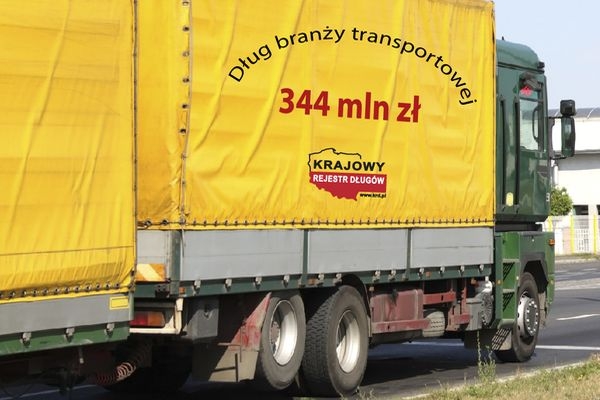
The number of transport companies listed in the National Debt Register has increased by over 10% over the last year, and their debt has reached 344 million PLN. Carriers first painfully felt the consequences of trade restrictions with Russia, and now they fear that their troubles may deepen further due to the introduction of a minimum wage for foreign drivers entering Germany.
It has not been an easy year for the transport industry. In the spring of 2014, with the outbreak of the Russian-Ukrainian war and the introduction of trade sanctions against Russia, some transport companies lost a significant number of orders. This applied both to those coming from Polish exporters and from European Union companies trading with Russia. The latter chose Polish carriers because they offered cheaper services and, moreover, had a better understanding of the specifics of the Russian market and the rules that apply there. With the sanctions imposed by the EU on Russia and the Russian embargo on EU products, these orders came to an end.
– Since February of last year, the number of indebted transport companies registered in the National Debt Register has increased by over 10% and now stands at 10,014. Their debt has grown by 44.5 million PLN. This is a major change, especially since we have generally recorded a slowdown in the growth of the number of debtors across the entire economy. It is clear that there are payment problems in this industry, which can be linked to the loss of some orders – says Adam Łącki, President of the Management Board of the National Debt Register Economic Information Bureau.
In the provinces located along the border with Russia, Belarus, and Ukraine, the number of indebted transporters has increased by 108, reaching 1,132, and their debt has grown by 4.4 million PLN to 55.8 million PLN. But it was not only carriers from these 4 provinces that transported goods to the East. The largest number of indebted companies in this industry is in the Mazowieckie, Upper Silesia, and Greater Poland regions – carriers from these 3 provinces account for nearly 42% of all debtors. Their total debt is 142.5 million PLN. The three most indebted transport companies listed in the National Debt Register are based in the Silesian, Lower Silesian, and Warmian-Masurian provinces. Each of them owes their creditors over 5 million PLN.
As if there were not enough problems in the East, the turn of the year brought another problem, this time in Germany. The local government introduced regulations requiring professional drivers driving on German roads to be paid a minimum of 8.5 euros per hour.
– This is not about concern for Polish drivers, who spend their salaries in Poland anyway; it is a brutal attempt to eliminate Polish competition from the German market. Competition that is not only cheaper but also better. There are 2,500 transport companies belonging to the Rzetelna Firma (Reliable Company) program, and their owners are signaling to us that maintaining these regulations is fatal for them. It would cause labor costs to rise by 50-60%. Our companies are unable to bear such costs, so the number of debtors will increase even further. Therefore, we demand that the Polish government, either through direct talks with the German government or through the European Commission, leads to such changes in German regulations so that they do not apply to entrepreneurs from other countries – says Waldemar Sokołowski, President of Rzetelna Firma.
For now, Berlin has suspended the application of minimum wage regulations regarding transit journeys. However, as carriers associated with Rzetelna Firma emphasize, this does not solve the problem. Firstly, the suspended regulations can easily be put back into effect; secondly, Polish carriers also provide cabotage services in Germany (transport within Germany) and transport goods from Germany to Poland and vice versa. In both of these cases, the minimum wage regulation still applies.