









Systemic support for investments in low-emission transport, including state financial guarantees and the development of a detailed government policy on intermodal transport – these were the expectations voiced by experts and logistics industry managers participating in a debate on decarbonization during the European Economic Congress in Katowice (April 24-26, 2023).
Anna Papka, Public Policy Manager – Sustainability for Central and Eastern Europe at Amazon, said that it would be easier for large logistics corporations to plan investments in intermodal rail transport, which relies on easily transferable containers, if the government established and announced a map of planned transshipment terminals.
– From our point of view, in achieving the decarbonization to which we have committed as a publicly traded company, it would help to reduce road transport to a minimum and move towards intermodal transport – said Anna Papka.
According to her, the rail network in Poland is well-developed, but the most important elements are the terminals that allow for the transshipment of goods onto trains. “This will reduce transport costs and environmental impacts,” said the Amazon representative, whose company still transports goods by road in Poland and plans the location of distribution centers near motorways and road transport hubs.
Deputy Minister of Infrastructure Andrzej Bittel emphasized that the National Railway Program being implemented in Poland and its update include measures to increase train length, transport safety, and the capacity of railway lines in Poland. Furthermore, programs for the ongoing maintenance of infrastructure are being consistently implemented.
– When key modernizations are completed, we will be able to determine whether there are indeed problems with a lack of capacity and bottlenecks, or whether it is actually about the convenience associated with road transport and business habits in logistics – said Andrzej Bittel.
In his opinion, it is not so much the railway infrastructure that requires special intervention, but the entire environment guaranteeing access to the railway line – such as ramps or goods packaging points. “We have deficits here,” the deputy minister admitted. At the same time, he pointed out that investments are also being made in this area, exceeding previously planned scales, such as port stations in Gdańsk, Gdynia, Świnoujście, and Szczecin.
– We will work towards containerization and the speed of logistics – the deputy minister announced. He emphasized at the same time that the market in Poland is growing, and according to Polityka Insight data, since 2012, the share of intermodal transport in rail freight has increased by 7.7 percentage points – to 11.2 percent. – This results from expectations regarding the reduction of the carbon footprint, but it is also a business necessity – said Andrzej Bittel.
Magdalena Szaroleta, Sales Director at Raben Transport, said that the implementation of intermodal services is proceeding very slowly. The reason is not only costs but also customer expectations, for whom speed is important, and currently, intermodal transport does not meet this condition.
– For logistics companies, the key is the expectation of the business client, for whom the values are: time, cost, and reducing the risk of disruptions, e.g., in rail traffic – emphasized Magdalena Szaroleta.
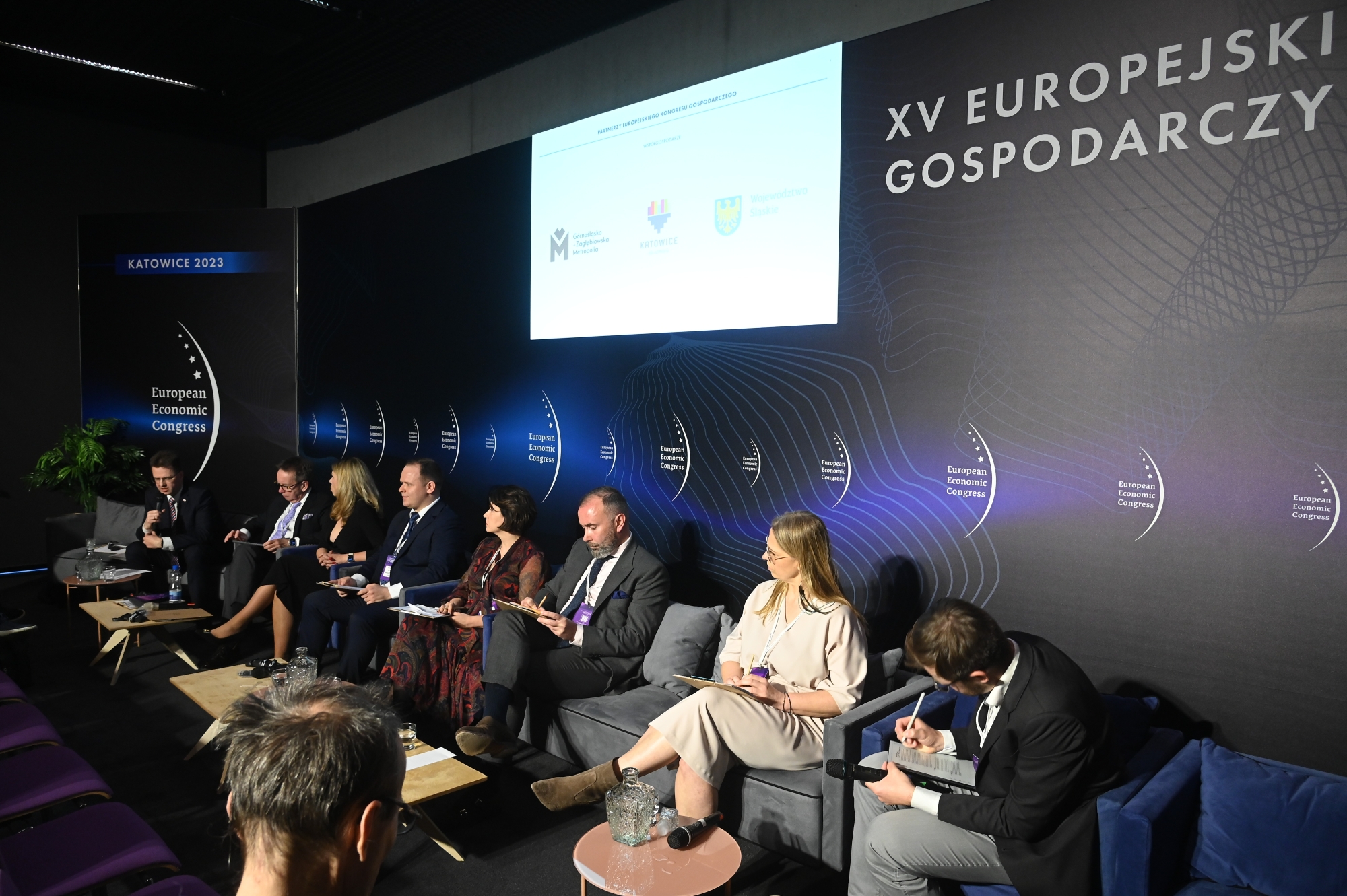 Photo PAP/C. Piwowarski
Despite this, Raben tries to acquire clients for intermodal transport, for example, by organizing rail transport together with other logistics companies.
The development of rail transport would also allow for the development of electric vehicle transport on short sections, including the so-called last mile. “We are experimenting a lot with electromobility, but these investments are very expensive and can only be implemented for sections of up to 70 kilometers,” added the head of sales at Raben Transport.
According to her, “a lot is happening” in the field of transport decarbonization, but it is being done with great effort. Such projects are basically only available to large companies where there is capital to implement ideas.
– There is a need for subsidies, large concepts, and support for the industry – appealed Magdalena Szaroleta.
Cezary Raczyński, CEO of mLeasing, pointed out that the banking sector is already forced to calculate the carbon footprint of its portfolio of financed projects, and leasing companies may soon also be covered by similar requirements as banks.
– Currently, 25 percent of our leasing portfolio is in heavy transport, but it accounts for 60 percent of the CO2 emissions of the entire portfolio. We will probably prefer modern technologies in the case of truck leasing – he said. He mentioned that 60 percent of companies in Poland have fewer than four vehicle sets and do not have the capital for more expensive trucks.
He indicated that Polish companies will soon also have to meet growing requirements in European markets. When internal combustion engines are burdened with environmental costs, the total relative cost of low-emission vehicles will fall.
– When costs start to converge, then decarbonization will take off – said Cezary Raczyński.
– It seems that it is worth giving the sector a chance through not so much subsidies, but financial guarantees. This will allow for increased capital consumption and investment in low-emission means of transport – said the CEO of mLeasing.
Krzysztof Krawiec, manager of the Sustainable Transport program at WiseEuropa, confirmed that the fragmentation of the TSL industry in Poland results in limited investment opportunities for companies. – Neither the government alone nor the companies alone will meet the challenges – he noted. According to him, the lack of development of low-emission transport could end up for the Polish transport industry in Europe with a weakening of its strong position, built mainly on a cost advantage that is diminishing.
Anna Kornecka, Director of the Institute at the Clean Poland Program Association, warned that it may turn out that a cautious approach to decarbonization in the domestic market will knock Polish business out of markets in Europe. In her opinion, the main trend in the pursuit of decarbonization should be reducing the transport intensity of the economy. She also pointed out that there will be no decarbonization of transport, or any field of the economy, without investment in RES.
One of the ideas for reducing transport emissions is hydrogen fuel. Adam Czyżewski, Chief Economist at PKN ORLEN S.A., mentioned this, speaking about Orlen’s strategy regarding hydrogen fuels, which focuses on public transport in cities, but its second pillar is the development of hydrogen-powered heavy transport, with charging stations along motorways.
Asked if there is a chance for the “hydrogenization” of transport in Poland in the perspective of a dozen or so years, Czyżewski said that it is “definitely achievable,” especially since at least until 2050 it will not be possible to switch all transport to electricity – due to technological limitations, e.g., in terms of batteries. He recalled that Orlen, in its strategy, also takes into account the use of other alternative fuels, including biofuels or synthetic fuels.
According to him, Orlen’s hydrogen strategy focuses on the supply side, i.e., increasing the availability of hydrogen for vehicle users. As Adam Czyżewski emphasized, the fact that we currently have only about a hundred hydrogen-powered vehicles in Poland shows how low the demand is now.
– However, we are also working on the demand side, implementing a project to develop public transport, and then road transport, in cooperation with agglomerations – said the chief economist of PKN Orlen. He added that a lot depends on whether hydrogen fuels will be profitable for business, which is why support systems, regulations, or alternative costs are also important.
– We would like to invest in hydrogen vehicles, but investing requires scale and a system, like in Germany, where there is support for the purchase of hydrogen-powered trucks – said Anna Papka from Amazon. According to her, the state can ensure the security of investments, e.g., by presenting plans for the construction of intermodal terminals or other sectoral policies.
She indicated that the B2B industry is facing the prospect of increased transparency, and when companies are forced to disclose data on their carbon footprint, the decarbonization process will accelerate.
Source of information: PAP MediaRoom