









What impact does the growing power of the shipowner market have on the level of domestic and global inflation? Compared to September 2021, transport prices in Poland increased by 16.4%, and the general inflation rate reached 17.2%. Would the prices of consumer goods and services in Poland – the highest in 25 years – be significantly lower if the shipowner market were regulated? Experts from the Polish Institute of Road Transport are looking for answers to these questions.
Freight rate costs have been falling for several months, and the value of the Drewry World Container Index, which allows for tracking and assessing weekly changes in freight rates in container shipping year-on-year, has decreased by over 60%. In the last week alone, it fell by 3%. However, the 34th consecutive decline in this indicator does not mean that the record peaks of 2021 and the beginning of this year have ceased to affect the economy.
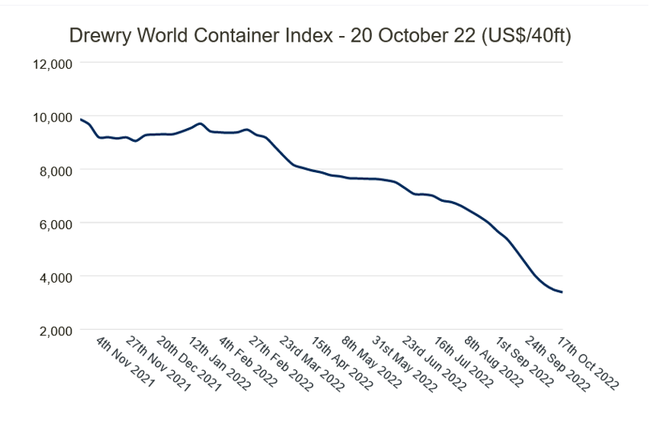
Fig. 1 Drewry index value November 2021-October 2022. Source: https://www.drewry.co.uk/supply-chain-advisors/supply-chain-expertise/world-container-index-assessed-by-drewry
– Analyzing data from 143 countries over the last 30 years, the International Monetary Fund found that shipping costs are an important factor in inflation worldwide: when freight rates double, inflation rises by about 0.7 percentage points. Most importantly, the effects are quite persistent and last up to 18 months. This means that the increase in transport costs observed in 2021 may be increasing inflation by about 1.5 percentage points currently. The same correlation is indicated by a simulation conducted by the United Nations Conference on Trade and Development (UNCTAD), which shows that bottlenecks in maritime transport in 2021 caused an 11% increase in the prices of imported goods – emphasizes Janusz Piechociński, President of the Polish-Asian Chamber of Commerce and Industry, one of the authors of the report “International transport – challenges and the role of transport in a changing world”.
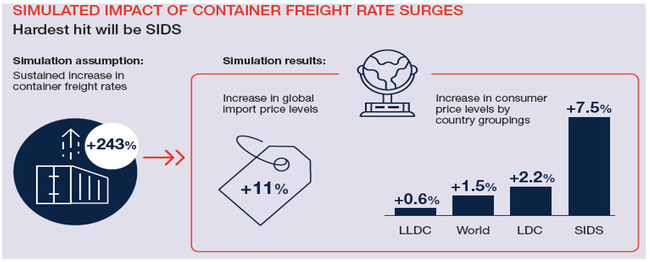 Fig. 2. Simulated increase in freight rates in container shipping on the prices of goods imported by sea on a global scale and the price level of consumer goods in various groups of countries. Source: UNCTAD, Review of maritime transport 2021, New York-Geneva, p. 84
Given that the “reaction” of consumer product prices to freight rates builds up gradually and only peaks after 12 months, many experts emphasize that we will only feel the record freight rates from the last quarter of 2021 and the beginning of this year in the prices of goods in the winter of 2023. Of course, the extent to which the increase in shipowner costs translates into the inflation level in a given country also depends on factors such as national monetary policy, the share of imports in national GDP, or finally, geographical location.
– The higher cost of maritime transport primarily affected products such as electronics, optics, etc., which are more strongly integrated into global supply chains. Raising the price level of such products makes them unattainable for consumers with lower income levels, which in effect reduces the level of social welfare – points out Prof. Andrzej S. Grzelakowski, Head of the Department of Logistics and Transport Systems at the Gdynia Maritime University.
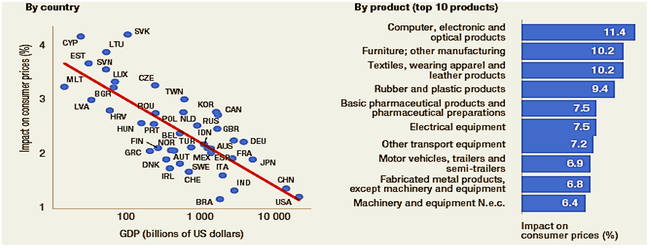
Fig. 3 Estimated effects of the increase in freight rates in container shipping on the price level of 10 selected consumer and investment goods paid by their final purchaser in various groups of countries (including Poland). Source: UNCTAD, Review of maritime transport 2021, New York-Geneva, p. 84
It is worth emphasizing that the effect of rising transport prices, compounded by the use of a number of additional fees and surcharges, not only related to the need to cover costs resulting from existing market perturbations (port congestion, lack of empty containers, etc.), but also introduced to obtain extra revenue (e.g., premium fees and others), was an unprecedented increase in EBITDA/EBITD in the history of shipping. However, these record profits were made at the expense of shippers and representatives of the TSL sector. They bore the consequences of a drastic increase in the costs of container transport by sea (direct costs), as well as costs resulting from an unprecedented decline in the quality of transport services provided by container operators (indirect costs).
In the USA, which is served primarily by a foreign fleet of container shipowners, a campaign condemning this situation has even begun. It was emphasized that ocean carriers are reporting extraordinary revenues and profits, but at the same time, the ship arrival schedule is failing. There is congestion in ports, and American exporters have problems with shipping, e.g., agricultural products. The President of the United States took the side of the shippers, stating: “When corporations don’t have to compete, their profits go up because the prices of their services go up, but small businesses, family farmers, and ranchers go under. We see this happening with ocean carriers moving goods in and out of America.”
In turn, the International Federation of Freight Forwarders Associations (FIATA) presented a set of key requirements that, if met, could ensure more rational operating conditions in the maritime transport market. To start with, lines should stop spending their record profits on vertical integration and instead start contributing to, for example, the decarbonization of transport. FIATA pointed out that to achieve the International Maritime Organization (IMO) goal of reducing emissions by 50% for maritime transport by 2050, about $1.5 trillion needs to be invested, which is a “significant challenge.” Therefore, instead of creating “unprecedented market concentration,” lines should invest in new propulsion technologies and fuels.