











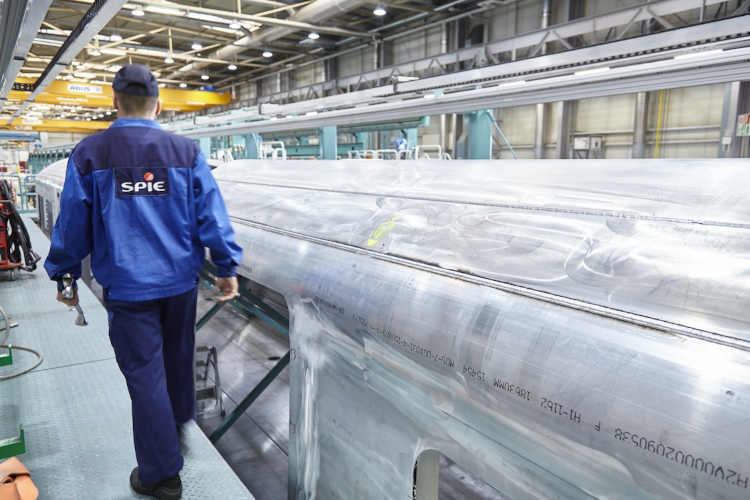
Demand for warehouses has fallen by 37%. However, they are not at risk of liquidation, as production is taking up the vacant space. Total demand for warehouse space in Poland reached a total of 1.95 million m2 in the first half of 2023. This represents a decline in demand, which is the result of a slowdown among the largest e-commerce players, whose share of total demand was only 4 percent. On the other hand, the demand for production space is growing. A noticeable and increasingly strong trend in the market is the conversion of warehouses into production halls. Such an advanced transformation requires a specialized approach and the coordination of many processes, e.g., increasing the load-bearing capacity of the floor or installing an overhead crane for transporting large-scale elements.
According to data from the JLL report, total demand for warehouse space in Poland in the first half of 2023 reached a total of 1.95 million m2. This represents a significant overall decline. This result is 37 percent lower compared to 2022 and 18 percent below the five-year average for the first six months of the year.
Experts attribute the reasons for the suppressed demand to the slowdown of the largest e-commerce players, who are recording significant declines after a hot period for the market during the pandemic. The share of the aforementioned leaders in the period under review was only 4 percent, while in the record-breaking year of 2021, it was as high as 20 percent. Meanwhile, the manufacturing sector is doing great. According to the Global Manufacturing Prospects 2023 survey conducted by KPMG, as many as 84 percent of companies state that they are confident about their growth prospects until 2025.
– The stable situation of manufacturing companies and positive forecasts for their growth mean that more and more entities are planning to increase production capacity. Consequently, there is growing interest in renting space adapted for production. An increasingly noticeable effect of this trend on the market is the adaptation of existing warehouses into full-fledged production halls. Such a process, despite its complexity, is feasible and represents a practical alternative for many entrepreneurs – comments Weronika Kantorska, Junior Project Manager at SPIE Building Solutions.
From warehouse to production hall: a complicated path
Adapting an existing warehouse hall for production activities is possible. However, the differences in the requirements that individual spaces must meet make the transformation of a warehouse a complex process that requires the involvement of proven specialists. Verifying the needs of a given enterprise is just the beginning of advanced work. The second step, immediately after defining the requirements that a specific production hall must meet, is to compare them with the state of the existing warehouse hall.
Basic changes necessary for conducting any production include, among others, changing the way the facility is used, adjusting lighting intensity, ensuring the appropriate temperature specified in regulations, or expanding and modernizing social and office facilities. Entrepreneurs planning to conduct heavy production must take into account parameters such as floor load-bearing capacity or structural strength in case it is necessary to install an overhead crane for transporting large-scale elements. In many cases, the installation of technological gases will also be necessary.
– The most engaging and often necessary changes include, among others: rebuilding air conditioning and ventilation systems, basic, emergency, and evacuation lighting, fire safety installations, e.g., sprinkler systems, fire alarm systems (SSP), or water and sewage systems. An important element that positively affects not only the company’s finances but also the environment is the installation of heat recovery systems from technological equipment – adds Weronika Kantorska from SPIE Building Solutions.
According to the expert, other advanced changes that often prove necessary also include replacing or adding transformers, rebuilding power supply systems on the medium and low voltage side, or running power lines to devices and machines, as well as installing busbar trunking systems. Often, it is necessary to perform teletechnical installations and equipment, such as structured cabling or server rooms.
The often convenient location of warehouses, which favors the planning of logistics operations, is one of the deciding factors in favor of carrying out the transformation. Although adapting warehouse space for production activities is not the most obvious solution, entrepreneurs seem increasingly willing to take advantage of the possibility of modifying already available infrastructure.
Source: Brandscope